




When This Grease Makes Sense (And When It Doesn’t)
After 15 years spec’ing lubricants for steel mills to mining fleets, I’ve watched procurement teams make the same mistake: they buy grease like office supplies.
This is the right grease when you’re dealing with:
- Heavy shock loads + high temperatures (120–150°C in rolling mill bearings)
- Water washout environments — marine, paper mills, open-pit mining
- Extended relubrication intervals where accessing bearings costs production time
- EP (Extreme Pressure) protection without depleting additives
This is NOT the right grease when:
- Light-duty, low-temperature applications where basic lithium grease works
- Upfront cost per kilogram is your only decision metric
- Your OEM spec explicitly calls for polyurea or another thickener
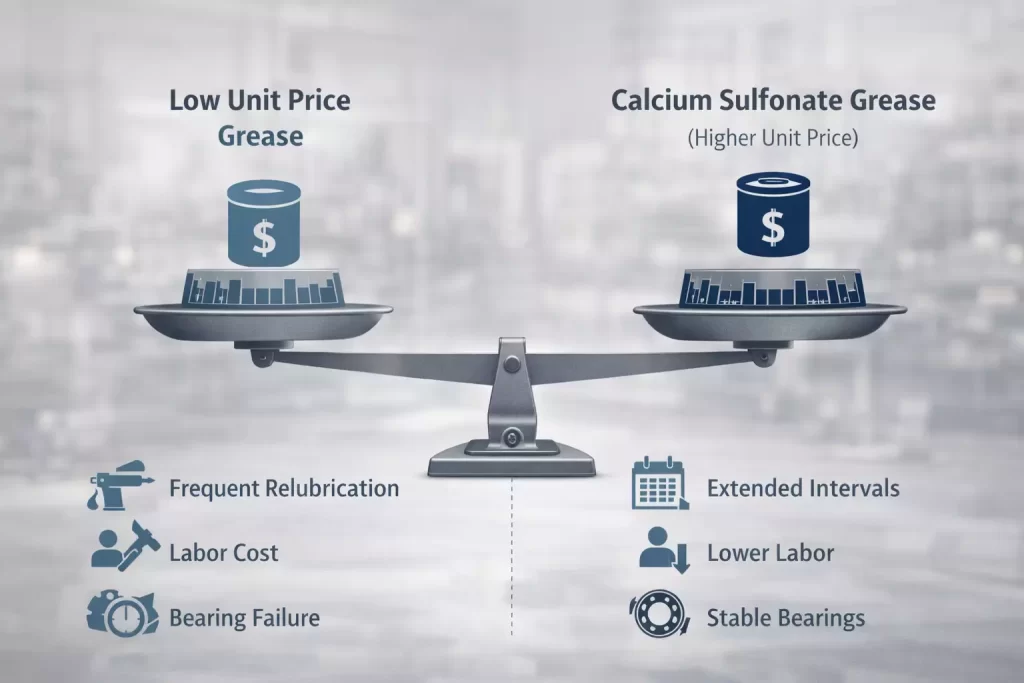
The biggest trap? Buyers focus on price per drum and ignore relubrication interval. A grease costing 30% more but lasting 3× longer and preventing one bearing failure will save you money. Period.
The Three Mistakes Costing Your Plant Money
Mistake #1: Shopping by unit price instead of Total Cost of Ownership (TCO)
Two quotes: lithium complex at $4.50/kg, calcium sulfonate at $6.80/kg. The cheaper one gets the PO. Six months later, bearings run 15°C hotter, you’re re-greasing every 500 hours instead of 1,500 hours, and you’ve replaced two wheel bearings. This is where you lose money.
TCO formula: (Grease cost × kg used) + (Labor cost × regrease events) + (Bearing cost ÷ bearing life) + (Downtime cost × failure probability). Run this calculation. The higher-cost grease usually wins in harsh environments.
Mistake #2: Wrong viscosity grade or NLGI grade
Base oil viscosity (ISO VG) and NLGI grade control how grease flows and churns. NLGI 2 in a system designed for NLGI 1 causes blockages. NLGI 3 in high-speed bearings generates heat. Get this wrong and your grease works against you.
Mistake #3: Assuming all “calcium sulfonate” greases are equal
The thickener might be calcium sulfonate complex, but base oil type (mineral vs synthetic PAO vs ester), additives, and manufacturing create different performance. Always request test reports — ASTM D-2596 for four-ball wear, ASTM D1264 for water washout, oxidation stability data.
Technical Parameters You Actually Need to Check
Here’s my vetting checklist. Each parameter tells you how grease will behave in your equipment.
Key Parameters:
- Base oil type: Mineral works to ~110°C; synthetic PAO/ester extends to 150–180°C with better oxidation stability
- NLGI grade: NLGI 1 (soft, centralized systems), NLGI 2 (general), NLGI 3 (high-speed/vertical)
- Dropping point: Ca-sulfonate shows >280°C; practical service temp is 30–50°C below
- Four-ball wear/EP: ASTM D-2596 wear scar + D-2266 weld load measure load capacity
- Oxidation stability: Hours to 2.0 TAN increase predicts service life
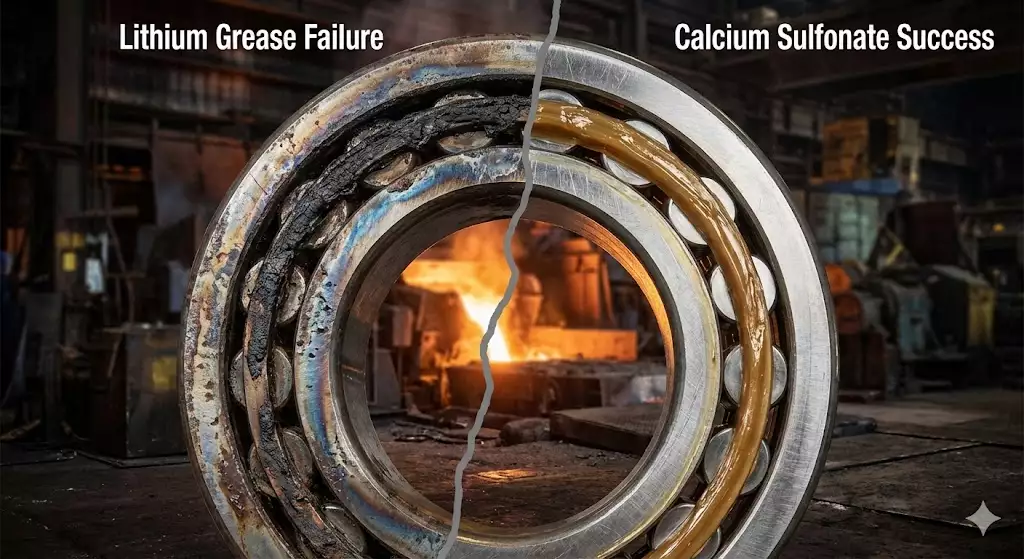
- Water washout (ASTM D1264): Ca-sulfonate <5% vs lithium 15–25%
- Shear stability (ASTM D217): <10% penetration change after 100,000 strokes
- OEM approvals: SKF, FAG, Timken, Caterpillar mean real-world testing
Table #1: Key Parameters vs. Application
| Parameter | Threshold to Request | Best For |
|---|---|---|
| Base Oil | Synthetic PAO for >120°C | High-temp, oxidation risk |
| NLGI Grade | Match to lube system | NLGI 1: centralized; 2: general; 3: high-speed |
| Dropping Point | >280°C for Ca-Sulfonate | Continuous high-temp (>120°C) |
| Four-Ball Weld | >315 kg (often >400 kg) | Heavy shock loads, mining, steel |
| Water Washout | <5% @ 79°C | Marine, paper mills, wet mining |
| Oxidation Life | >1,000 hrs to 2.0 TAN | Extended intervals |
How Smart Buyers Evaluate Suppliers (4 Steps)
Step 1 — Define Equipment & Conditions
List: equipment type, bearing specs, operating speed/temp, contamination risk, current relubrication interval. If you don’t know your bearing operating temperature, measure it. You can’t optimize what you don’t measure.
Step 2 — Create Technical Spec
Required NLGI grade, base oil ISO VG (typically 100–220), minimum EP rating (>315 kg weld load), dropping point, water resistance, packaging format. Hand this to suppliers: “Show me test reports proving your grease meets this.”
Step 3 — Assess Technical Data
Demand: ASTM/ISO test reports, batch Certificates of Analysis, OEM approvals, formulation details. Red flags: vague “meets standards” claims without data, no batch traceability, can’t explain performance differences.
Step 4 — Run a Pilot Trial
Select 5–10 lube points, baseline current performance (temps, vibration, interval), switch to new grease, monitor 1–2 cycles (3–6 months), sample used grease for lab analysis. Measure: bearing temp drop? Extended interval? I’ve seen pilots cut relubrication frequency 60% and reduce temps 12°C. ROI was clear in three months. [data source: internal benchmark 2026]
Factory vs Trader vs Big Brand:
- Factory (like Zhongtian): custom formulations, competitive bulk pricing, direct technical support
- Trader: faster small-volume logistics, variable QC traceability
- Big brand: strong approvals, premium pricing
Lithium vs. Calcium Sulfonate vs. Polyurea: Which Saves Money?
Table #2: Thickener Performance Comparison
| Thickener | High-Temp | Water Resistance | EP/Load | Best Use |
|---|---|---|---|---|
| Lithium Complex | ~120–140°C | Moderate (15–25% washout) | Additive-dependent | General industrial, moderate-duty |
| Calcium Sulfonate | ~150–180°C | Excellent (<5% washout) | Inherent EP | Heavy-duty, water, high-temp, long intervals |
| Polyurea | ~160–200°C | Poor-Moderate | Lower | Electric motors, high-speed, clean/dry |
The Real Story:
Lithium complex is cost-effective for general service <110°C. Water resistance is moderate, oxidation tapers above 100°C, EP relies on additives that deplete.
Calcium sulfonate complex is built for punishment. The thickener provides inherent EP protection — calcium carbonate nanoparticles act like tiny ball bearings. Water washout <5%, superior oxidation stability. Higher upfront cost, but TCO wins in harsh environments — facilities cut relubrication from every 500 hours to 1,500–2,000 hours. That’s less labor, less grease, fewer failures. [industry studies]
Polyurea excels in high-temp, high-speed, low-load (electric motors). Excellent shear stability, but lower EP than calcium sulfonate in heavy shock loads.
My take: For heavy-load, wet, high-temp equipment, calcium sulfonate reduces TCO despite 30–50% higher upfront cost. For light-duty, clean/dry service, lithium or polyurea is more cost-effective.
Case Studies — Real Cost Reductions
Case #1: Steel Mill — Rolling Mill Bearings
Problem: Lithium grease failing at 110–130°C. Bearings dying every 6–8 months vs expected 18–24 months.
Action: Switched to Zhongtian calcium sulfonate + synthetic PAO base oil (ISO VG 220). Pilot on 6 bearings, 4-month monitoring.
Outcome:
- Bearing temps dropped 8–12°C
- Interval extended 400 hrs → 1,200 hrs (3×)
- Bearing life increased to 20+ months
- Grease consumption reduced 60%
- Annual TCO reduction: ~22%
Case #2: Open-Pit Mining — Wheel Bearings
Problem: Water ingress destroying wheel bearings. Lithium grease washing out, causing premature failures.
Action: Bulk calcium sulfonate (NLGI 2), onsite technical service, grease purge protocol.
Outcome:
- Water washout improved (<5% vs 18–22%)
- Bearing replacement reduced 40% over 18 months
- Unscheduled downtime dropped 30%
- Monthly lubricant use decreased 25%
Why Zhongtian Petrochemical
28+ years manufacturing, 2000+ SKUs: National high-tech enterprise with SRDI backing since 1997.
R&D capability: Pilot labs for custom formulations, field validation, OEM/private label production.
Global logistics: Bulk drums, IBCs, cartridges. ISO 9001/14001 certified, batch-level QC traceability, Certificate of Analysis per shipment.
Value-add: Free pilot samples, lubrication checklists, technical hotline/WhatsApp, on-site service for larger accounts.