




The best-known heat transfer oil manufacturers are Eastman (Therminol), Dow (DOWTHERM and SYLTHERM), Lubrizol (Paratherm), Global Heat Transfer (Globaltherm), Shell, ExxonMobil (Mobiltherm), Petro-Canada (CALFLO), Duratherm and FRAGOL, alongside Chinese producers that sell L-QB, L-QC and L-QD grades. The table below lists their fluids with the maximum bulk and film temperatures each maker publishes, which is the number that decides whether a fluid fits your heater.
This page is published by Zhongtian, a Chinese lubricant manufacturer that also makes L-QB, L-QC and L-QD heat transfer oils. Temperatures are taken from each manufacturer’s own product page or data sheet, as published in October 2026.
Heat transfer oil manufacturers and their fluids
| Manufacturer (country) | Fluid and type | Max bulk temperature | Max film temperature |
|---|---|---|---|
| Eastman (USA) | Therminol 55, synthetic hydrocarbon | 300 °C (315 °C extended use) | 335 °C |
| Therminol 66, modified terphenyl | 345 °C | 375 °C | |
| Therminol VP-1, biphenyl/diphenyl oxide eutectic | 400 °C | 430 °C | |
| Dow (USA) | DOWTHERM Q, diphenylethane and alkylated aromatics | 330 °C | Not published on product page |
| DOWTHERM A, synthetic organic, liquid or vapour phase | 400 °C | Not published on product page | |
| SYLTHERM 800, silicone | 400 °C | Not published on product page | |
| Lubrizol, Paratherm range (USA) | Paratherm NF, hydrotreated mineral oil | 316 °C in fired heaters | 343 °C |
| Paratherm HR, alkylated aromatic | 343 °C in fired heaters | 371 °C | |
| Global Heat Transfer (UK) | Globaltherm M, highly refined base stocks | 320 °C | 340 °C |
| Globaltherm Syntec, hydrogenated terphenyls | 345 °C | 375 °C | |
| Globaltherm Omnitech, diphenyl oxide/biphenyl | 400 °C | 425 °C | |
| Shell (UK) | Shell Heat Transfer Oil S2, refined mineral oil | 320 °C | 340 °C (2011 data sheet) |
| ExxonMobil (USA) | Mobiltherm 603, mineral oil | 285 °C closed, 150 °C open system | Not published |
| Mobiltherm 605, mineral oil | 315 °C closed, 180 °C open system | Not published | |
| Petro-Canada Lubricants (Canada) | CALFLO HTF / CALFLO AF; CALFLO XR synthetic blend | 326 °C / 316 °C; XR 288 °C | Not on catalogue page |
| Duratherm (USA) | Duratherm 600 / Duratherm 630 | 316 °C / 332 °C | 650 °F (343 °C) / 670 °F (354 °C) |
| FRAGOL (Germany) | FRAGOLTHERM Q-32-N, hydrogenated mineral oil | 320 °C | 340 °C |
| FRAGOLTHERM HT, synthetic | 350 °C | 380 °C | |
| Anhui Zhongtian Petrochemical (China) | L-QB, L-QC, L-QD | 280 to 350 °C by grade | Grade limit +20 °C (L-QB, L-QC) or +30 °C (L-QD) |
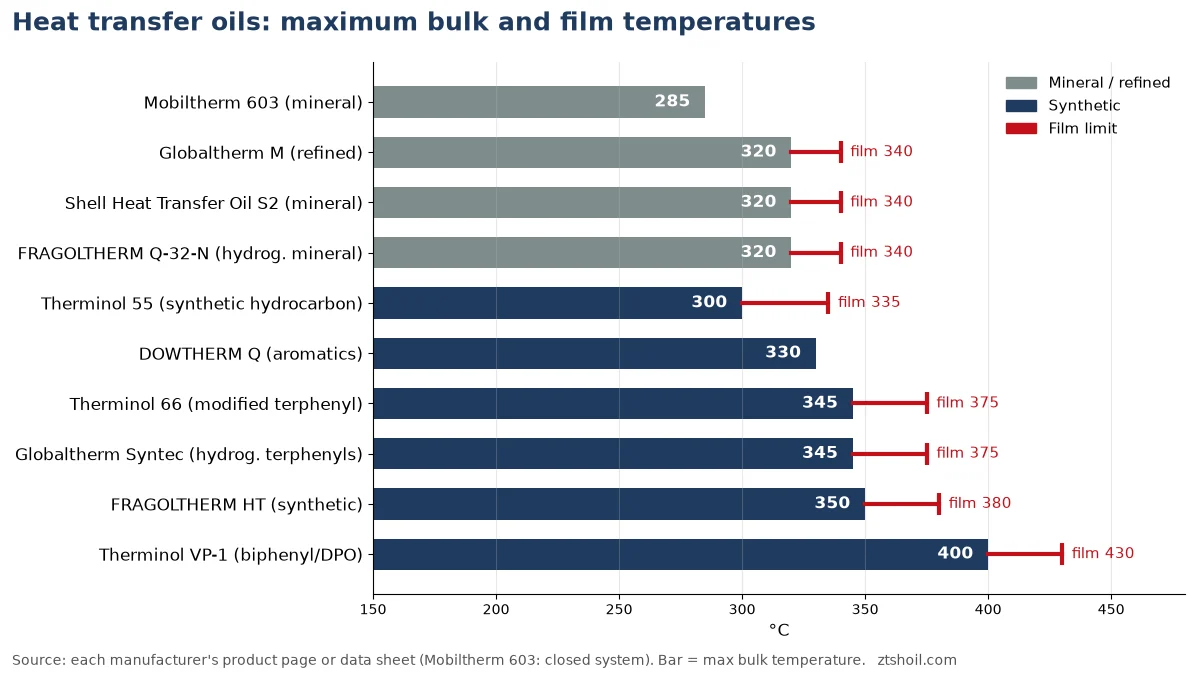
The list is grouped by company, not ranked; there is no public data that ranks heat transfer oil makers by volume. Two ownership points are worth knowing: Paratherm is now a Lubrizol range, and Petro-Canada Lubricants belongs to HF Sinclair, which announced in July 2026 that it plans to separate its lubricants business and retire its Canadian base oil refinery during 2027 (HF Sinclair).
What is the difference between bulk and film temperature?
Bulk temperature is what the system gauge reads; film temperature is the temperature of the thin layer of oil touching the heater surface, and it is always higher. ExxonMobil’s data for Mobiltherm puts the film about 15 to 30 °C above the bulk oil. The film limit is the one that must not be exceeded, because that is where the oil cracks and forms coke.
So size a fluid on the heater’s worst-case film temperature, not on the bulk set point. Low flow through the heater, a fouled strainer or overfiring can push the film past its limit while the bulk gauge still looks normal.
What are L-QB, L-QC and L-QD heat transfer oils?
They are the Chinese classes of organic heat transfer fluid, graded by maximum allowable service temperature. The family code Q also appears in the international classification ISO 6743-12 (family Q, heat transfer fluids), and German practice uses DIN 51522. In China the product standard is GB 23971; a new edition, GB 23971-2025, takes effect on 1 November 2026 and replaces the 2009 edition.
| Class | Type | Grades | Max allowable service temperature | Max film temperature | System |
|---|---|---|---|---|---|
| L-QB | Refined mineral oil or common synthetic | L-QB280, L-QB300 | 280 °C, 300 °C | Service temperature +20 °C | Closed or open |
| L-QC | Refined mineral oil or common synthetic | L-QC310, L-QC320 | 310 °C, 320 °C | Service temperature +20 °C | Closed |
| L-QD | Synthetic with high thermal stability | L-QD330, L-QD340 and higher | 330 °C, 340 °C, 350 °C | Service temperature +30 °C | Closed |
Two rules come with these classes, as stated on our data sheets: the actual maximum operating temperature should be at least 10 °C below the grade’s maximum allowable service temperature, and only L-QB is used in open systems. L-QC and L-QD are for closed systems, where the hot oil is kept away from air.
Mineral or synthetic heat transfer oil?
Mineral oils cover bulk temperatures up to roughly 315 to 320 °C; above that you need a synthetic. The published limits show the split clearly: Shell Heat Transfer Oil S2, Globaltherm M and FRAGOLTHERM Q-32-N stop at 320 °C, Mobiltherm 605 at 315 °C, while hydrogenated terphenyls reach 345 °C and biphenyl/diphenyl oxide fluids 400 °C.
- Open systems run much cooler. Where the expansion tank is open to air, oxidation sets the limit: Mobiltherm 605 is rated 315 °C in closed systems but 180 °C in open ones.
- Do not chase the highest rating. A fluid run near its ceiling ages fastest. Choose a grade with margin above your real film temperature.
- Ask before mixing. Different chemistries and different makers’ fluids should not be topped up into each other without the supplier’s confirmation.
How do you check a heat transfer oil supplier?
- Both limits on the data sheet. A serious supplier publishes maximum bulk and film temperature. Several well-known product pages give only one; ask for the other in writing.
- Test methods behind the numbers, and a certificate of analysis with each batch.
- An in-use monitoring plan. Shell’s data sheet names the properties to watch: viscosity, acidity, flash point (open and closed cup) and insolubles. In China, in-use limits are set by GB/T 24747-2023; ask your supplier which replacement limits they apply.
- Flushing and changeover support when replacing a degraded fluid or switching chemistry.
Zhongtian heat transfer oils
We make L-QB (L-QB280, L-QB300), L-QC (L-QC310, L-QC320) and L-QD (L-QD330 and up) heat transfer oils for indirect heating systems, made to order so that viscosity and other limits can be written into the purchase specification. Send us your heater type, maximum bulk temperature and whether the system is open or closed, and we will recommend a class with the margin your system needs.
Frequently asked questions
What is the maximum temperature for heat transfer oil?
It depends on the fluid. Published maximum bulk temperatures range from about 285 to 320 °C for mineral oils and up to 400 °C for biphenyl/diphenyl oxide synthetics, with film limits 20 to 30 °C higher.
How often should heat transfer oil be changed?
By analysis rather than by calendar. Sample at least once a year, more often in hot systems, and trend viscosity, acid number, flash point and insolubles against the supplier’s limits.
Which heat transfer oil is best for an open system?
A mineral fluid rated for open systems, run well below its closed-system limit. Among Chinese classes only L-QB is specified for open systems.
Sources
- Eastman, Therminol 55 data sheet (3/26)
- Eastman, Therminol 66 data sheet (3/26)
- Eastman, Therminol VP-1 data sheet (4/26)
- Dow, DOWTHERM A product page
- Dow, DOWTHERM Q product page
- Dow, SYLTHERM 800 product page
- Lubrizol, Paratherm NF
- Lubrizol, Paratherm HR
- Global Heat Transfer, Globaltherm M
- Global Heat Transfer, Globaltherm Syntec
- Global Heat Transfer, Globaltherm Omnitech
- Shell Marine pocketbook 2025, Heat Transfer Oil S2
- ExxonMobil, Mobiltherm 603
- ExxonMobil, Mobiltherm 605
- Petro-Canada Lubricants, heat transfer fluids catalogue
- HF Sinclair press release, 28 July 2026
- Duratherm 600
- Duratherm 630
- FRAGOL, FRAGOLTHERM Q-32-N
- FRAGOL, FRAGOLTHERM HT
- GB 23971-2025, Organic heat transfer fluids (effective 1 November 2026)
- GB/T 24747-2023, Safety technology conditions for organic heat transfer fluid
- DIN 51522:1998-11
- ISO 6743-12, Family Q (heat transfer fluids)
- Zhongtian L-QB, L-QC and L-QD product data sheets