




Quick Answer
Bearing lubrication refers to the use of grease or oil to reduce friction and wear between bearing components such as rolling elements and raceways. In industrial applications, grease lubrication accounts for approximately 80–90% of bearing use cases, while oil lubrication is preferred for high-speed or high-temperature systems requiring heat dissipation.
Studies across the bearing industry show that improper lubrication — including wrong lubricant type, incorrect quantity, or contamination — contributes to up to 80% of bearing failures.
Table of Contents
- What Is Bearing Lubrication?
- Why Is Bearing Lubrication Important?
- Types of Bearing Lubricants
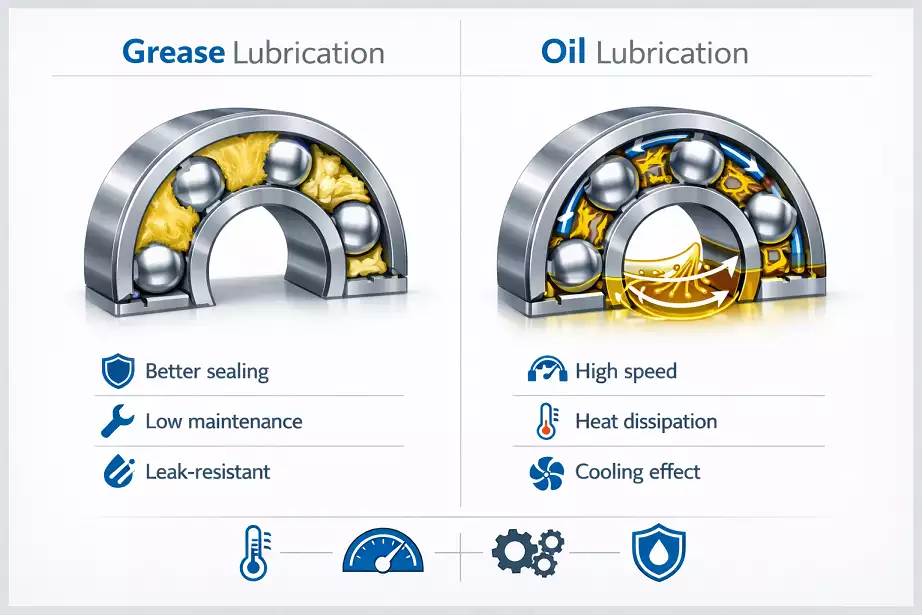
- Grease vs Oil: Full Comparison
- How to Choose the Right Bearing Lubricant
- Bearing Lubrication Methods
- How Much Grease Does a Bearing Need?
- How Often Should Bearings Be Lubricated?
- Bearing Lubrication by Industry
- Common Bearing Lubrication Problems & Solutions
- FAQ
- References & About the Author
What Is Bearing Lubrication?
Bearing lubrication is the process of applying a lubricant — typically grease or oil — to create a protective film between bearing surfaces, including rolling elements and raceways, in order to reduce friction, prevent wear, and extend service life.
This lubrication film, often referred to as an elastohydrodynamic (EHD) film, separates metal surfaces at a microscopic level, preventing direct contact and minimizing energy loss, heat generation, and surface damage.
What Is an EHD Lubrication Film?
An elastohydrodynamic (EHD) lubrication film is a microscopic oil layer that forms under high pressure between rolling elements and raceways. This film is typically only a few micrometers thick but is strong enough to prevent direct metal-to-metal contact.
Without a stable lubrication film, bearing surfaces experience immediate wear, increased friction, and rapid failure.
Why Is Bearing Lubrication Important?
Proper bearing lubrication is widely recognized as the most critical factor influencing bearing performance and lifespan.
Industry studies indicate that lubrication-related issues — including insufficient lubrication, over-lubrication, contamination, and incorrect lubricant selection — account for up to 80% of bearing failures in industrial environments.
Bearing lubrication performs five essential functions:
- Reduces friction between rolling elements and raceways
- Prevents wear by maintaining a protective film under load
- Protects against corrosion from moisture and contamination
- Dissipates heat generated during high-speed or high-load operation
- Seals against contaminants such as dust, water, and debris
Types of Bearing Lubricants
There are three main types of lubricants used in bearing applications:
1. Grease Lubrication
Grease lubrication is the most common bearing lubrication method, used in approximately 80–90% of industrial bearing applications.
Bearing grease acts as both a lubricant and a sealing medium, protecting against contamination while maintaining a stable lubrication film.
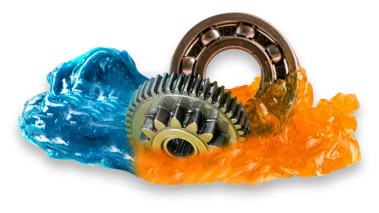
What is bearing grease? Bearing grease is a semi-solid lubricant made of three components:
| Component | Function |
|---|---|
| Base oil (typically 75–90%) | Provides the actual lubricating film |
| Thickener (lithium, polyurea, calcium) | Holds the oil in place within the bearing |
| Additives | Rust inhibitors, antiwear, antioxidants |
When to use grease:
- Hard-to-reach bearing locations
- Sealed or pre-lubricated bearings
- Applications with infrequent maintenance access
- Environments with dust or water contamination
2. Oil Lubrication
Oil is a liquid lubricant — mineral or synthetic — used when speed, temperature, or heat dissipation requirements exceed what grease can handle.
When to use oil:
- High-speed applications (turbines, spindles, CNC machines)
- High-temperature environments where grease would degrade
- Applications where heat must actively be removed from the bearing
- Gearboxes where bearings share oil with gears
Key property: Viscosity The most important oil selection parameter is viscosity — a measure of the fluid’s resistance to flow. Higher viscosity = thicker film. Lower viscosity = faster flow, better for high speeds.
Viscosity is expressed in centistokes (cSt) and must match the bearing’s operating speed and temperature.
3. Solid / Dry Lubrication
Used in extreme conditions where neither oil nor grease can survive.
Common solid lubricants:
- Molybdenum disulfide (MoS₂) — high load, vacuum environments
- Graphite — high-temperature applications up to 450°C
- PTFE (Teflon) — food-grade and clean-room environments
When to use solid lubricants:
- Extreme temperatures (above 200°C or below −50°C)
- Vacuum or radiation environments (aerospace)
- Food processing where contamination is not acceptable
Grease vs Oil for Bearings: Full Comparison
| Factor | Grease | Oil |
|---|---|---|
| Application | ~80–90% of bearings | High-speed / high-temp systems |
| Heat dissipation | Poor | Excellent |
| Sealing ability | Excellent | Limited |
| Maintenance frequency | Lower | Higher |
| Leakage risk | Minimal | Higher |
| Speed suitability | Low to medium speed | High speed |
| Re-lubrication | Manual / auto | Circulating system |
| Contamination protection | Better | Requires sealing |
| Cost | Lower system cost | Higher (pumps, reservoirs) |
Bottom line: Use grease as your default choice. Switch to oil only when heat dissipation, very high speed, or shared lubrication with other machine components requires it.
How to Choose the Right Bearing Lubricant
Selecting the correct bearing lubricant requires evaluating five key parameters:
1. Operating Speed (DN Value)
Speed determines the required oil viscosity.
Formula: DN = Bearing bore (mm) × Speed (RPM)
- High DN value → Use lower-viscosity lubricant
- Low DN value → Higher viscosity acceptable
Rule: At high speeds, thinner grease (NLGI Grade 1–2) is preferred to minimize churning and heat.
2. Load
- Light load, high speed → Low-viscosity oil or thin grease
- Heavy load, slow speed → High-viscosity oil or stiff grease (NLGI Grade 2–3)
- Shock loads → Grease with extreme pressure (EP) additives
3. Operating Temperature
| Temperature Range | Recommended Lubricant |
|---|---|
| −40°C to +80°C | Standard lithium grease |
| +80°C to +150°C | Polyurea or lithium-complex grease |
| +150°C to +200°C | Perfluoropolyether (PFPE) or synthetic grease |
| Above +200°C | Solid lubricants (graphite, MoS₂) |
| Below −40°C | Synthetic base oil grease (PAO or ester) |
4. Environment
- Wet / washout conditions → Calcium sulfonate or calcium complex grease (excellent water resistance)
- Dusty / contaminated environments → Stiffer grease with good sealing properties
- Chemical exposure → Synthetic or PFPE-based lubricants
- Food-grade applications → NSF H1 certified lubricants
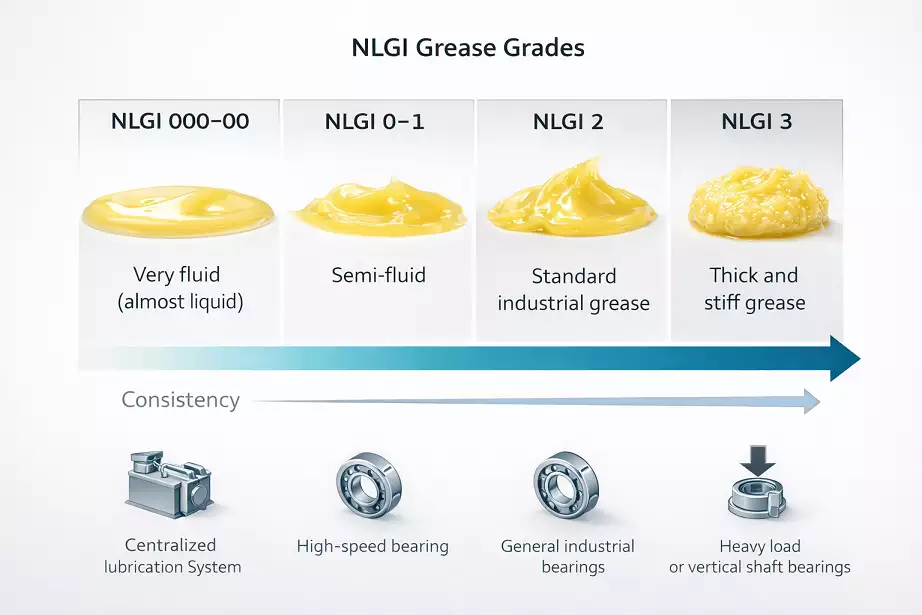
5. NLGI Grade Selection Guide
| NLGI Grade | Consistency | Typical Use |
|---|---|---|
| NLGI 000–00 | Very fluid | Centralized grease systems |
| NLGI 0–1 | Semi-fluid | High-speed, low-temperature bearings |
| NLGI 2 | Medium (most common) | General industrial bearings |
| NLGI 3 | Stiff | High-vibration, vertical shaft bearings |
NLGI Grade 2 is the correct starting point for most industrial bearing applications.
Bearing Lubrication Methods
Grease Application Methods
Manual Grease Gun The most common method for maintenance teams. Apply grease slowly while the machine rotates at low speed. Never inject grease rapidly into a static bearing.
Centralized Automatic Lubrication System Ideal for multiple lubrication points. Delivers precise, timed doses automatically — eliminating human error and over/under lubrication risk.
Pre-lubricated Sealed Bearings Factory-filled and sealed. No field relubrication required for the life of the bearing. Common in electric motors and household appliances.
Oil Application Methods
| Method | Best For |
|---|---|
| Oil bath | Low to medium speed horizontal shaft bearings |
| Oil mist | High-speed, light-load applications |
| Circulating oil system | High-speed, high-temperature; removes heat continuously |
| Oil injection | Extreme high-speed applications (turbines, spindles) |
How Much Grease Does a Bearing Need?
The standard rule: Fill bearing housing to 30–40% of its free internal volume (depending on speed and bearing type).
This is critical. Most bearing failures from over-lubrication happen because maintenance teams assume “more grease = better protection.”
What happens with too much grease:
- Rolling elements must force through excess lubricant
- Churning generates excessive heat
- Oil separates from the thickener (“bleeding”)
- Operating temperature rises — accelerating grease degradation
What happens with too little grease:
- Inadequate film formation
- Metal-to-metal contact
- Rapid wear, overheating, and premature failure
How Often Should Bearings Be Lubricated?
There is no universal relubrication interval. The correct interval depends on:
- Bearing type and size
- Operating speed
- Operating temperature
- Environmental conditions (dust, water, vibration)
- Lubricant quality and grade
General Relubrication Guidance
| Operating Temperature | Oil Bath Change Interval |
|---|---|
| Around 50°C | Every 12 months |
| 70°C to 100°C | Every 3 months |
| Above 100°C | Monthly or based on oil analysis |
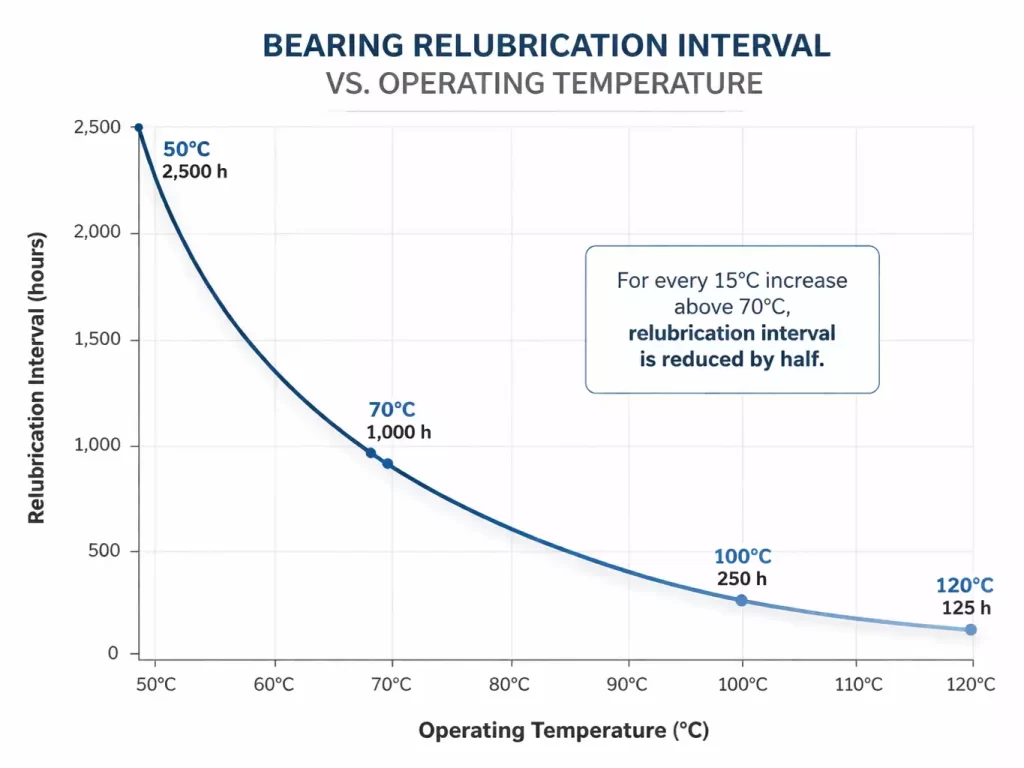
Temperature rule for grease: As a general rule of thumb, for every 15°C above 70°C, the relubrication interval should be halved.
For vertical shaft bearings: Halve the standard calculated interval.
Best Practice: Condition-Based Relubrication
Modern plants increasingly use ultrasound monitoring to detect actual friction levels in bearings. This replaces calendar-based schedules with condition-based intervals — ensuring grease is added only when the bearing actually needs it, preventing both over- and under-lubrication.
Bearing Lubrication by Industry
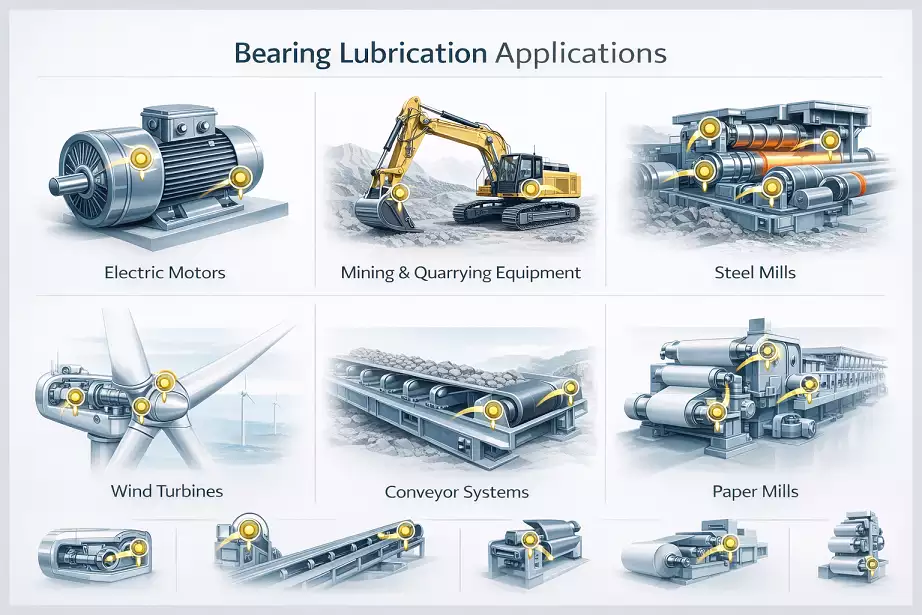
Electric Motor Bearings
- Most use pre-lubricated, sealed ball bearings
- Where relubrication is required: use polyurea grease (NLGI Grade 2–3)
- Avoid over-packing: excess grease in motor bearings causes churning and elevated temperatures
- Critical: use grease compatible with the motor’s temperature class
Mining & Quarrying Equipment
- Extreme load, contamination, vibration, and shock conditions
- Use high-viscosity lithium-complex or calcium sulfonate grease with EP additives
- Consider automatic lubrication systems for inaccessible lubrication points
- Relubrication intervals are short — weekly or based on operating hours
Steel & Paper Mill Bearings
- Combination of high heat, water, steam, and heavy load
- Best choice: calcium sulfonate complex grease — provides exceptional water resistance and high-temperature stability
- Paper mills specifically require greases that do not contaminate the product
Wind Turbine Bearings
- Extreme demands: long intervals between maintenance, variable loads, low temperatures, remote locations
- Main shaft bearings require synthetic base oil greases with excellent low-temperature performance
- Main bearing grease must resist fretting wear (micro-movement under vibration)
Conveyor Systems
- Long lubrication intervals, often in dirty environments
- Use NLGI Grade 2 lithium-complex grease with anti-corrosion additives
- Centralized automatic lubrication systems recommended for long conveyor lines
Common Bearing Lubrication Problems & Solutions
Problem 1: Bearing Overheating
Cause: Over-lubrication, incorrect viscosity, or wrong NLGI grade for operating speed.
Signs: Elevated temperature, discoloration of grease, burnt smell.
Solution:
- Verify grease fill level (target 30–40% depending on speed and bearing type)
- Confirm viscosity grade matches operating speed (DN value)
- Check if bearing temperature returns to normal after initial run-in (temporary temperature rise is normal after relubrication)
Problem 2: Grease Leakage from Bearings
Cause: Over-packing, grease too soft for the application, or seal damage.
Signs: Grease oozing from seals, greasy deposits on surrounding components.
Solution:
- Reduce grease quantity to 30–40% fill (depending on bearing type)
- Select higher NLGI grade (stiffer grease)
- Inspect and replace worn or damaged seals
Problem 3: Premature Bearing Wear
Cause: Under-lubrication, lubricant starvation, or contamination.
Signs: Increased noise, vibration, elevated temperature, visible pitting on raceways.
Solution:
- Verify relubrication interval is being followed
- Check that fresh grease is actually reaching the bearing (not blocked by hardened residue)
- Inspect seals for contamination ingress
- Consider switching to a higher-quality lubricant with better oxidation stability
Problem 4: Incompatible Grease Mixing
Cause: Using a different grease type during relubrication without purging the old grease.
Signs: Oil bleeding, salt-like deposits, sudden drop in lubricating performance.
Solution:
- Always confirm new grease is compatible with the existing grease before mixing
- When switching grease types, flush the bearing completely with the new product before resuming normal relubrication
- Maintain records of the grease product used in each bearing location
Problem 5: Grease Degradation (Oxidation)
Cause: Extended service beyond grease life, excessive temperature, or water contamination.
Signs: Grease turns dark, hard, or crumbly. Loss of consistency. Bearing noise increases.
Solution:
- Shorten relubrication intervals in high-temperature applications
- Select a grease with higher oxidation stability (polyurea or synthetic base oil)
- Install better sealing to reduce water ingress
FAQ
What is bearing lubrication? Bearing lubrication is the process of applying grease or oil to create a protective film between bearing components — including rolling elements and raceways — in order to reduce friction, prevent wear, and extend service life.
Why is lubrication important for bearings? Without adequate lubrication, metal-to-metal contact occurs immediately between rolling elements and raceways. This generates extreme heat, causes rapid wear, and leads to bearing failure. Industry studies indicate that lubrication-related issues account for up to 80% of bearing failures in industrial environments.
Which lubricant is best for bearings — grease or oil? Grease is the correct choice for approximately 80–90% of industrial bearing applications. Oil is better when operating speeds are very high, when heat must be actively removed from the bearing, or when bearings share lubrication with gearboxes or other components.
What grease is best for electric motor bearings? Polyurea-based grease (NLGI Grade 2 or 3) is the most widely recommended choice for electric motor bearings. It offers excellent high-temperature stability, oxidation resistance, and is compatible with common motor seal materials.
How often should bearings be lubricated? There is no universal interval. General guidance: for oil bath systems at 50°C, change oil annually; at 70–100°C, every 3 months. For grease-lubricated bearings, as a general rule of thumb, halve the standard interval for every 15°C above 70°C. Condition-based monitoring (ultrasound) is the most reliable approach.
How much grease should I put in a bearing? Fill the bearing housing to 30–40% of its free internal volume (depending on speed and bearing type). Over-filling is one of the most common maintenance mistakes and causes overheating through churning.
Can you mix different bearing greases? Mixing incompatible greases can cause oil to bleed from the thickener, forming salt-like deposits that damage rolling elements. Always verify grease compatibility before mixing. When switching grease types, flush the bearing completely with the new grease first.
What causes bearing grease to break down? The main causes are: excessive heat, extended service beyond grease life, water contamination, oxidation, and mechanical shearing at very high speeds. Choosing a grease with the correct temperature rating and oxidation stability minimizes premature breakdown.
What is NLGI grade in bearing grease? NLGI (National Lubricating Grease Institute) grade indicates the consistency (stiffness) of a grease. NLGI 2 is the standard for most industrial applications. Higher grades are stiffer and better for high-vibration or vertical shaft applications. Lower grades are more fluid and suited for centralized lubrication systems.
What happens if a bearing is over-lubricated? Over-lubrication forces rolling elements to work against excess grease, causing churning. This generates heat, accelerates grease degradation, increases operating temperature, and can ultimately cause the same failure as under-lubrication — just from the opposite direction.
Is synthetic oil better than mineral oil for bearings? Synthetic oils offer higher viscosity index (more stable across temperature ranges), better oxidation resistance, and longer service life. They are preferred for extreme temperatures, long relubrication intervals, and applications where premium performance justifies the higher cost.
Conclusion
Bearing lubrication is not a secondary maintenance task — it is the primary defense against bearing failure. Industry studies indicate that lubrication-related issues account for up to 80% of bearing failures, tracing back to errors such as wrong lubricant type, wrong quantity, wrong interval, or incompatible products.
The key principles to remember:
- Default to NLGI Grade 2 grease for most industrial bearings
- Fill to 30–40% of housing free volume (depending on speed and bearing type) — never more
- Match lubricant to temperature, speed, load, and environment — not just habit
- Switch to oil only when heat dissipation or speed demands it
- Never mix incompatible greases without flushing first
- As a general rule of thumb, halve relubrication intervals for every 15°C above 70°C
- Use condition monitoring to replace calendar-based intervals where possible
At Zhongtian Petrochemical, we supply industrial lubricants engineered for these exact demands — from extreme-pressure mining greases to synthetic polyurea formulations for electric motors and wind turbines. Our technical team works directly with maintenance engineers to match the right lubricant to every bearing application.
👉 Contact our lubrication engineers at ztshoil.com →
References & About the Author
Written by: Zhongtian Petrochemical Lubrication Engineering Team — specialists in industrial lubricant formulation and bearing maintenance optimization with over 15 years of field experience across mining, steel, paper mill, and power generation sectors.
Technical References:
- Koyo/JTEKT Bearing Knowledge Library — Bearing Lubrication Classification and Methods
- National Lubricating Grease Institute (NLGI) — Grease Grade Standards
- Mobil Industrial — Relubrication Interval Determination Guide
- Machinery Lubrication — Lubricant Failure and Bearing Performance Research
- Bearing News — Common Bearing Failure Causes in Industrial Applications
© 2025 Zhongtian Petrochemical Co., Ltd. | ztshoil.com | All rights reserved.
This article is intended for industrial maintenance engineers and procurement professionals. For application-specific lubrication recommendations, contact our technical team.