





A complete industrial grease specification carries ten fields: the equipment requirement, the lubricated component, base oil viscosity, thickener, NLGI grade with its test method, temperature range, speed and load, environment, delivery method, and the test evidence that confirms them. Industrial grease should be selected from those fields and the operating conditions, not from color, thickener name or NLGI grade alone. If one field is missing, two products carrying the same NLGI grade may still behave very differently. The table further down sets out all ten with what to request for each.
This guide is for maintenance teams, procurement engineers and OEM specifiers who need to compare industrial lubrication grease on a like-for-like basis. It explains what to put in a specification, what evidence to request from a supplier and which test results answer common failure questions.
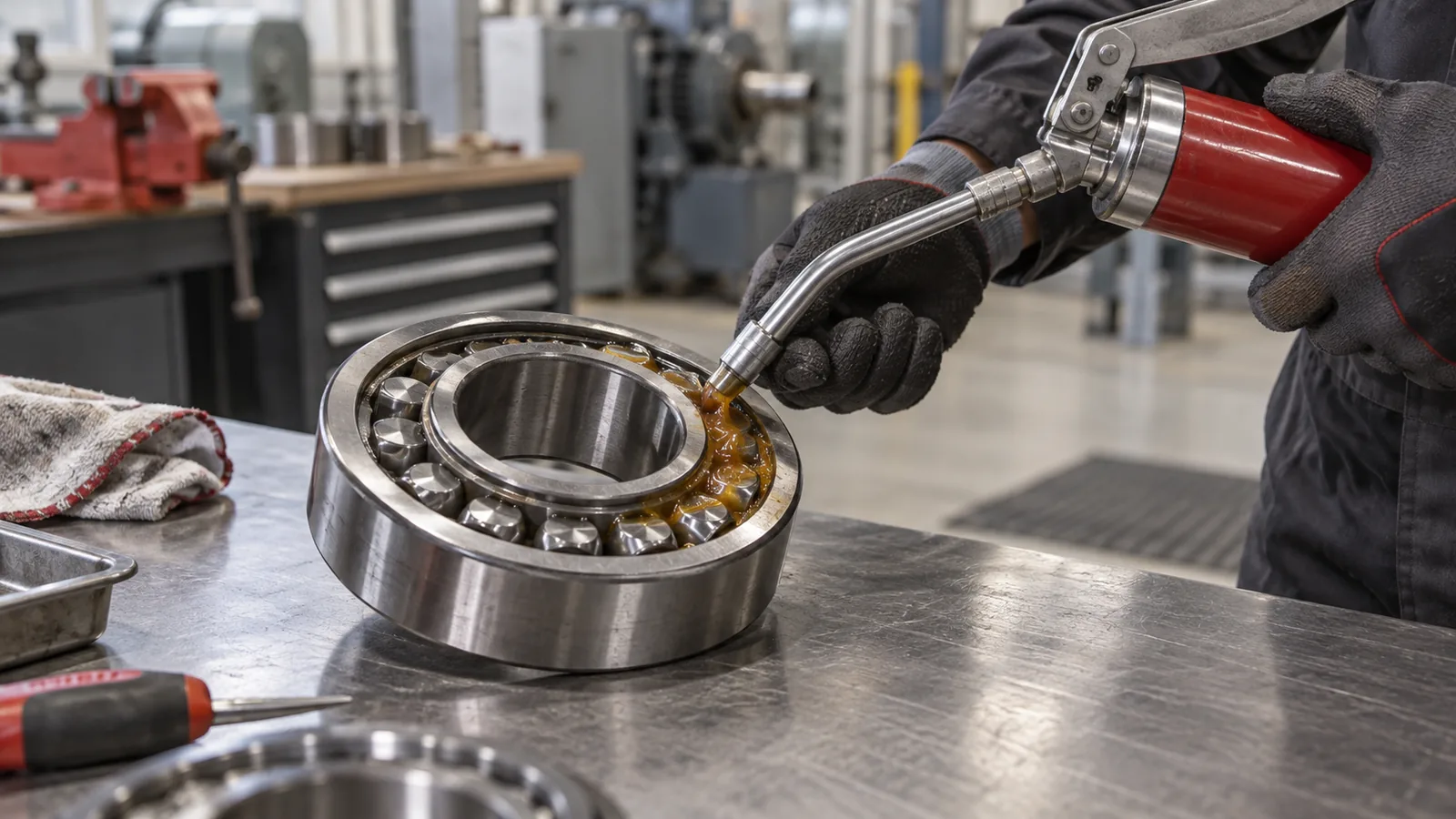
What an industrial grease specification should contain
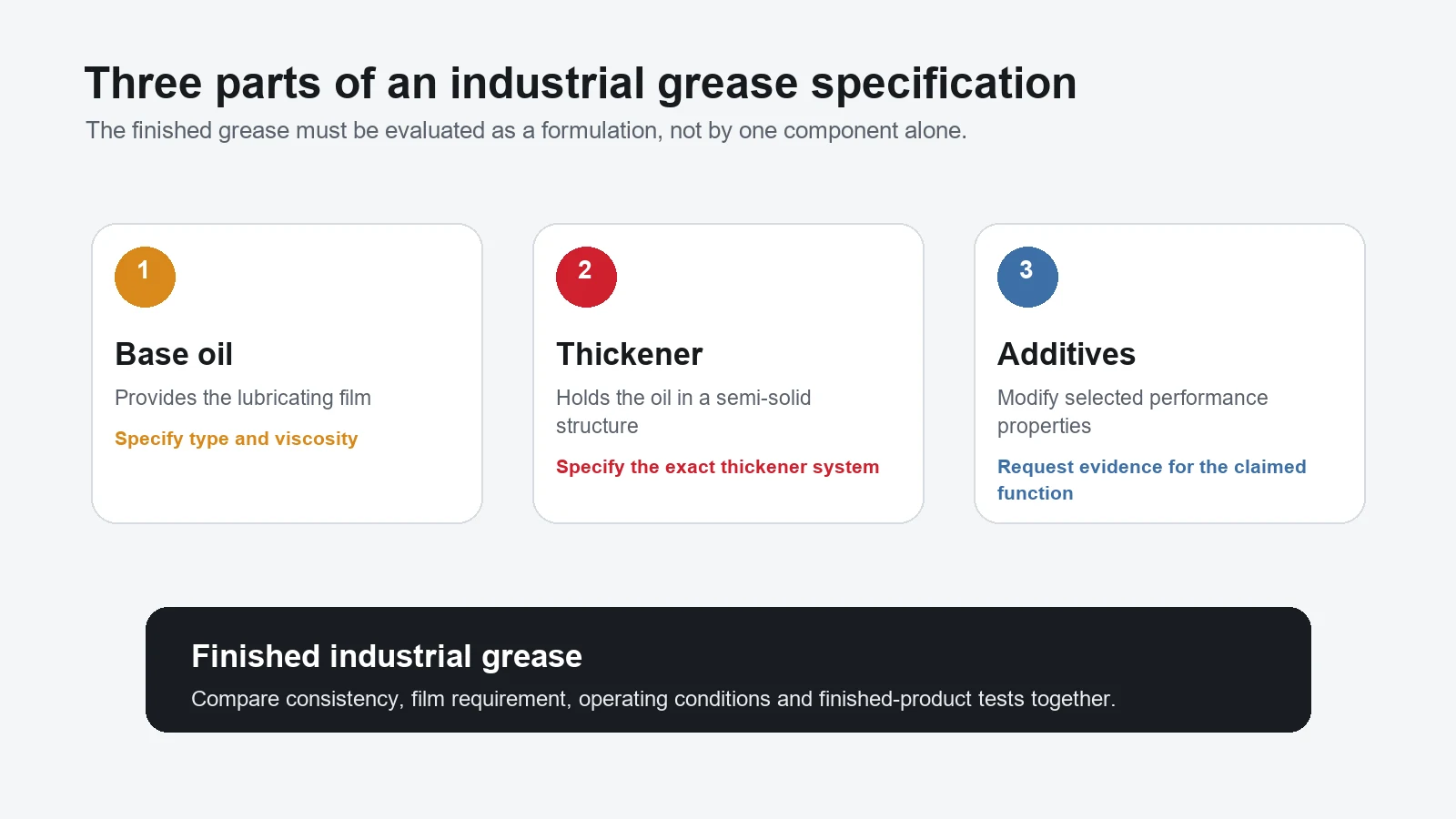
Grease is generally made from a lubricating fluid, a thickener and additives. The fluid provides the lubricating film, while the thickener holds that fluid in a semi-solid structure. Additives are selected for functions such as oxidation resistance, corrosion protection or load carrying. The NLGI grease FAQ describes these as the main components and also notes that grease consistency and base fluid viscosity are independent properties for most soap-thickened greases.
That distinction matters in purchasing. “NLGI 2 lithium grease” describes consistency and a thickener family, but it does not fully define the lubricating film, low-temperature behavior, oxidation resistance, water resistance or suitability for a particular bearing.
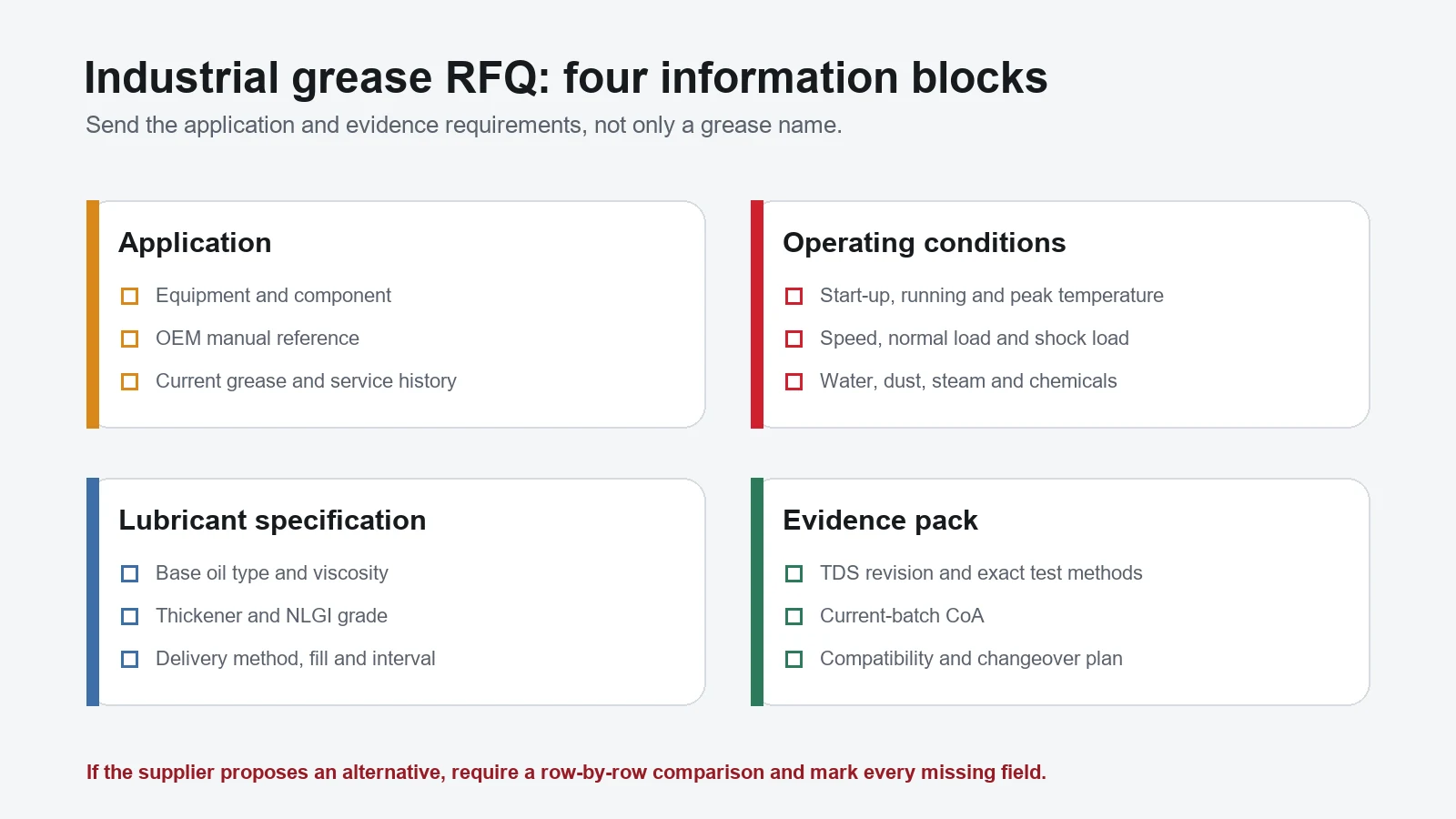
A complete request for quotation should state the following:
| Specification field | What to provide or request | Why it matters |
|---|---|---|
| Equipment requirement | OEM grease designation, manual reference or approved product | This is the first selection constraint and should not be replaced by a generic recommendation. |
| Lubricated component | Bearing type, joint, open gear, slide or other contact | Geometry and motion affect film formation and grease distribution. |
| Base oil viscosity | Viscosity at 40°C and, where available, at 100°C | Base oil viscosity affects film thickness at operating temperature. |
| Thickener | Exact thickener system, not just “multipurpose” | Thickener chemistry affects structure, water response and changeover risk. |
| NLGI grade | Grade plus the worked penetration test method | NLGI grade describes consistency, not base oil viscosity. |
| Temperature | Minimum start-up, normal running and maximum observed temperature | A single “high temperature” label is too vague for selection. |
| Speed and load | Bearing speed or speed factor, normal load and shock load | Speed, load and temperature are primary selection variables in bearing applications. |
| Environment | Water, steam, dust, process chemicals and washdown exposure | Contamination can change the required formulation and relubrication practice. |
| Delivery method | Manual, centralized system, cartridge or sealed-for-life fill | Pumpability and consistency must suit the delivery system. |
| Evidence | TDS, current batch CoA and relevant test conditions | A result cannot be compared correctly without its method, units and test conditions. |
The Timken grease lubrication guide identifies environment, temperature, load, speed, bearing geometry and lubricant distribution as inputs to selection. SKF likewise organizes its bearing grease selection chart around operating temperature, speed and load. These are useful screening frameworks, but the equipment manufacturer’s instructions remain the controlling reference.
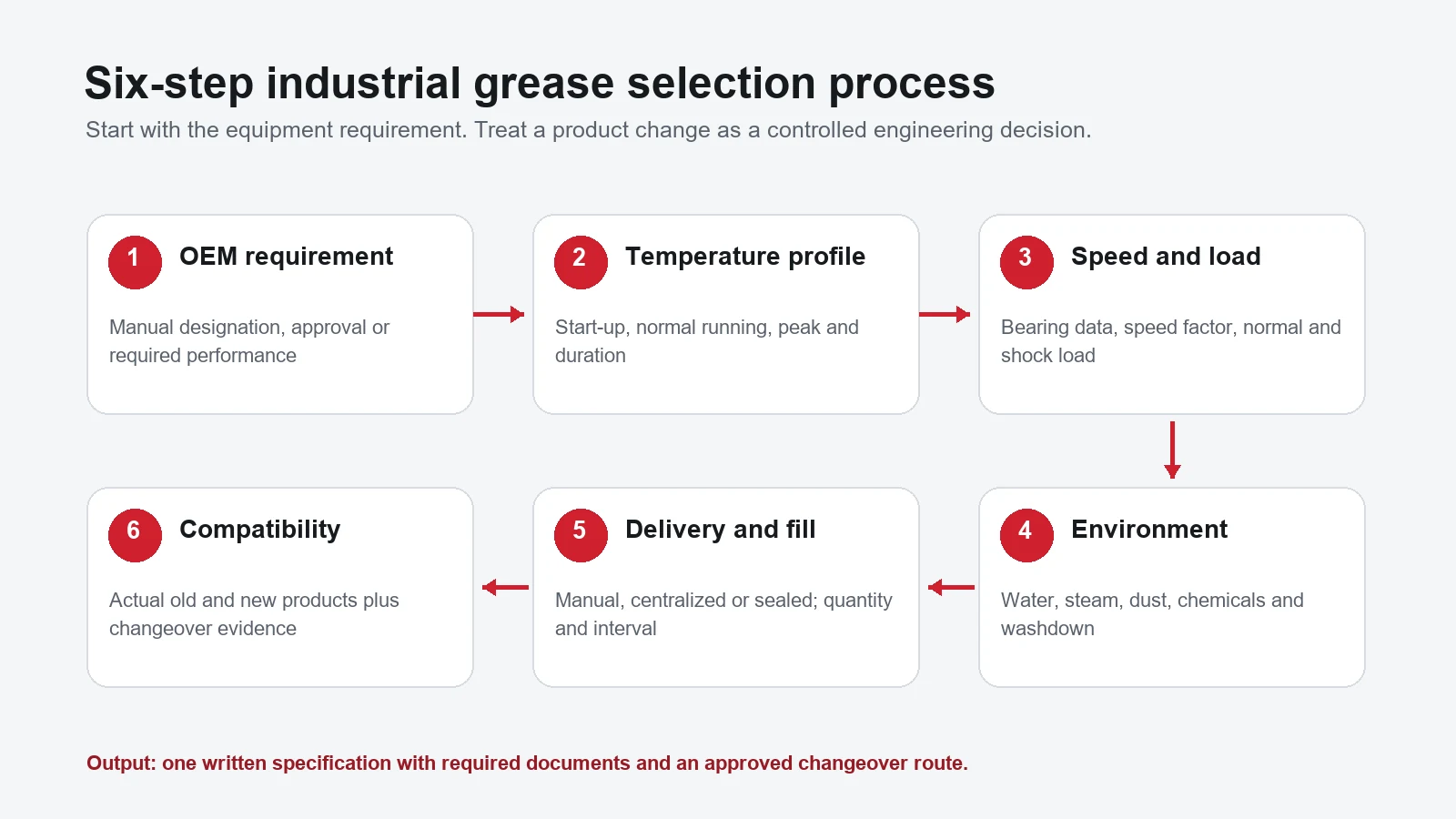
A six-step industrial grease selection process
1. Start with the OEM requirement
Record the exact grease designation, standard, approval or performance requirement in the equipment manual. If the manual names a product, do not assume that a similar color, NLGI grade or thickener is an equivalent. Ask the supplier to map every required field and identify any item it cannot confirm.
For older equipment with no available manual, record the current product, service history and operating conditions before considering a change. A stable application should not be converted merely because another grease is described as newer or more advanced.
2. Separate start-up, running and peak temperature
Do not submit one ambient temperature and call it the operating range. Record:
- the lowest temperature at start-up;
- the normal stabilized temperature near the lubricated component;
- the highest measured temperature during the duty cycle;
- the duration and frequency of temperature peaks.
Dropping point is a laboratory test result. It is not, by itself, approval to run a grease continuously at that temperature. The operating limit must come from the complete product specification, the equipment requirement and the relevant test evidence.
3. Match base oil viscosity to speed and load
High speed tends to increase churning and heat, while slow speed and high load can require a stronger lubricating film. This trade-off concerns base oil viscosity as well as grease consistency. Asking only for NLGI 2 leaves the base oil film requirement undefined.
Provide bearing dimensions and speed when available. For a rolling bearing, a supplier may use a speed factor as part of the calculation, but the formula and units must be stated. If the application is an electric motor, use the dedicated electric motor bearing grease guide to collect the motor-specific inputs before requesting a recommendation.
4. Describe water and contamination exposure
“Wet environment” can mean occasional condensation, direct water spray, steam, outdoor exposure or continuous process-water contamination. These are not equivalent. State the source of the water, frequency of exposure and whether the plant uses washdown chemicals.
Also identify dust, metal fines and process chemicals. A grease that remains in place but traps abrasive contamination can still shorten component life. Sealing and application practice therefore belong in the same review as the lubricant.
5. Check the delivery method and fill practice
A grease must reach the contact zone. Confirm whether the system uses manual regreasing, an automatic centralized system or a sealed fill. For centralized systems, line length, ambient temperature and pumpability may rule out a grade that appears acceptable in a static table.
Do not copy a generic fill percentage or relubrication interval into a maintenance procedure. Quantity and interval depend on bearing geometry, speed, temperature, contamination, seal arrangement and the equipment maker’s instructions. Record the current quantity and interval so that any change can be monitored.
6. Treat changeover as a compatibility decision
Thickener family alone does not prove that two finished greases can be mixed. Base fluids and additive systems also matter. If compatibility has not been demonstrated for the two actual products, use a controlled changeover plan based on the OEM and lubricant suppliers’ instructions. That may require laboratory compatibility testing, removal of the old grease, a defined purge and closer inspection after start-up.
For formulation differences between common thickener systems, see the grease types reference. For a narrower comparison, use the polyurea and lithium grease guide. Neither page should replace a compatibility check on the two finished products being changed.
What NLGI grade tells you, and what it does not
NLGI grade classifies grease consistency from its worked penetration at 25°C. The official NLGI grade reference assigns a penetration range to each grade. ASTM also states that worked penetration is used to determine NLGI consistency grade in ASTM D217-21a.
| NLGI grade | Worked penetration range, 0.1 mm | Consistency direction |
|---|---|---|
| 000 | 445 to 475 | Most fluid in the NLGI scale |
| 00 | 400 to 430 | Very fluid |
| 0 | 355 to 385 | Soft |
| 1 | 310 to 340 | Soft |
| 2 | 265 to 295 | Medium |
| 3 | 220 to 250 | Firm |
| 4 | 175 to 205 | Very firm |
| 5 | 130 to 160 | Hard |
| 6 | 85 to 115 | Hardest in the NLGI scale |
An NLGI grade does not identify the base oil viscosity, thickener chemistry, dropping point, water resistance, oxidation stability or approved operating temperature. Those must be specified separately. This is why “NLGI 2 grease specifications” should never be treated as one universal product specification.
The table below shows the difference using rows from Zhongtian Petrochemical’s Automotive Wheel Hub Bearing Grease Product Manual, revision dated March 10, 2026. These are product-specific manual values, not ranges for all greases of the same grade.
| Product manual row | Worked penetration, 0.1 mm | Dropping point | Stated use temperature | What the comparison shows |
|---|---|---|---|---|
| Automotive general lithium grease, grade 2 | 265 to 295 | ≥180°C | -20°C to 120°C | This row falls in the NLGI 2 penetration range. |
| Wheel hub unit grease | 265 to 295 | ≥180°C | -30°C to 120°C | The same consistency range does not produce the same stated low-temperature limit. |
| Heavy truck wheel hub bearing grease, grade 2 | 265 to 295 | ≥280°C | -30°C to 200°C | The same consistency range can be paired with a different dropping point and stated use range. |
| Automotive general lithium grease, grade 3 | 220 to 250 | ≥180°C | -20°C to 120°C | A firmer grade does not automatically mean a higher stated operating temperature. |
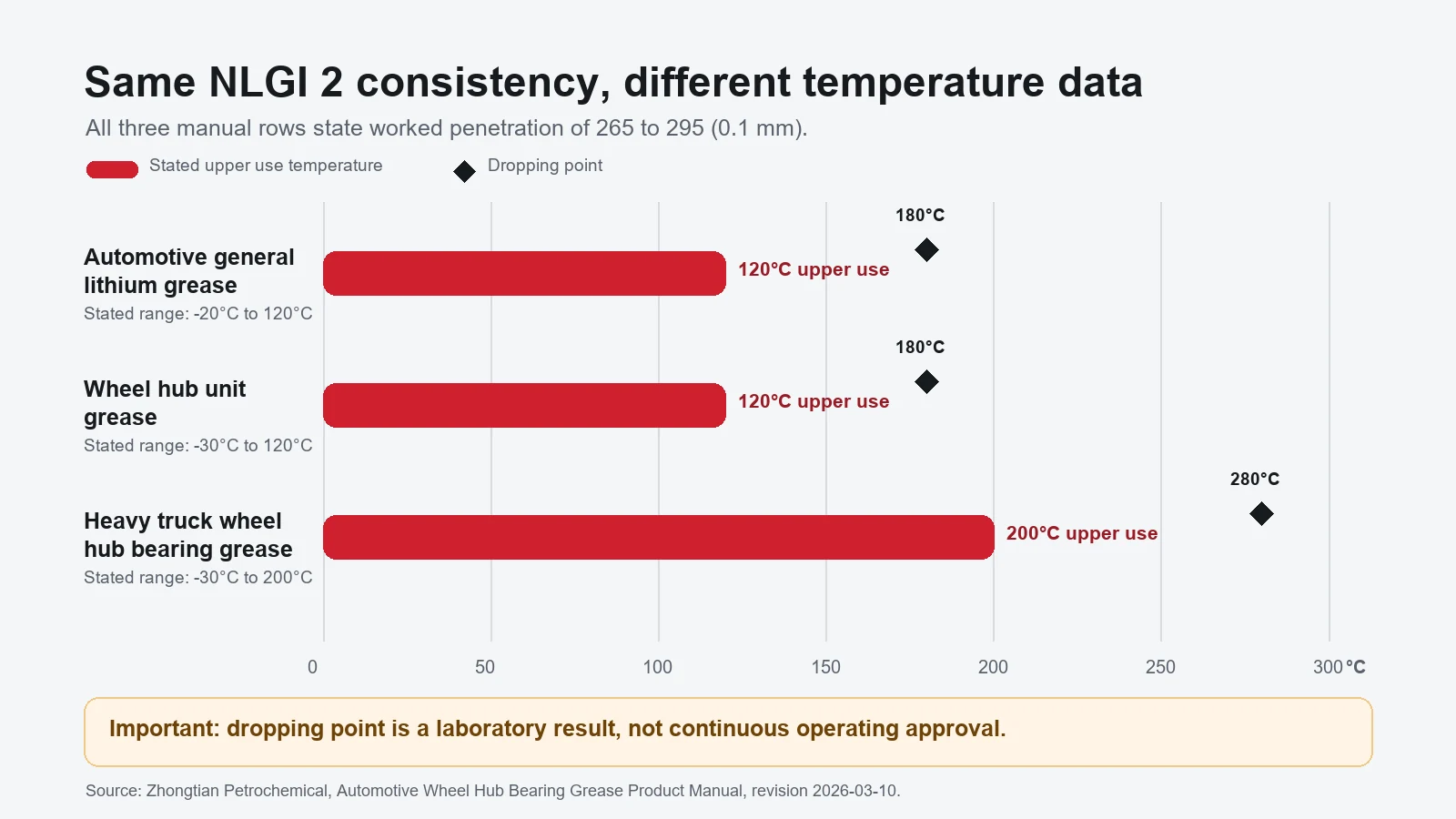
The comparison is direct. NLGI grade measures consistency. It does not define a grease’s operating temperature or base oil viscosity. In Zhongtian Petrochemical’s March 2026 manual, two grade 2 rows share a worked penetration of 265 to 295, yet their stated use ranges extend to 120°C and 200°C respectively. The same split runs through the high-temperature range: HP-2 and HP-X are both NLGI 3, and ultra-high-temperature grease is an NLGI 2 that outruns both on temperature because its thickener is inorganic rather than a metal soap. Read each product’s stated range from its own data sheet rather than from the grade.
Use the full NLGI grease grades guide when the immediate question is grade selection. Use this page when the task is to build the complete industrial grease specification around that grade.
Thickener and base oil answer different questions
The thickener gives grease its structure. The base oil provides the lubricating film. Additives modify selected performance characteristics. All three must be considered, but they do not answer the same purchasing question.
| Question | Primary field to examine | Evidence to request |
|---|---|---|
| Will the lubricant form a suitable film at operating temperature? | Base oil type and viscosity | TDS viscosity values and the OEM viscosity requirement |
| Is the grease soft or firm enough for the delivery method? | NLGI grade and worked penetration | Test method and penetration range |
| How will the structure respond to heat, water and shear? | Thickener plus finished-product test results | Dropping point, water-related tests and mechanical stability tests with conditions |
| Can it replace the grease already in the bearing? | Both finished formulations | Product-specific compatibility evidence and an approved changeover procedure |
| Does it meet a regulated or OEM-controlled requirement? | Exact approval or registration | Current certificate or listing for the exact product |
Do not infer a food-contact registration, OEM approval or other compliance status from a thickener type. Those claims require documentation for the exact finished product.
Test evidence to request before approving a grease
A Technical Data Sheet is useful for product design values and typical properties. A Certificate of Analysis is useful for the reported results of a particular batch. They are not interchangeable, and neither should be evaluated from a number without its test method and units.
Ask the supplier for a comparison sheet with these columns:
| Field | Minimum comparison detail |
|---|---|
| Property | Exact property name, such as worked penetration or oil separation |
| Result type | Typical value, specification limit or batch result |
| Test method | Full standard and method designation |
| Units | Keep MPa, kPa, percent and 0.1 mm distinct |
| Conditions | Temperature, time, pressure, stroke count and other stated conditions |
| Product and batch | Exact product designation and batch or lot number where applicable |
| Document control | Issue date, revision and issuing entity |
This prevents a common purchasing error: treating numbers as comparable when the test duration, temperature or reporting unit is different.
Match a failure symptom to the test evidence
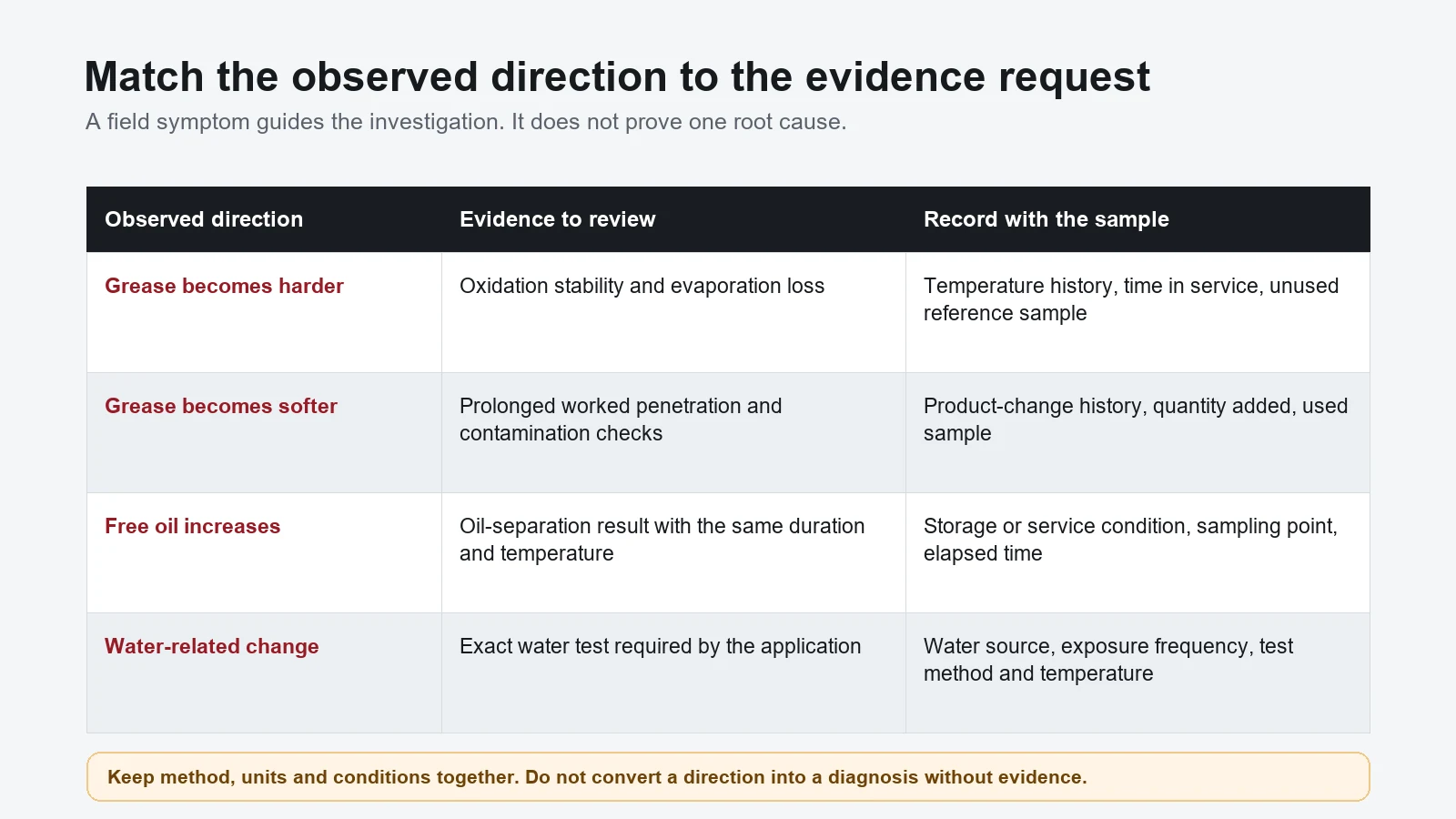
Field symptoms do not identify one cause by themselves. Hardened grease may involve oxidation, evaporation, contamination, excessive temperature or an incompatible mixture. Softened grease may involve shear, contamination or mixing. Oil separation may reflect storage, heat, mechanical working or formulation behavior. The first step is to preserve a sample and record the operating conditions, not to assign a cause from appearance alone.
The following evidence map uses methods and example limits from Zhongtian Petrochemical’s March 10, 2026 wheel hub bearing grease manual. It shows how a test request should be framed. It does not claim that one test alone diagnoses a field failure.
| Observed direction | Evidence to review | Example manual method and condition | Comparison caution |
|---|---|---|---|
| Grease becomes harder | Oxidation stability and evaporation loss | SH/T 0325 at 99°C for 100 h; SH/T 0337 at 99°C for 22 h | Pressure drop and mass loss answer different questions. Keep MPa and kPa distinct. |
| Grease becomes softer | Prolonged worked penetration | GB/T 269 after 100,000 strokes | Some rows report percentage change; others report an absolute 0.1 mm difference. Do not compare them as the same unit. |
| Free oil or bleed increases | Oil separation | SH/T 0324 at 100°C for 30 h in some rows; 100°C for 24 h in another | A percentage from a 24-hour test is not directly comparable with a 30-hour result. |
| Water-related change appears | Water washout or water-related stability test | Request the exact method and temperature stated for the candidate product | “Water resistant” is not a test result. Compare the same method and conditions. |
The company manual does not print the edition year for these method designations. For the oil-separation rows it prints SH/T 0324. China’s public standards record lists NB/SH/T 0324-2010 as the current cone-screen method and shows that it replaced SH/T 0324-1992. A supplier comparison should record the edition the laboratory actually used for every named method.
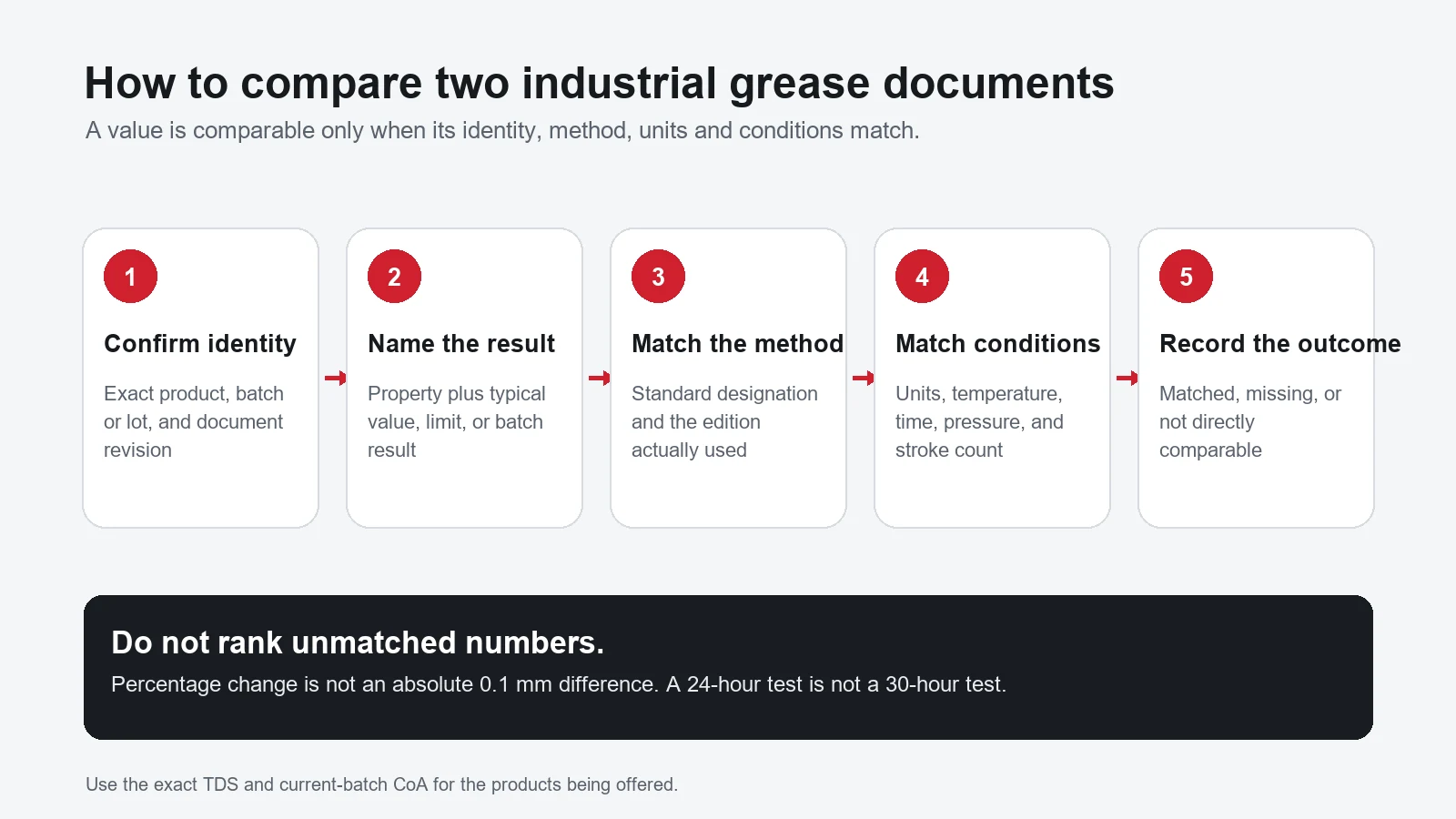
A grease test value is comparable only when the property, method, units and conditions align. In the March 2026 Zhongtian manual, prolonged penetration is reported both as percentage change and as an absolute difference in 0.1 mm, while oil separation examples use both 24-hour and 30-hour conditions. Combining those numbers in one ranking would be misleading.
For a symptom-focused workflow, see why grease hardens or separates. When requesting laboratory work, include an unused reference sample, a used sample from the affected component, equipment identification, service hours and the recorded temperature history.
A procurement-ready grease request template
Copy the following fields into an RFQ or supplier evaluation form. Complete what is known and mark missing fields for follow-up.
| RFQ field | Buyer entry |
|---|---|
| Equipment and lubricated component | |
| OEM manual reference or required grease designation | |
| Current grease and supplier | |
| Minimum start-up temperature | |
| Normal measured operating temperature | |
| Maximum measured temperature and duration | |
| Bearing dimensions and speed, where applicable | |
| Normal load and shock load | |
| Water, steam, dust or chemical exposure | |
| Application method and current fill quantity | |
| Relubrication interval and service history | |
| Required base oil type and viscosity | |
| Required thickener and NLGI grade | |
| Required test methods and limits | |
| TDS revision requested | |
| Current batch CoA requested | |
| Compatibility evidence and changeover plan required |
If the supplier proposes an alternative, require a row-by-row comparison. “Equivalent,” “premium” and “multipurpose” are not substitutes for the missing fields.
How to compare two supplier documents
Use this order:
- Confirm that both documents refer to the exact finished products being offered.
- Separate typical values from specification limits and batch results.
- Align the test method, units, temperature, duration and pressure.
- Compare the fields required by the OEM before optional performance claims.
- Record every missing or non-equivalent field instead of assuming a match.
- Request a written changeover recommendation if the current product will be replaced.
For each critical property, the final comparison should be traceable to a document revision or batch record. Product photography, color and package wording may help identify a container, but they do not establish technical equivalence.
Frequently asked questions
Is NLGI 2 a complete grease specification?
No. NLGI 2 defines a worked penetration range of 265 to 295 at the specified test condition. It does not define base oil viscosity, thickener, dropping point, water resistance, operating temperature or compatibility. Those fields must be added to the specification.
Is NLGI grade the same as oil viscosity?
No. NLGI grade describes grease consistency. Base oil viscosity describes the fluid component and its resistance to flow. The two properties must be selected separately.
Does a higher dropping point mean a higher continuous operating temperature?
Not automatically. Dropping point is one laboratory result. Continuous operating suitability also depends on the base oil, thickener, additives, oxidation behavior, mechanical stability, application and equipment requirement.
Can greases with the same thickener be mixed?
The shared thickener name is not enough to prove compatibility between two finished products. Confirm compatibility for the actual products and obtain an approved changeover procedure before mixing or replacing grease.
Which document should a buyer request, a TDS or a CoA?
Request both when the property is important to approval. The TDS describes the product and its typical or specified properties. The CoA reports results associated with a particular batch. Check the method, units, conditions, revision and batch identity.
Send the application, not just the grease name
For a technical comparison, send the OEM grease requirement or current product name together with the component, speed, load, measured temperature range, contamination exposure and lubrication method. Ask for the matching TDS fields, relevant test methods, a current batch CoA and a written changeover recommendation where applicable.
Contact Zhongtian Petrochemical with that information so the response can address the actual application rather than a generic “industrial grease” label.
This page has been reviewed by the technical department of Zhongtian Petrochemical. Statements regarding the products and testing have been verified against the company’s existing records. Date of last review: 2026-09-10.