





Bottom line: The natural and hybrid pitches at the 2026 World Cup are maintained by hydraulically driven cylinder mowers, aerators and utility vehicles. These machines need high-VI hydraulic oil for hydrostatic circuits and GL-4 gear oil for reel and transmission drives — not generic one-size-fits-all oil.
- High-VI hydraulic oil keeps mower response consistent from cool dawn to hot afternoon
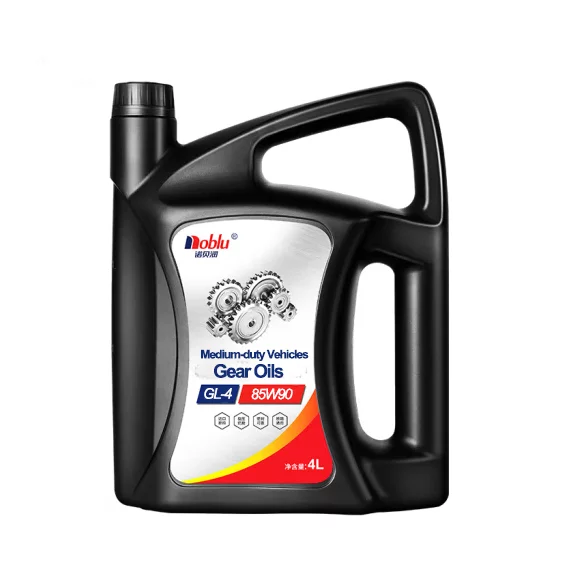
- GL-4 gear oil protects reel drives and moderate-load transmissions
- Low-temperature hydraulic oil covers cold-start venues and early-morning schedules
- Documented TDS, MSDS and batch CoA are what procurement teams should ask for
- OEM guidance always wins over generic grade recommendations
A mower that hesitates or leaks oil onto the turf a few hours before kickoff is not an inconvenience — it is a scheduling and reputation problem on a tournament pitch built for international broadcast.

Why pitch maintenance suddenly matters for lubrication
The 2026 tournament is unusually demanding on grounds teams. Natural or hybrid grass was mandated at all 16 venues — including stadiums that normally run on other surface systems. Several indoor venues ripped out artificial turf, closed roofs for weeks and ran air conditioning nonstop just to grow grass.
At MetLife Stadium, crews installed Tahoma 31 Bermudagrass over roughly two feet of sand — about 20 truckloads of sod, grown for roughly ten months, with full irrigation and vacuum ventilation underneath. FIFA’s senior pitch manager framed it simply: the best players deserve the best grass.
But here is what matters for a lubricant buyer: that surface creates a relentless duty cycle.
- Mowers run early morning when grass is cool and wet
- Utility vehicles operate under afternoon heat
- Aerators and reel drives see repeated load, hour after hour
- Hydraulic systems must respond smoothly without leaking, foaming or slowing as temperature swings
Zhongtian is not a tournament sponsor or official supplier. The connection is technical: the machines that maintain elite grass need the same hydraulic oil and gear oil that grounds-maintenance fleets specify worldwide.
Small machines, unforgiving tolerances
Turf machines look compact next to cranes or chiller plants. Do not mistake size for simplicity.
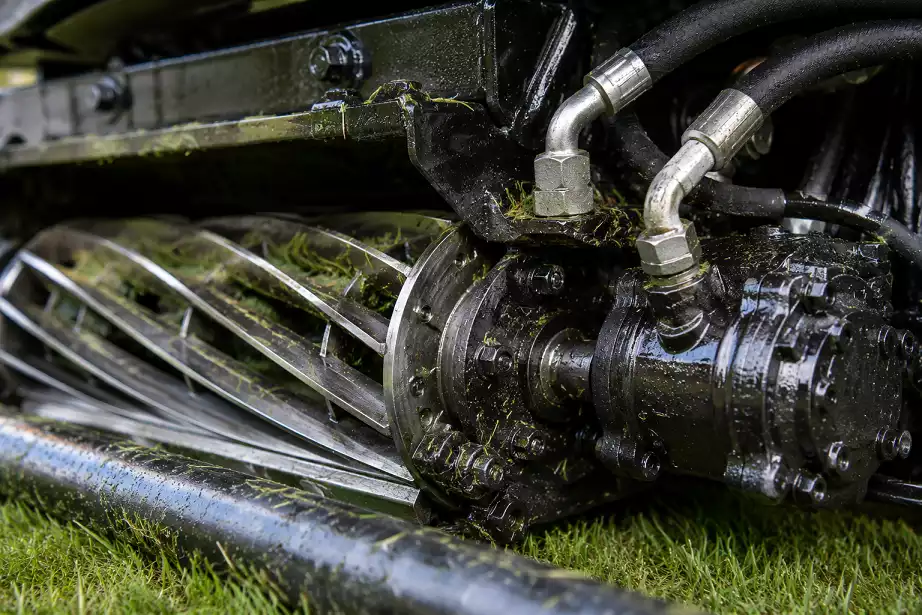
A cylinder mower depends on consistent reel speed and smooth hydrostatic travel. An aerator needs steady hydraulic power without jolting the surface. Utility vehicles must move over a finished pitch without leaving oil spots, ruts or uneven patterns. Every mark is visible. Every hesitation shows in the stripe quality.
Three practical outcomes hang on the oil choice:
- Predictable machine response — the operator should feel the same control at 6 a.m. and 2 p.m.
- Gear and hydraulic component protection — not just anti-wear, but the right protection for each system
- Clean operation around grass that cannot be contaminated — a single drip of the wrong fluid ruins a finished surface
A standard one-grade hydraulic oil is not the strongest choice here. The duty cycle is too wide, and the cost of getting it wrong is too visible.
What hydraulic oil for turf mowers must deliver
A turf mower hydraulic system needs more than basic anti-wear performance. It needs viscosity that stays useful across the whole working day.
Morning mowing starts with cool, relatively thick oil. By afternoon, the same machine runs in higher ambient heat, with thinner oil and a harder-working pump. If viscosity drops too sharply, the operator feels it as sluggish response, uneven travel, reduced control.
Five properties separate the right oil from the wrong one:
| Property | Why it matters for turf equipment |
|---|---|
| High viscosity index | Less viscosity change as temperature swings → consistent hydrostatic response from dawn to afternoon |
| Anti-wear film strength | Pumps, motors and valves see repeated start-stop cycles under load |
| Demulsibility (water separation) | Outdoor equipment ingests water, washdown and condensation daily |
| Filterability and cleanliness | Small hydraulic passages and control valves punish dirty or unstable fluid instantly |
| Seal compatibility | A weeping hose or seal leaves marks on grass that broadcast cameras will show |
For most grounds-maintenance fleets, Zhongtian L-HV high-VI hydraulic oil is the more relevant choice than a basic AW oil. It is built for wide-temperature outdoor hydraulic duty — exactly the profile of turf equipment that runs dawn to dusk. ISO VG 46 is the common starting point for many mower and utility circuits. The equipment manual always decides the final grade.
Where GL-4 gear oil fits in
Not every lubricated part of a mower is hydraulic. Reel drives, gear cases and some transmissions need gear oil, not hydraulic oil.
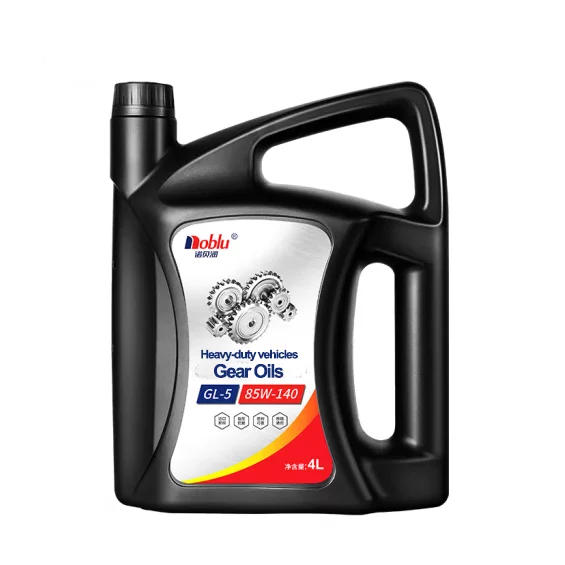
GL-4 is the grade for moderate-load gear systems — especially where yellow-metal compatibility matters. This is not the place to drop in a heavier EP oil just because it sounds tougher. The right question is: what does the gearbox or reel-drive housing specify?
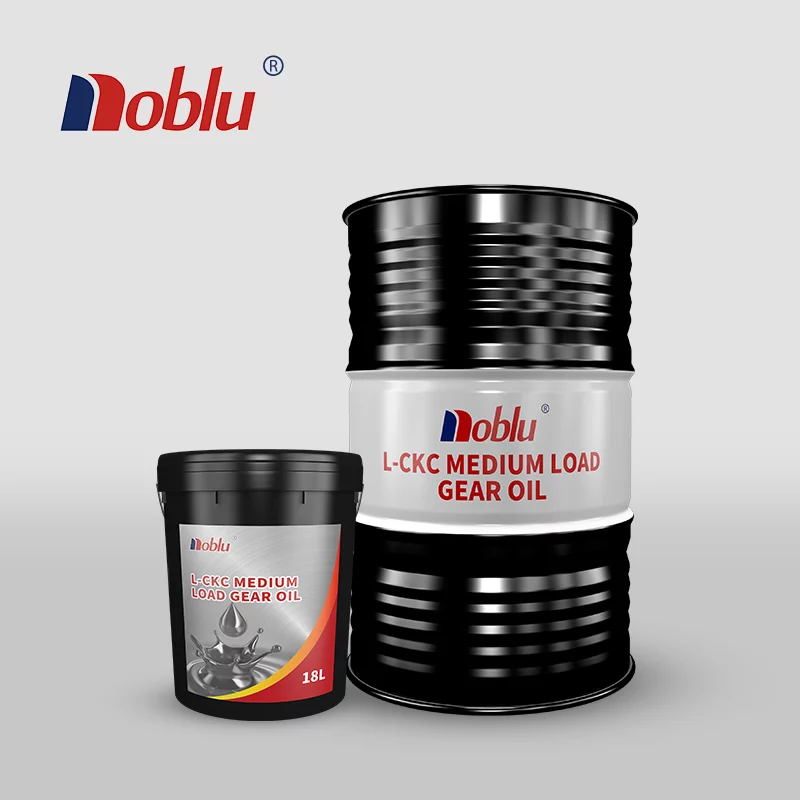
For those drives, Zhongtian L-CKC medium-load gear oil covers GL-4 duty. Match the grade to the manual, not to intuition.
Product selection at a glance
| Pitch-maintenance system | Lubricant | Zhongtian product |
|---|---|---|
| Hydrostatic mower / utility circuits | High-VI hydraulic oil, commonly VG 46 | L-HV high-VI hydraulic oil |
| Reel drives, gear cases, transmissions | GL-4 / medium-load gear oil | L-CKC medium-load gear oil |
| Cold starts or low-temp venues | Low-temperature hydraulic oil | L-HS extreme-low-temp hydraulic oil |
| Full hydraulic range comparison | Category-level selection | Hydraulic oil product range |
A 6-step buyer checklist for turf-fleet lubricants
Do not start with the tournament story. Start with the equipment manual, the ambient temperature range, and the maintenance risk you are trying to prevent.
- Confirm the OEM viscosity grade first. VG 46 is common in mobile hydraulics, but the manual wins every time.
- Choose high-VI oil for wide temperature swings. Grounds equipment runs from cool dawn to hot afternoon — standard oil thins too much across that range.
- Demand the TDS and batch CoA. Verify viscosity, viscosity index, flash point, pour point and water-separation performance before accepting a shipment.
- Keep hydraulic circuits and gear cases separate. Hydraulic oil and GL-4 gear oil solve fundamentally different problems. Do not cross-fill.
- Plan for leak control from day one. Seal compatibility and hose condition matter because oil on turf is visible to everyone.
- Use oil analysis, not a calendar. Tournament-style duty compresses operating hours. Sample-based intervals are safer than guessing.
Why trust Zhongtian for this specification
Anhui Zhongtian Petrochemical has manufactured lubricants since 1998, with product families covering hydraulic oil, gear oil, engine oil, compressor oil and grease — 2,000+ product types from a 200,000-ton/year capacity plant.
For export buyers, the credibility signals that matter are practical, not promotional:
- Documented product data — TDS, MSDS, batch certificates of analysis
- Grade matching to real machines — not forcing every application into one product
- Export documentation — Zhongtian ships to 100+ countries with full paperwork
For turf-maintenance procurement, start at L-HV high-VI hydraulic oil and L-CKC / GL-4 gear oil. Browse the full hydraulic oil category for grade comparison. For cold-climate fleets, cross-check L-HS extreme-low-temperature hydraulic oil before locking the grade.
Compliance note
This article uses the 2026 World Cup as a descriptive news context for pitch-maintenance machinery. It does not claim that Zhongtian is affiliated with, endorsed by, or a supplier to FIFA, the tournament, any team or any stadium. All venue, turf and logistics references should be rechecked against original named sources before publication.
FAQ
What oil do stadium turf mowers use?
Hydrostatic turf mowers typically use hydraulic oil around ISO VG 46, per OEM specification. For professional fleets working across cool mornings and hot afternoons, a high-viscosity-index (HVI) hydraulic oil is preferred — it keeps machine response consistent where a standard oil would thin out.
Why does viscosity index matter for grounds equipment?
A high-VI oil changes viscosity less as temperature changes. A mower that starts at 6 a.m. in cool, wet conditions and runs into a hot afternoon needs the same hydraulic response across that entire span. Standard oil thins more sharply; high-VI oil holds its grade.
Is GL-4 gear oil the same as hydraulic oil?
No. Hydraulic oil transmits power and protects pumps, motors and valves. GL-4 gear oil protects moderate-load gears, reel drives and transmissions. A pitch fleet needs both — but they belong in different systems. Do not cross-fill.
Can Zhongtian help select the right grade?
Yes. Send the equipment model, OEM lubricant requirement, operating temperature range and maintenance interval target through the Zhongtian contact page. The safest recommendation is based on your machine manual and duty cycle, not on a generic label.
Next step: Compare L-HV high-VI hydraulic oil against your OEM viscosity requirement. Then request TDS, MSDS and batch documentation from Zhongtian. For gear cases, evaluate L-CKC GL-4 gear oil against your drive specifications.