




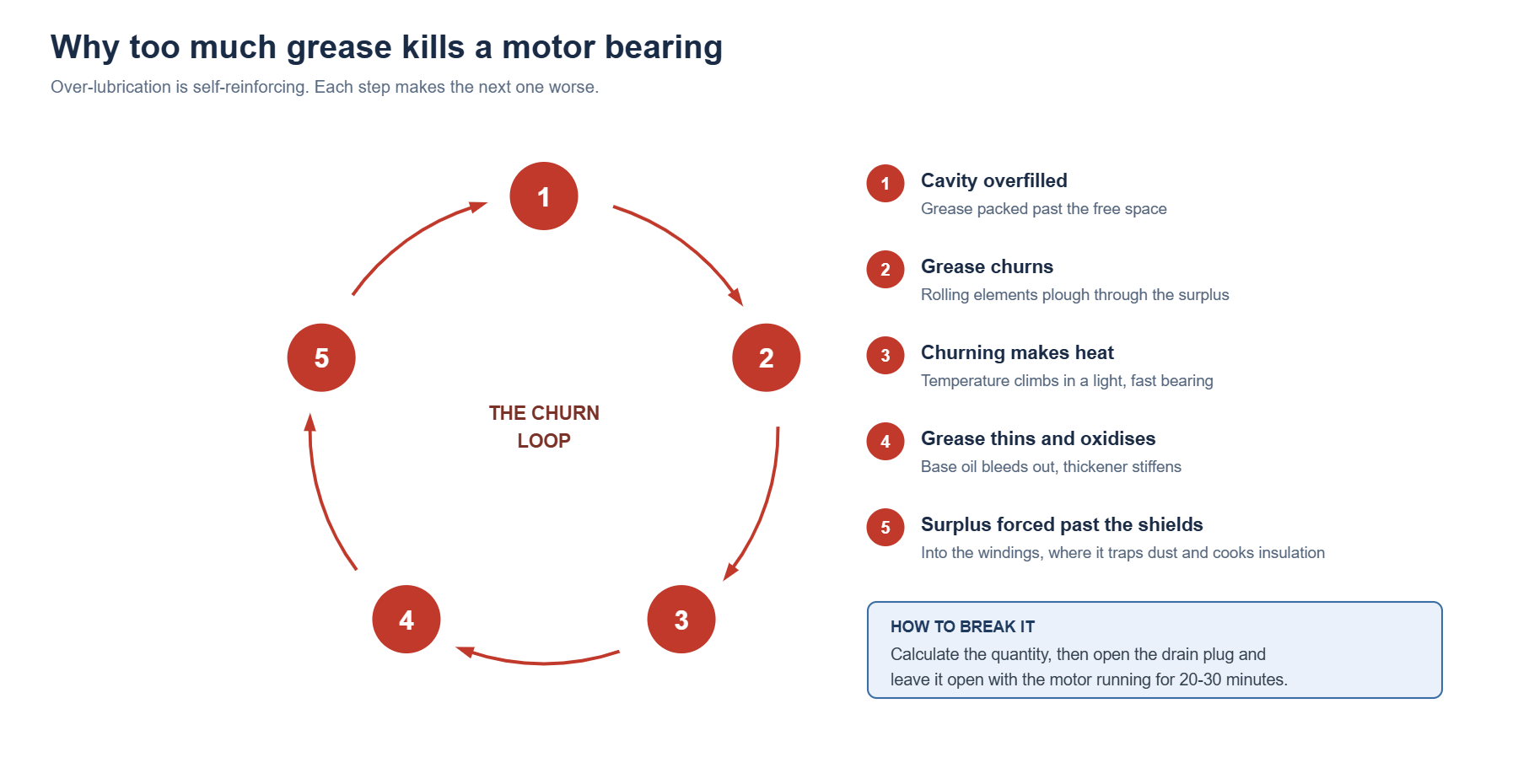
The most dangerous person near an electric motor is the one with a grease gun and good intentions. Motor bearings are the rare application where too much grease kills faster than too little: excess grease churns in the light, fast, low-friction space of a motor bearing; churning makes heat; heat thins and oxidizes the grease; and the surplus gets driven past the shields into the windings, where it collects dust and cooks insulation. The mechanism runs in one direction and it is why this guide leads with quantity before chemistry: the damage starts with volume, and no choice of grease undoes it.
How much: the formula
G (ounces) = 0.114 × D × B, where D is bearing outside diameter in inches and B is width in inches. In metric, G (grams) ≈ 0.005 × D × B in millimeters.
A 6309 bearing (OD 100 mm, width 25 mm): 0.005 × 100 × 25 = 12.5 grams, about four strokes of a typical gun rather than four minutes of pumping. Calibrate your gun once with a kitchen scale and a paper cup (output varies 0.5–3 g per stroke between guns); after that, count strokes.
How often: the interval logic
Relubrication interval shortens with speed, size and temperature. The figures below are planning heuristics in common maintenance use, not values from a published standard. Treat them as a starting point and let the motor nameplate or the bearing maker’s own table override them:
| Motor / speed | Typical interval |
|---|---|
| Small, 1800 rpm, clean & cool | Years, often lubed-for-life |
| Medium (15–75 kW), 1800 rpm | ~12 months |
| Medium, 3600 rpm | ~6 months |
| Large / hot / dirty | 1–3 months |
Two adjustments beat any table: halve the interval for every ~15°C above 70°C housing temperature, and follow the nameplate when it disagrees with generic guidance.
The procedure that prevents the pressure problem
- Run the motor to operating temperature.
- Remove the drain plug at the bottom of the housing. This is the step that separates professionals from bearing-killers. Grease needs an exit, or it exits through the shields.
- Wipe the fitting; add the calculated amount slowly.
- Leave the drain open, motor running, 20–30 minutes so excess purges.
- Replug; log date and quantity.
Why polyurea became the motor default
Motor bearings are lightly loaded, fast, warm, and expected to run for years with nobody opening them. That profile is unusual, and it is why the factory fill in most sealed motor bearings is polyurea rather than a lithium soap. The thickener chemistry behind that, and the cases where lithium is still the better buy, are covered in ポリウレアグリース. What matters here is narrower: whichever grease is in the bearing, the quantity rules above decide whether it survives. The full head-to-head with lithium is in polyurea vs lithium grease, and the product line for maintenance and OEM fills is polyurea grease (wholesale).
The compatibility caveat: polyurea and lithium mix badly in many pairings. Converting a motor from lithium to polyurea means purging through the drain over several shortened intervals, rather than assuming the new grease will displace the old.
The dielectric-grease confusion, settled
“Electric motor grease” searches attract two unrelated needs. Bearing grease lubricates rotating steel. Dielectric grease insulates electrical connections. It is a silicone barrier compound with negligible load capacity; pack a bearing with it and it fails early. Conversely, polyurea bearing grease on a connector does nothing useful. The full disambiguation is in can dielectric grease double as a lubricant?. For the genuine electrical-contact job, Zhongtian’s 電気接点グリース is a purpose-built product (volume resistance 120 Ω·cm, −35 to 120°C), not a bearing grease pressed into the wrong role.
Bearing-quantity and interval fundamentals for other machinery are in ベアリング潤滑ガイド.
よくある質問
What grease should I use for electric motor bearings? A polyurea grease of the OEM-specified NLGI grade (usually 2, sometimes 3 for vertical motors) unless the nameplate says otherwise.
How much grease does a motor bearing need? G (oz) = 0.114 × D × B by bearing dimensions in inches, which is typically a few grams and a handful of gun strokes rather than a filled cavity.
Can I mix polyurea with lithium grease? Treat as incompatible: purge through the drain port over several shortened intervals when converting.
Is dielectric grease OK for motor bearings? No. It is an electrical insulator compound, not a bearing lubricant.
Sources and limits
- Grease quantity formula G = 0.114 × D × B is the long-standing bearing-dimension rule used across motor maintenance practice; confirm against the bearing manufacturer’s figure where one is published for your part number.
- Relubrication intervals in the table are planning heuristics, not standard values. No figure in this article is asserted as a published interval for any specific motor.
- Polyurea grade, operating range and dropping point: Zhongtian Petrochemical technical data sheet, current production. Electrical contact grease volume resistance: Zhongtian product data.
The one number worth writing on the motor before you next touch it is the calculated gram figure for that bearing, next to the date it was last done. A machine with that written on it does not get over-greased by the next person, which is the whole failure this page is about. If you want the calculation checked against your bearing schedule, send the bearing designations and the duty cycle.