




Slideway oil, also called way oil, is the lubricant for the sliding guideways and tables of machine tools. It differs from an ordinary hydraulic or gear oil in three respects: friction modifiers that stop the stick-slip judder of slow-moving slides, tackiness that keeps the film on the slideways, and the ability to separate from water-based coolant. Horizontal slideways on small and medium machines usually take ISO VG 68 (some use 32), and vertical or inclined slideways a heavier oil such as ISO VG 220. A hydraulic oil can stand in only where it is a combined hydraulic and slideway oil of the HG type in the same viscosity grade.
What is slideway oil?
Slideway oil is a lubricant classified for machine-tool slideways, the flat or V-shaped surfaces that carry tables, saddles and heads. ISO 6743-13 sets out the classification of family G, “lubricants for slideways”, in three categories (ISO 6743-13:2002 sample):
| ISO category | Sliding surfaces | What the oil adds |
|---|---|---|
| L-GA | Both surfaces metal | Anti-wear, corrosion protection, tackiness and anti-stick-slip properties |
| L-GB | One surface non-metallic (for example a polymer or resin slide lining) | GA properties plus separation from aqueous cutting fluids |
| L-GS | Synthetic slideway lubricant | Designed to emulsify or dissolve in the coolant, so contamination has minimal impact on coolant performance |
A fourth designation sits in the hydraulic standard. ISO 6743-4 defines HG oils as “oils of HM type with anti-stick/slip properties”, intended for machines with combined hydraulic and slideway lubrication systems where stick-slip at low speed must be minimised (ISO 6743-4:1999 sample). That is what an L-HG slideway oil is. In China, slideway oils are covered by the industry standard SH/T 0361-1998.
What causes stick-slip, and how does slideway oil prevent it?
Stick-slip is the jerky stop-start motion of a slide that alternates between static and dynamic friction. ExxonMobil’s technical note on stick-slip explains that it can occur when static friction exceeds dynamic friction and there is some elasticity in the system, and that slideways are far more susceptible than other parts because they spend much of their time stopping, reversing and creeping in mixed lubrication (ExxonMobil, Stick-slip). The result is jerky slide movement, inaccurate machining and rejected parts.
Two additives do different jobs here. Friction modifiers prevent stick-slip: ExxonMobil writes that slideway lubricants contain friction modifiers “to reduce static friction and thus prevent stick-slip”. Tackiness is what keeps the oil on the slideways: Chevron says the tacky quality of its slideway lubricants suits them to once-through applications (Chevron Way Lubricant), and Mobil recommends its heavier grades for vertical and inclined slideways where drain-down can be a problem.
The machine-tool industry tests this. According to the same ExxonMobil note, the Cincinnati Lamb friction test measures the ratio of static to dynamic friction, and Cincinnati Machine sets the upper limit of that ratio at 0.8. Slideway oils are approved against Cincinnati specifications by viscosity: P-53 for ISO VG 32, P-47 for ISO VG 68 and P-50 for ISO VG 220, as listed by Chevron, Shell and Mobil.
Slideway oil vs hydraulic oil: can you use one for the other?
Slideway oil and hydraulic oil can be swapped only in one direction and only with the right oil. The ISO 6743-13 note on category GA says GA oils “may be substituted by HG type oils of the same viscosity grade” as long as the anti-stick-slip requirements are met, so an HG combined hydraulic and slideway oil can serve the slideways. An ordinary HM hydraulic oil has no anti-stick-slip requirement and is not a slideway oil. Going the other way, ISO 6743-4 warns that multifunctional HG fluids “do not function successfully under all hydraulic applications”. Mobil rates its ISO VG 32 and 68 slideway oils as suitable as a moderate-duty hydraulic fluid, not a general one (Mobil Vactra data sheet).
Many machines keep the two apart. The lubrication table in an Okuma VTM-200 manual lists G68 and G220 slideway oils for the centralized slideway units and an ISO VG 32 hydraulic oil for the hydraulic unit, and warns that mixing in other oils can cause turbid oil and lubrication failure (Okuma VTM-200 manual).
Machinists run into the tank confusion often. In one r/Machinists thread, an operator who had poured about 300 ml of guide oil into what they thought was a CNC lathe’s hydraulic tank learned from the replies that it was the slideway lube tank and the oil was right; the hydraulics had their own tank (thread). In another, a field service technician described the plastic lining on box slideways torn off after the slideway oil was contaminated, and a reply said ISO VG 68 hydraulic oil can get a manual machine by but should not go into a CNC metered lube system (thread). A third commenter described repairing several machines whose oil lines had been blocked by car engine oil used in place of slideway oil (thread).
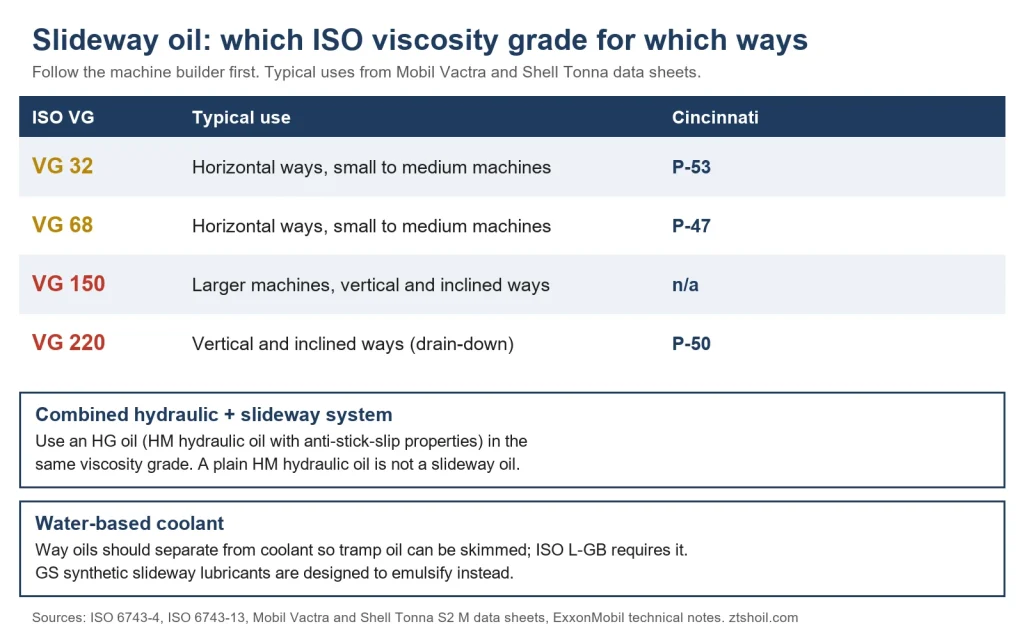
Which slideway oil viscosity: ISO VG 32, 68, 150 or 220?
Slideway oil viscosity follows the orientation and size of the slideways, and the machine builder’s specification comes first. The grades are ISO viscosity grades, the classification used across industrial lubricants (ISO 3448).
| ISO VG | Typical use | Cincinnati approval | Example products |
|---|---|---|---|
| 32 | Horizontal slideways on small to medium machines; some combined hydraulic and slideway systems | P-53 | Mobil Vactra No. 1, Shell Tonna S2 M 32 |
| 68 | Horizontal slideways on small to medium machines | P-47 | Mobil Vactra No. 2, Shell Tonna S2 M 68 |
| 150 | Larger machines; vertical and inclined slideways | n/a | Mobil Vactra No. 3 |
| 220 | Vertical and inclined slideways where drain-down is a problem | P-50 | Mobil Vactra No. 4, Shell Tonna S2 M 220 |
Sources: Mobil recommends Vactra No. 1 and No. 2 “for horizontal slideways on small to medium size machine tools” and No. 3 and No. 4 for vertical and inclined slideways (Mobil); Shell states that Tonna S2 M 32 and 68 are for horizontal slides and S2 M 220 for vertical slides (Shell Tonna S2 M brochure).
Machine manuals follow the same pattern. The Okuma VTM-200 manual above calls for G68 and G220 slideway oils on different units, and a Sharp V-1 knee mill manual specifies ISO VG 68 for the slideways and ballscrews, naming Mobil Vactra No. 2 and Shell Tonna S2 M 68 among suitable oils (Sharp V-1 manual).
Why must slideway oil separate from coolant?
Slideway oil must separate from water-based coolant because it always ends up in the coolant. ExxonMobil’s note on slideway oil and coolant separability explains that slideway lubrication is typically a total-loss, open system, so the oil runs off into the coolant as tramp oil (ExxonMobil, Way Oil & Coolant Separability). There it can reduce the coolant’s lubricity, raise the risk of bacterial growth and odours, lower its pH, and cause foaming. Coolant that gets into the slideway oil works the other way, increasing stick-slip and reducing machining precision.
A slideway oil that separates cleanly floats off and can be skimmed. The same note describes the Toyoda test, in which 90 ml of 5 percent coolant is shaken with 10 ml of slideway oil and left for 16 hours; a result of 90/0/10 means complete separation, while 98/2/0 means a stable emulsion formed. Shell makes the same point for Tonna S2 M: better separation lets the oil be removed easily and limits bacteria and fungi in the coolant. The exception is the ISO L-GS category, which is designed to emulsify or dissolve in the coolant instead.
Checks before blaming the machine
If a slide chatters at low feed, positions inconsistently or squeals, check the lubricant before the drives:
- The right oil in the right tank. Slideway lube and hydraulic tanks are separate on many machines; read the label or the manual.
- The grade. A thin oil on vertical slideways drains off; compare it with the machine builder’s specification.
- The supply. An empty reservoir or a blocked metering line starves the slideways.
- The coolant. Heavy tramp oil in the coolant, or milky oil on the slideways, is a separation problem; see the section above.
Zhongtian L-HG slideway oil
Zhongtian Petrochemical makes L-HG slideway oil for machines with combined hydraulic and slideway systems. The product page lists anti-stick-slip properties to prevent crawling, anti-wear and rust protection, and compatibility with seal materials. The values below are typical figures printed on that page, not batch results.
| ISO VG | 32 | 46 | 68 | 100 |
|---|---|---|---|---|
| Kinematic viscosity at 40 °C, mm²/s | 31.33 | 45.67 | 66.41 | 98.79 |
| Viscosity index | 95 | 98 | 96 | 99 |
| Flash point (open), °C | 205 | 224 | 230 | 236 |
| Pour point, °C | −27 | −24 | −21 | −21 |
The range covers ISO VG 32 to 100. If your machine calls for VG 150 or 220 on vertical slideways, send us the specification and we will tell you what we can supply. Our minimum order is 20 packaging units, and technical data sheets and certificates of analysis are issued by grade and batch. For the hydraulic side of a combined system, see L-HM vs L-HV hydraulic oil.
Looking for high-temperature grease?
This page used to cover high-temperature grease as well. Grease for kilns, furnaces, dryers and other hot bearings now has its own guide: see high-temperature grease, or match a grease to your temperature and load with the grease selector.
Frequently asked questions
What is the difference between slideway oil and hydraulic oil? Slideway oil has friction modifiers that prevent stick-slip, tackiness that keeps it on the slideways, and separation from coolant. A plain HM hydraulic oil has none of these requirements. An HG oil is a hydraulic oil with anti-stick-slip properties made for combined hydraulic and slideway systems.
Can I use hydraulic oil instead of slideway oil? Only an HG combined hydraulic and slideway oil in the same viscosity grade, according to the ISO slideway classification. An ordinary hydraulic oil lacks the anti-stick-slip properties a slideway needs.
What viscosity slideway oil do I need? Follow the machine builder. Horizontal slideways on small and medium machines usually take ISO VG 68 or 32, and vertical or inclined slideways a heavier grade such as ISO VG 220.
Why does my machine chatter only during slow moves? Slow moves keep the slides in mixed lubrication, where stick-slip starts if static friction exceeds dynamic friction. A slideway oil with the right friction modifiers, in the right grade, is the first thing to check.
Tell us the machine, the slideway orientation and the coolant you run, and we will match a slideway oil grade. Contact Zhongtian Petrochemical.