





Lithium vs silicone grease comes down to what the grease touches. Lithium grease is a mineral-oil grease for loaded metal-on-metal parts such as bearings, hinges and chassis points. Silicone grease is for rubber seals, O-rings, plastics and electrical connectors, and it is weak under heavy load between steel parts. PTFE grease means one of two things: a synthetic grease with PTFE powder added, used on bearings, slides and O-rings, or a perfluoropolyether (PFPE) grease thickened with PTFE, which is chemically inert and used where chemicals, oxygen or extreme life rule out ordinary grease. Never mix them without cleaning out the old grease first.
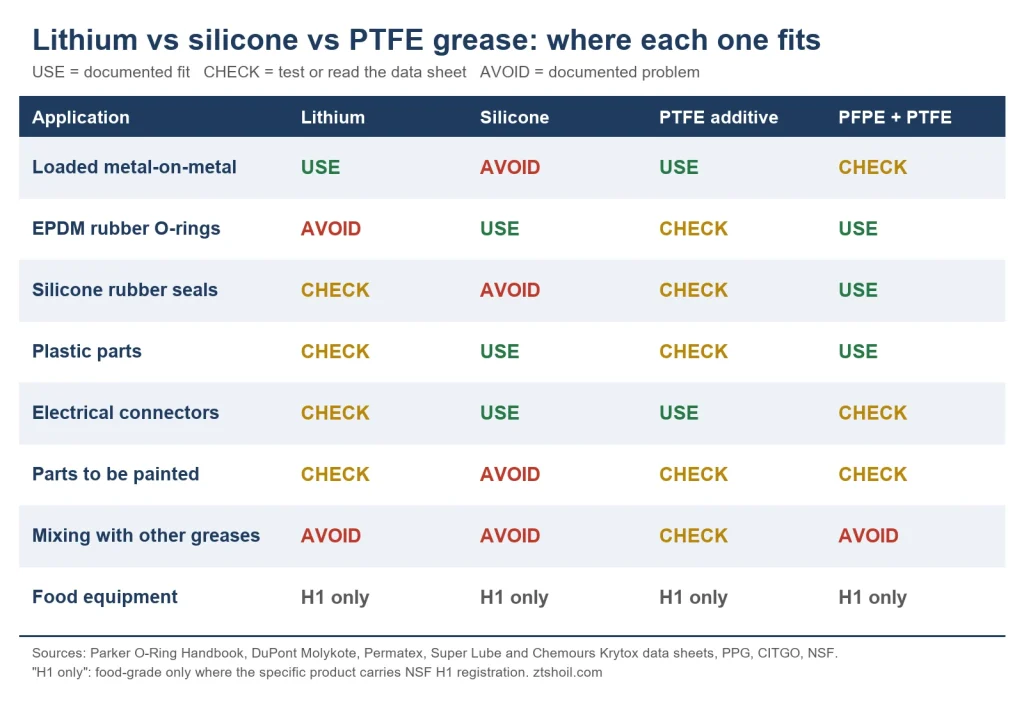
Lithium vs silicone vs PTFE grease at a glance
Lithium, silicone and PTFE greases differ in their base oil, which decides what materials they are safe on, and in their thickener, which decides how they behave under load and heat. The temperature ranges below are those of the named example products, not of every grease in the family.
| Lithium grease | Silicone grease | PTFE grease (PTFE additive) | PFPE grease with PTFE thickener | |
|---|---|---|---|---|
| Base oil and thickener | Usually mineral oil with lithium 12-hydroxystearate soap | Silicone oil, often thickened with silica | Synthetic base fluid with PTFE powder | Perfluoropolyether oil thickened with PTFE |
| Example and its range | WD-40 white lithium: −30 to 150 °C | Molykote 111: −40 to 200 °C | Super Lube Multi-Purpose: −43 to 232 °C | Krytox GPL 205: −36 to 204 °C |
| Best on | Loaded metal-on-metal parts | Rubber seals, O-rings, plastics, electrical connectors | Bearings, slides, O-rings | Chemical and oxygen service, plastics and elastomers |
| Avoid | EPDM seals | Heavily loaded steel-on-steel; silicone rubber; anything to be painted | Assuming it is a PFPE grease: check the base fluid | Mixing with any other grease |
| Food-grade (NSF H1) | Only specific registered products | Some products, for example Super Lube silicone grease | Some products, for example Super Lube Multi-Purpose | Some products, for example Krytox GPL 205 |
Sources: WD-40 Australia, DuPont Molykote 111, Super Lube data sheet (2024), Chempoint for Chemours Krytox GPL 205.
What is lithium grease best for?
Lithium grease is best for loaded metal-on-metal lubrication at moderate temperatures. Machinery Lubrication notes that “the vast majority of lithium-based greases are formulated with 12-hydroxystearate soap”, that their dropping point is around 350 to 400 °F, and that their maximum usable temperature is around 250 °F (about 120 °C) (Machinery Lubrication). WD-40 Australia describes its formula as designed for metal-on-metal lubrication (WD-40 Australia). Lithium soap remains a large share of the market: STLE reports that it accounted for 38 percent of grease sales by weight in 2023, down from 50 percent in 2020 (STLE).
White lithium grease is lithium grease made white. CRC says white lithium grease has zinc oxide added, is designed for moderate loads and is not recommended for wheel bearings (CRC Industries Australia), while WD-40 Australia says the main difference from ordinary lithium grease is appearance. Some brands add zinc oxide; check the data sheet of the product you have.
Two limits matter in practice. Most lithium greases are mineral-oil based, and the Parker O-Ring Handbook lists EPDM rubber as not compatible with mineral oil products, including greases (Parker O-Ring Handbook). And Machinery Lubrication notes that lithium 12-hydroxystearate “is less compatible with other greases” than calcium 12-hydroxystearate, which matters when you switch products.
What is silicone grease best for?
Silicone grease is best for rubber, plastic and electrical parts that need lubrication, sealing or insulation rather than load-carrying. DuPont lists Molykote 111 as a silicone grease with a silica thickener, rated −40 to 200 °C, suitable for rubber and plastic O-rings, gaskets and seals, and compatible with many plastics and elastomers (DuPont). Permatex describes its dielectric tune-up grease as “a silicone dielectric compound”, an excellent lubricant on rubber, plastic and ceramic surfaces, rated −54 to 204 °C, and not for pure oxygen systems (Permatex data sheet). In other words, most “dielectric grease” sold for spark plug boots and connectors is a silicone grease.
Silicone grease is the wrong choice for heavily loaded steel parts. A Shin-Etsu Chemical patent describes silicone greases as generally poor at boundary lubrication between steel surfaces, which greatly limits their use in heavy-duty machines (US4842753A). DuPont positions its silicone greases the same way: Molykote 33 for light-load applications (DuPont) and Molykote G-5021 for low to medium loads on plastic combinations (DuPont).
Two more cautions. Silicone grease can swell silicone rubber: the Parker O-Ring Handbook says silicone rubber “tends to absorb silicone fluids, resulting in swelling and softening”, and it accepts the pairing only with very high-viscosity silicone fluids at moderate temperature. And silicone contamination spoils paint: PPG lists spraying over surfaces that contain silicone as a cause of fisheyes in a paint finish (PPG Refinish). Keep silicone grease away from parts that will be painted.
What is PTFE (Teflon) grease?
PTFE grease is any grease that relies on polytetrafluoroethylene, and it comes in two very different kinds. “Teflon” is a Chemours brand for its fluoropolymer resins, and Chemours states that products without a trademark licence may not use the name (Chemours). So “Teflon grease” in a search usually means PTFE grease, not a Chemours product.
The common kind is a synthetic grease with PTFE powder added. Super Lube Multi-Purpose Synthetic Grease combines synthetic base fluids with Syncolon (PTFE) micro powders; its 2024 data sheet gives NLGI grades 000 to 2, a range of −43 to 232 °C, a dropping point above 287 °C, NSF H1 registration and dielectric properties, lists O-rings and plain and rolling bearings among its uses, and states that it contains no silicone and is safe in paint spraying and finishing operations (Super Lube data sheet).
The premium kind is a perfluoropolyether (PFPE) oil thickened with PTFE. Chemours’ Krytox GPL 205 is described as an H1 food-certified, NLGI 2, PFPE-based grease with a PTFE thickener for −36 to 204 °C. Chemours says Krytox greases are chemically inert, nonflammable, safe in oxygen service, silicone free, and “do not damage plastics or elastomers” (Chemours Krytox data sheet).
A PTFE grease is not a dry PTFE spray. On r/motorcycle, a rider recommended a PTFE spray for a sticky throttle cable because, in their experience, grease in a cable traps dust (thread). And on r/GasBlowBack, an owner who resealed a gas magazine with PTFE grease found it leaking again weeks later with a white crust; replies explained that the venting gas dries the grease and leaves PTFE powder behind (thread).
Which grease for rubber seals and O-rings?
For rubber seals and O-rings, the grease has to suit the rubber. The Parker O-Ring Handbook lists silicone oil and grease among the fluids EPDM resists, and mineral oil products among those it does not, so silicone grease suits EPDM and a mineral-oil lithium grease does not (Parker O-Ring Handbook). The same handbook says all seal polymers except silicone rubber can be used with silicone oils and greases. The distributor Silmid sums up the trade-off: use silicone grease where you need a rubber- and plastic-friendly option and PTFE where chemical inertness is the priority (Silmid).
| Seal material | Silicone grease | Mineral-oil lithium grease | PFPE / PTFE grease |
|---|---|---|---|
| EPDM | Compatible (Parker) | Not compatible (Parker) | Compatible (Chemours: no damage to elastomers) |
| Silicone rubber | Avoid, except very high-viscosity silicone at moderate temperature (Parker) | Check the seal maker’s chart | Compatible (Chemours) |
| Other common seal rubbers | Compatible (Parker) | Check the seal maker’s chart | Compatible (Chemours) |
A flashlight hobbyist on r/flashlight reported using a silicone grease, OKS 1110, on rubber O-rings across more than 150 lights with one broken O-ring, and warned that it could be bad for some silicone rubbers (thread).
Which grease for plastic parts?
For plastic parts, silicone and PFPE greases are the safer starting points, and a test on the actual part is still needed. A Nye Lubricants executive writing in Machine Design put the rule as “fluoroethers and silicones are compatible with most plastics”, warned that ester oils need extreme caution with polycarbonate, polystyrene and several other plastics, and added that “the only way to ensure compatibility is through rigorous testing” (Machine Design). A Braycote PFPE report lists ABS, polycarbonate, acetal, nylon 66, polypropylene and PVC among plastics unchanged after 1,000 hours in contact with PFPE at 70 °C (Braycote report).
Spray products add a second risk. On r/3Dprinting, an owner reported that a white lithium grease spray made a PETG printed part delaminate while a PLA part was unaffected; the top replies pointed at the spray’s solvent rather than the grease (thread). Replies in an r/consolerepair thread give the same working rule: silicone on plastic gears, lithium on metal rails (thread).
Can you mix lithium, silicone and PTFE greases?
Do not mix them; clean out the old grease first. A CITGO article on grease compatibility says mineral oils, PAOs and esters are generally compatible with each other but “silicone oils are not compatible with mineral based oils”, that incompatible mixtures can soften and run out of a wheel bearing, and that ASTM D6185 is the test for a grease pair (Farm Progress, CITGO). Chemours says PFPE lubricants “should not be mixed with other common types of lubricants” and that parts must be completely cleaned of other greases before Krytox is applied. Our guide to removing old grease from bearings gives the purge and cleaning steps; for lithium against polyurea, see polyurea vs lithium grease.
Which of them are food-grade?
None of the three families is food-grade as a class; only individual products registered by NSF as H1 are. NSF’s registration letters define H1 as “acceptable as a lubricant with incidental food contact” in and around food processing areas, and say the registration is current when the NSF mark and category code appear on the label and the product is listed in the NSF White Book (NSF). Each family has H1 examples: Super Lube silicone grease (registration 141974) and Super Lube Multi-Purpose with PTFE (096790) on their data sheets, and Krytox GPL 205. Check the registration number of the product in hand, not the grease type.
Zhongtian lithium and PFPE greases
Zhongtian Petrochemical makes lithium greases and a perfluoropolyether grease. Values below are typical figures printed on the product pages, not batch results; ask for the technical data sheet before you specify one.
| Product | What the product page states | Use |
|---|---|---|
| Multi-purpose lithium grease | Mineral oil with fatty acid metal soap; NLGI 1, 2, 3; dropping point 170, 175, 180 °C; water washout 2.1, 1.8, 1.4% (38 °C, 1 h) | Loaded metal-on-metal parts |
| Perfluoropolyether grease | Perfluoropolyether base oil with inorganic thickener and solid lubricants; insoluble in most solvents; non-reactive in concentrated oxygen and chlorine; dropping point 227 °C | Chemical and oxygen exposure, high-temperature points |
Our minimum order is 20 packaging units, and technical data sheets and certificates of analysis are issued by grade and batch. For the full range of grease thickeners, see our guide to types of grease.
Frequently asked questions
Is PTFE grease the same as Teflon grease? In practice yes: both names mean a grease containing PTFE. Teflon is Chemours’ brand for its fluoropolymers, and products without a licence may not use it.
Can I use silicone grease instead of lithium grease? Not on heavily loaded metal parts such as bearings and chassis points; silicone grease is weak in steel-on-steel boundary lubrication. Use it on rubber, plastic and electrical parts.
Can I use white lithium grease on O-rings? Avoid it on EPDM, which is not compatible with mineral oil products. For rubber O-rings, a silicone grease or a PFPE grease is the safer choice, except on silicone rubber.
Where should you not use silicone grease? On heavily loaded steel parts, on silicone rubber seals, near surfaces that will be painted, and in pure oxygen systems unless the maker says the product is suitable.
Is PTFE grease better than lithium grease? It depends on the job. PFPE greases are documented as safe on plastics and elastomers and in chemical and oxygen service, and some PTFE greases carry NSF H1 registration for food equipment; for ordinary loaded metal parts, lithium grease is the usual choice. Choose by the material and the load, not by the name.
Tell us the part, the materials it touches and the temperature range, and we will suggest a grease. Contact Zhongtian Petrochemical.