




Short Answer: Polyurea vs Lithium Grease
Neither polyurea nor lithium grease is automatically better. The correct choice depends on the bearing or lubrication point, operating temperature, speed, load, water exposure, relubrication interval, existing grease, and the equipment manufacturer’s requirements.
As a general screening rule:
- Polyurea grease is often considered for electric motors, fans, pumps, and rolling bearings where long grease life, higher-temperature service, or medium-to-high-speed operation is important. SKF, for example, specifies its LGHP 2 polyurea grease for electric motors, industrial fans, water pumps, and medium- and high-speed rolling bearings.
- Conventional lithium grease is widely used for general-purpose machinery and routine lubrication, but its suitability still depends on the exact formulation, base oil, additives, operating conditions, and equipment specification.
- Lithium complex grease can be a candidate where higher-temperature capability, mechanical stability, or water resistance is required, but the thickener type alone does not establish the final performance of the grease.
- Compatibility must be verified before changing grease. Thickener type is only one part of compatibility; base oils and additives can also affect the result. NLGI recommends evaluating the specific greases rather than relying solely on generalized compatibility charts.
The safest selection sequence is:
Application → Temperature → Speed → Load → Water/contamination → OEM requirements → Existing grease → TDS → Compatibility → Trial validation.
This is why a grease should be selected as a formulated product for a specific application, rather than simply by choosing the thickener family with the strongest-sounding performance claim.
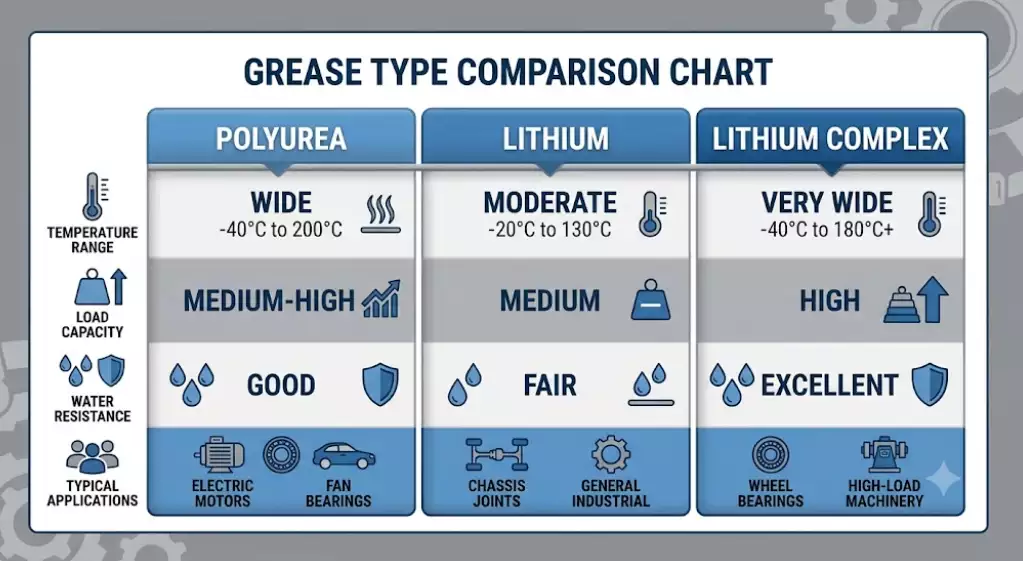
Polyurea vs Lithium vs Lithium Complex: At a Glance
| Selection factor | Polyurea | Conventional Lithium | Lithium Complex |
|---|---|---|---|
| Thickener type | Polyurea / urea family | Lithium soap | Lithium complex soap |
| Typical candidate applications | Electric motors, fans, pumps, rolling bearings | General machinery and routine lubrication | Bearings and machinery requiring a higher-temperature or heavier-duty grease formulation |
| High-temperature suitability | Product-specific; often used for higher-temperature bearing applications | Product-specific; conventional grades may have more limited temperature capability | Often a candidate for higher-temperature service |
| High-speed bearing use | Common candidate, depending on base oil and formulation | Product-dependent | Product-dependent |
| Water resistance | Formulation-dependent | Formulation-dependent | Formulation-dependent |
| Mechanical stability | Formulation-dependent | Generally suitable for many general-purpose applications | Often designed for demanding mechanical conditions |
| Compatibility | Must be verified with the existing grease | Must be verified with the existing grease | Must be verified with the existing grease |
| Best selection method | Application + OEM requirements + TDS | Application + OEM requirements + TDS | Application + OEM requirements + TDS |
Important: These are screening categories, not automatic product recommendations. Grease performance depends on the complete formulation, including base oil, viscosity, thickener, additives, NLGI grade, and application-specific testing.
For example, SKF’s LGHP 2 is a polyurea-based grease specifically positioned for electric motors, industrial fans, water pumps, and medium- to high-speed rolling bearings. This illustrates why the application and product specification matter more than the thickener name alone.
Final approval depends on the current TDS, equipment requirements, compatibility review, and sample validation. Thickener name alone is not enough.
For broader grease-family background, see the ZTSHOIL guide to grease types and applications. This page focuses on the procurement decision between polyurea, lithium, and lithium complex grease.
The Real Decision: Application Risk vs Approval Evidence
Polyurea vs lithium grease is mainly a comparison of thickener systems. The thickener holds base oil in the grease structure and influences how the grease behaves under mechanical work, temperature, water exposure, and mixing with other greases. The U.S. National Lubricating Grease Institute explains grease as a semi-solid lubricant made from a fluid lubricant, thickener, and additives; that structure is why two greases with similar appearance can behave very differently in service.
But the thickener does not decide the application by itself.
A buyer also needs to review base oil viscosity, NLGI grade, worked penetration, dropping point, oxidation stability, oil separation, water washout, corrosion protection, additives, and the equipment maker’s maintenance requirements. Color does not approve a grease. A product name such as “blue high temperature grease” or “EP grease” does not approve it either.
The cleaner procurement rule is:
Shortlist by equipment conditions, then approve by TDS and compatibility.
| Buying situation | Better first screening direction | What can block approval |
|---|---|---|
| Bearing application with heat and longer relubrication planning | Polyurea grease may enter the comparison | Existing grease compatibility, bearing speed, seal design, and current TDS limits |
| Moderate-duty machinery with regular relubrication | Lithium grease may be practical | High heat, shock load, severe water exposure, or OEM restrictions |
| Higher temperature or heavier-duty service | Lithium complex grease deserves separate review | Wrong NLGI grade, weak load data, water exposure, or poor fit with application method |
| Gearbox, reducer, or centralized system | Semi-fluid lithium grease may be considered when the equipment calls for this format | Pumpability, leakage behavior, consistency grade, and system design |
| Unknown grease replacement | No thickener should be approved blindly | Current grease identity, compatibility guidance, purge method, and test plan |
These are RFQ screening rules, not universal approvals. OEM requirements and site maintenance procedures override any general comparison page.
Polyurea, Lithium, and Lithium Complex Are Not the Same Choice
Polyurea grease is commonly associated with rolling-element bearing applications, especially where buyers are trying to control oxidation, heat exposure, and relubrication planning. That does not mean every polyurea grease is suitable for every electric motor, fan, pump, or high-speed bearing. Speed, fill quantity, seal design, base oil viscosity, and compatibility with the grease already in the bearing still matter.
Lithium grease is often discussed first because many maintenance teams and distributors already know it. It can fit general machinery and routine lubrication programs when operating conditions are moderate and relubrication is regular.
Lithium complex grease is not simply a premium label for ordinary lithium grease. It is a different lithium-based thickener system and should be compared as its own candidate. In the ZTSHOIL product manual excerpts used for this article, Extreme Pressure Lithium Complex Grease is listed with an operating temperature range of -30°C to 220°C, model options 2# and 3#, and a dropping point of 270°C or 280°C depending on grade. The same excerpt lists four-ball extreme pressure values including PD 3089 N and ZMZ 441 N under the SH/T0202 test method.
Polyurea grease needs the same discipline. If a buyer is replacing another thickener system with polyurea, the issue is not only whether polyurea is suitable in theory. The buyer must confirm the product’s current TDS, application limits, and compatibility with the grease already in service.
This matters most in bearings. A grease that works in one bearing position can still be wrong for another if speed, fill quantity, temperature, seal design, or relubrication interval changes.
| Equipment or application | Candidate grease family to discuss | Conditions to confirm before buying |
|---|---|---|
| Electric motor bearings | Polyurea or other bearing grease specified by the OEM | Existing grease, speed, bearing temperature, fill quantity, relubrication interval |
| Pumps and fans | Polyurea, lithium complex, or OEM-specified grease | Heat, vibration, bearing speed, seal condition, purge method |
| General rolling bearings | Lithium, lithium complex, or polyurea | Load, speed, temperature, contamination, maintenance interval |
| Automotive chassis points | Lithium or lithium complex | Water exposure, load, service interval, OEM recommendation |
| Heavy-duty machinery pins and bushings | EP lithium or lithium complex | Shock load, dust, water, wear pattern, grease retention |
| Gearboxes and reducers requiring grease instead of oil | Semi-fluid lithium grease | Consistency grade, leakage control, pumpability, gearbox design |
| High-temperature bearing points | Lithium complex, bentonite, or other high-temperature grease | Actual bearing temperature, oxidation stability, oil separation, relubrication access |
| Low-speed heavy-load parts | EP lithium or lithium complex | Load-carrying data, contamination, movement pattern, grease film retention |
ZTSHOIL Semi-Fluid Lithium Grease is listed in the provided manual excerpt for gearboxes and reducers in metallurgy, mining, energy, transportation, and construction machinery. The excerpt also states that it is suitable for centralized lubrication systems of large-scale units and lists an operating temperature range of -20°C to 120°C.
ZTSHOIL Extreme Pressure Lithium Grease is listed for high-temperature, humid, heavy-load centralized lubrication systems of large equipment in metallurgical and chemical industries. The provided manual excerpt lists an operating temperature range of -20°C to 120°C and describes advantages including anti-wear performance, anti-rust and water resistance, oxidation resistance, and pumping performance.
For high-temperature and heavy-load environments, the provided ZTSHOIL manual excerpt also includes Bentonite Lubricating Grease, with an operating temperature range of -30°C to 250°C and model options covering 1#, 2#, and 3# consistency grades. That does not make bentonite grease a direct substitute for polyurea or lithium in every case. It means high-temperature service may require a broader grease-family comparison.
TDS Items That Should Decide the Purchase
A TDS should be reviewed before price negotiation is treated as final. For distributors, industrial users, and private-label buyers, it connects a grease name to operating limits.
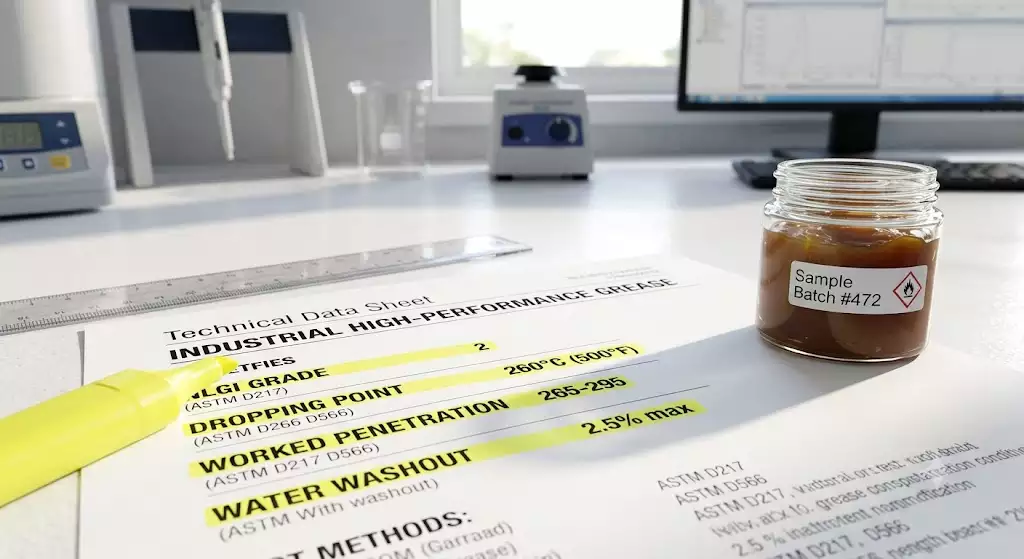
NLGI consistency is one of the first checks because it describes grease stiffness. The NLGI consistency scale is based on worked penetration, commonly measured using ASTM D217; NLGI 2 is a common general-purpose consistency, while softer grades are often considered for centralized systems or enclosed gear applications where the equipment calls for them. The exact grade must still match the machine design.
| TDS item | What it tells the buyer | Procurement use |
|---|---|---|
| Thickener type | Whether the grease is polyurea, lithium, lithium complex, bentonite, or another system | Helps screen compatibility and application boundary |
| NLGI grade or worked penetration | Grease consistency and relative stiffness | Affects pumpability, retention, dispensing, and mechanical fit |
| Operating temperature range | Stated service-temperature boundary | Screens out obvious mismatches, but does not approve the product alone |
| Dropping point | Heat-related structural indicator, commonly tested by ASTM D2265 or equivalent methods | Useful for comparison, but not the same as continuous service temperature |
| Oil separation | Stability under heat or storage conditions | Important for storage, dispensing, and consistency in use |
| Water washout or water resistance | Response to water exposure, often reviewed using ASTM D1264 or similar methods | Important for chassis, outdoor machinery, wet bearings, and harsh environments |
| Oxidation stability | Resistance to aging under heat and oxygen | Important where longer relubrication intervals are planned |
| Corrosion resistance | Protection of metal surfaces | Important where moisture, storage, or downtime exposure exists |
| Low-temperature flow or similar viscosity data | Movement and pumpability under cold conditions | Important for centralized lubrication and cold-weather operation |
| Extreme pressure data | Load-carrying performance under test conditions | Important for heavy load, shock load, pins, bushings, and gears |
The ZTSHOIL product manual excerpts used for this article list common grease test categories such as worked penetration, dropping point, corrosion testing, steel mesh oil separation, evaporation, water washout, leakage, oxidation stability, and corrosion resistance. The manual also states that physical property values are typical of normal production and may vary.
That statement is important. A buyer should request the current TDS for the exact product, grade, packaging, and application before approval.
For packaging, the provided ZTSHOIL manual excerpts list grease options including 320g, 400g, 500g, 1kg, 2kg, 5kg, 12kg, 15kg, 170kg, and 180kg. Smaller packs may suit retail or distributor programs, while pails and drums may suit industrial maintenance and workshop use.
Switching Grease Is a Compatibility Project, Not a Refill Task
The highest-risk moment is not always the first fill. It is often the switch from one grease to another.
Polyurea, lithium, lithium complex, and other grease families should not be mixed casually. When the existing grease is unknown, the new grease may look similar but behave differently because the thickener system, base oil, and additive package are different.
Grease compatibility is not determined by thickener name alone. The Society of Tribologists and Lubrication Engineers notes that compatibility can depend on thickener, base oil, additives, and the way the mixture changes consistency, dropping point, and mechanical stability. In procurement terms, that means a compatibility chart can help with early screening, but it cannot replace supplier guidance or site validation.
A controlled switch normally starts with four checks:
- Identify the current grease name, thickener type, and NLGI grade if possible.
- Review the equipment maker’s lubrication requirement and the current grease supplier’s compatibility guidance.
- Decide whether cleaning, purging, or a staged changeover is required.
- Test the candidate grease under defined operating conditions before wider use.
Dropping point is another common trap. A high dropping point can support high-temperature screening, but it does not replace oxidation stability, oil separation, base oil viscosity, bearing temperature, relubrication interval, and load data.
Speed also changes the decision. A grease selected for a slow, heavily loaded pin may not suit a high-speed bearing. In high-speed positions, excessive grease quantity can raise operating temperature because of churning, even when the grease chemistry is otherwise suitable. SKF’s bearing maintenance guidance also treats correct grease quantity and relubrication practice as part of bearing performance, not as an afterthought.
Use engineering review when any of these conditions apply:
- The equipment is expensive, safety-critical, or difficult to shut down.
- The grease will replace an unknown or different thickener type.
- The bearing runs at high speed or high temperature.
- Water, dust, chemicals, or vibration are severe.
- The grease will be sold under a private label, where field complaints affect the local brand.
- The application involves centralized lubrication, gearboxes, reducers, electric motors, or heavy construction machinery.
If a grease change could stop production, treat it as a technical approval project.
ZTSHOIL Grease Options to Discuss in an RFQ
ZTSHOIL can discuss grease-family selection and current TDS availability based on the buyer’s application details. The purpose of the first exchange is to reduce the list of possible products before samples, packaging, and quotation are finalized.
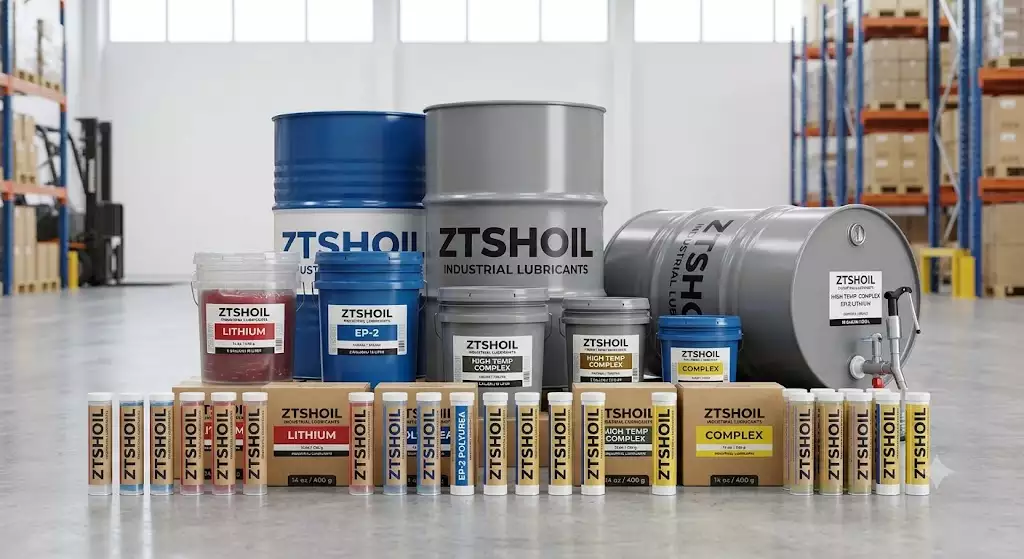
Based on the provided ZTSHOIL product manual excerpts, the following grease families may be relevant to a polyurea vs lithium grease buying discussion because they define lithium-based or alternative high-temperature options that buyers often compare during selection.
| ZTSHOIL grease family from provided excerpts | Listed model or grade | Listed operating temperature range | Where it may enter the discussion |
|---|---|---|---|
| Semi-Fluid Lithium Grease | 0#, 00#, 000# | -20°C to 120°C | Gearboxes, reducers, centralized lubrication systems |
| Extreme Pressure Lithium Grease | 0#, 1#, 2#, 3# | -20°C to 120°C | Humid, heavy-load centralized lubrication systems |
| Extreme Pressure Lithium Complex Grease | 2#, 3# | -30°C to 220°C | Higher-temperature and heavier-duty selection discussions |
| Bentonite Lubricating Grease | 1#, 2#, 3# | -30°C to 250°C | High-temperature, heavy-load, and harsh-environment comparisons |
The comparison should not stop at temperature range. For example, the provided Extreme Pressure Lithium Complex Grease excerpt lists worked penetration, dropping point, copper corrosion, four-ball extreme pressure data, and oxidation stability. Those test items give buyers a more complete basis for comparison than thickener type alone.
Zhongtian Petrochemical supports lubricant and grease buyers through product selection discussion, technical formulation review, OEM/ODM cooperation, quality control documentation, packaging options, and ongoing supply communication. For private-label buyers building a local lubricant range that may include gasoline engine oil, diesel engine oil, gear oil, and grease, the technical discussion should cover both product performance and market positioning.
For supplier-background reading, see ZTSHOIL’s comparison of global and Chinese lubricant grease manufacturers. For broader lubricant manufacturer context, see the guide to global lubricant manufacturers.
What to Send Before Asking for a Price
A useful RFQ for polyurea vs lithium grease should make the application visible. Without operating conditions, the supplier can only guess.
Send these details before requesting a final quotation:
- Equipment type and lubrication point
- Current grease name, thickener type, and NLGI grade if known
- Normal and peak operating temperature
- Bearing speed, machine speed, or speed category
- Load condition: light, moderate, heavy, or shock load
- Water, dust, chemical, or outdoor exposure
- Relubrication interval and application method
- Whether the grease is for maintenance, resale, or private label
- Required packaging size
- Target market and climate conditions
- Any OEM or customer specification that must be followed
If the current grease is unknown, say that clearly. Unknown compatibility is not a small detail; it changes the approval path.
The safest buying sequence is: define the equipment conditions, shortlist the grease family, review the current TDS, check compatibility, approve a sample, then confirm packaging and supply terms.
If your team is comparing polyurea, lithium, lithium complex, or other grease options for industrial use, distribution, OEM, ODM, or private-label programs, contact Zhongtian Petrochemical with the application details and request the matching current TDS for review.
FAQ
Is polyurea grease better than lithium grease?
Not universally. Polyurea grease can be an appropriate choice for certain electric motors, fans, pumps, and rolling-bearing applications, but the correct grease depends on temperature, speed, load, base oil, formulation, OEM requirements, and compatibility.
Can polyurea grease be mixed with lithium grease?
Do not assume that they are compatible. Compatibility depends on the specific grease formulations, including thickener, base oil, and additives. NLGI and SKF guidance support evaluating the specific products rather than relying only on generalized compatibility assumptions.
Which grease is better for electric motor bearings?
Polyurea is commonly used in electric-motor bearing applications, but the exact grease should be selected according to the motor manufacturer’s requirements, bearing speed, temperature, base oil viscosity, relubrication interval, and compatibility. SKF, for example, specifies a polyurea-based grease for electric motors and similar applications.
Is lithium complex grease better for high temperatures?
Lithium complex grease can be a candidate for higher-temperature applications, but thickener type alone does not determine performance. Base oil, additives, oxidation stability, mechanical stability, oil separation, bearing speed, and the manufacturer’s operating limits also need to be evaluated.
Does a higher dropping point mean better high-temperature performance?
No. Dropping point is a useful comparative test property, but it should not be treated as the continuous operating temperature of a grease. High-temperature selection requires evaluation of the complete formulation and application conditions.
Can I switch directly from lithium grease to polyurea grease?
Not automatically. Identify the existing grease, obtain the proposed grease’s TDS, review compatibility, follow the equipment manufacturer’s requirements, and establish an appropriate purge or changeover procedure before switching.
Does NLGI 2 mean a grease is suitable for my bearing?
No. NLGI grade primarily describes grease consistency. It does not by itself establish temperature capability, speed capability, load performance, water resistance, or compatibility.
What information should I provide when requesting a grease quotation?
Provide the equipment type, bearing or lubrication point, operating temperature, speed, load, water exposure, existing grease, NLGI grade, required packaging, estimated quantity, and any OEM or certification requirements. More complete application information allows suppliers to recommend and quote a more appropriate product.