





Quick answer
The safest way to source lubricants is to qualify the supplier before negotiating price. Define the equipment specification, shortlist 3–5 suppliers, verify certifications and OEM approvals, request batch-specific CoAs, audit quality and traceability, then compare landed cost and supply risk.
Lubricants sourcing is the process of finding, verifying and contracting a supplier who can deliver oils and greases that match your equipment’s specification, batch after batch. Finding candidates is easy. Directories list hundreds of them. Proving that a candidate is reliable before you commit is the part that takes work, and it is the part most sourcing guides skip
This guide covers the verification methods: how to read a Certificate of Analysis line by line, how to audit a supplier in five steps, and how to score candidates on a weighted scorecard. It is written from the perspective of a manufacturer that supplies industrial buyers in more than 100 countries and regions. Where a claim rests on our own factory practice, we say so.
On this page
- What is lubricants sourcing?
- Which supplier type fits your situation
- The six-step lubricants sourcing framework
- How to read a Certificate of Analysis
- Supplier scorecard
- Red flags
- Cross-border sourcing
- FAQ
What is lubricants sourcing?
Lubricants sourcing is the procurement discipline of selecting and qualifying suppliers of industrial oils and greases. It covers four decisions. What specification does the equipment require? Which type of supplier can meet it? How do you verify that supplier’s claims? And what commercial terms make the relationship sustainable?
It differs from ordinary purchasing in one important respect. A lubricant that is 15% off specification looks identical in the drum. It performs acceptably for weeks. Then it fails at the bearing months later. You cannot inspect quality visually, so verification has to be documentary and analytical. That is why this guide is built around evidence rather than supplier reputation.
Which supplier type fits your situation
Most guides treat “supplier” as one category. In practice there are four, and they suit different buyers. Picking the wrong type is the most common structural mistake in lubricants sourcing. It produces a relationship that cannot deliver what you need, however well you negotiate.
| Supplier type | Best for | Custom formulation | Typical MOQ | Technical support | Weakness |
|---|---|---|---|---|---|
| Integrated manufacturer (refines or blends in-house) | Volume buyers, private label, custom specs | Yes | Higher | Direct from formulators | Less local stock |
| Toll / contract blender | Buyers with their own formulation | Yes, to your recipe | High | Process only | No formulation ownership |
| Specialty formulator | Niche duty (food grade, extreme temp, PFPE) | Yes, narrow range | Low to medium | Deep but narrow | Limited product breadth |
| Distributor | Local stock, mixed brands, fast replenishment | No | Low | Application-level | Margin stacking; no batch control |
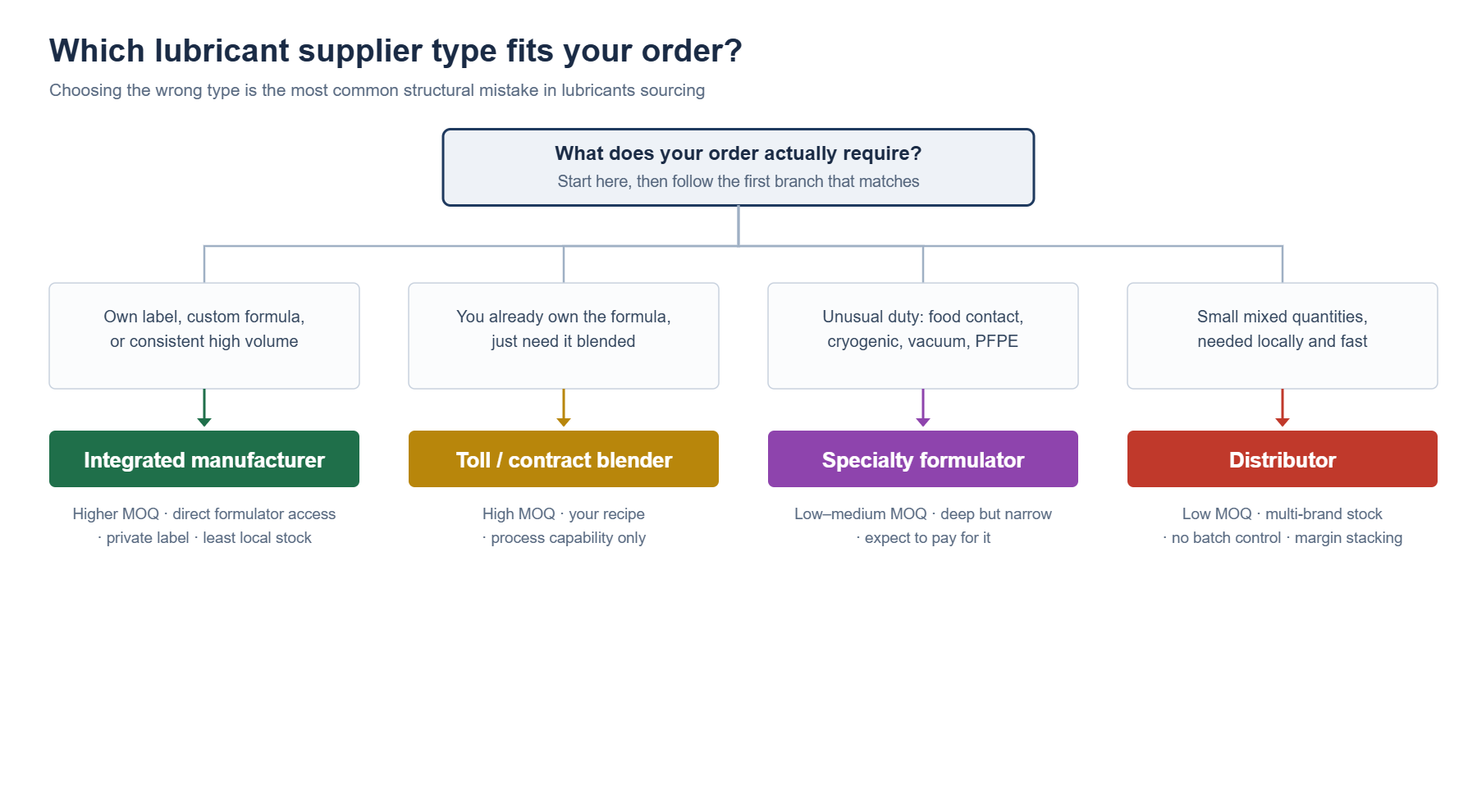
A short decision rule works for most cases. Need consistent large volumes, or a formulation under your own label? Go to a manufacturer. Need small quantities of many brands next week? Go to a distributor. Is your duty unusual, such as food contact, cryogenic or vacuum service? Go to a specialty formulator and accept the price. For a view of who the large manufacturers are by market position, see our breakdown of the top 10 global lubricant manufacturers by market share.
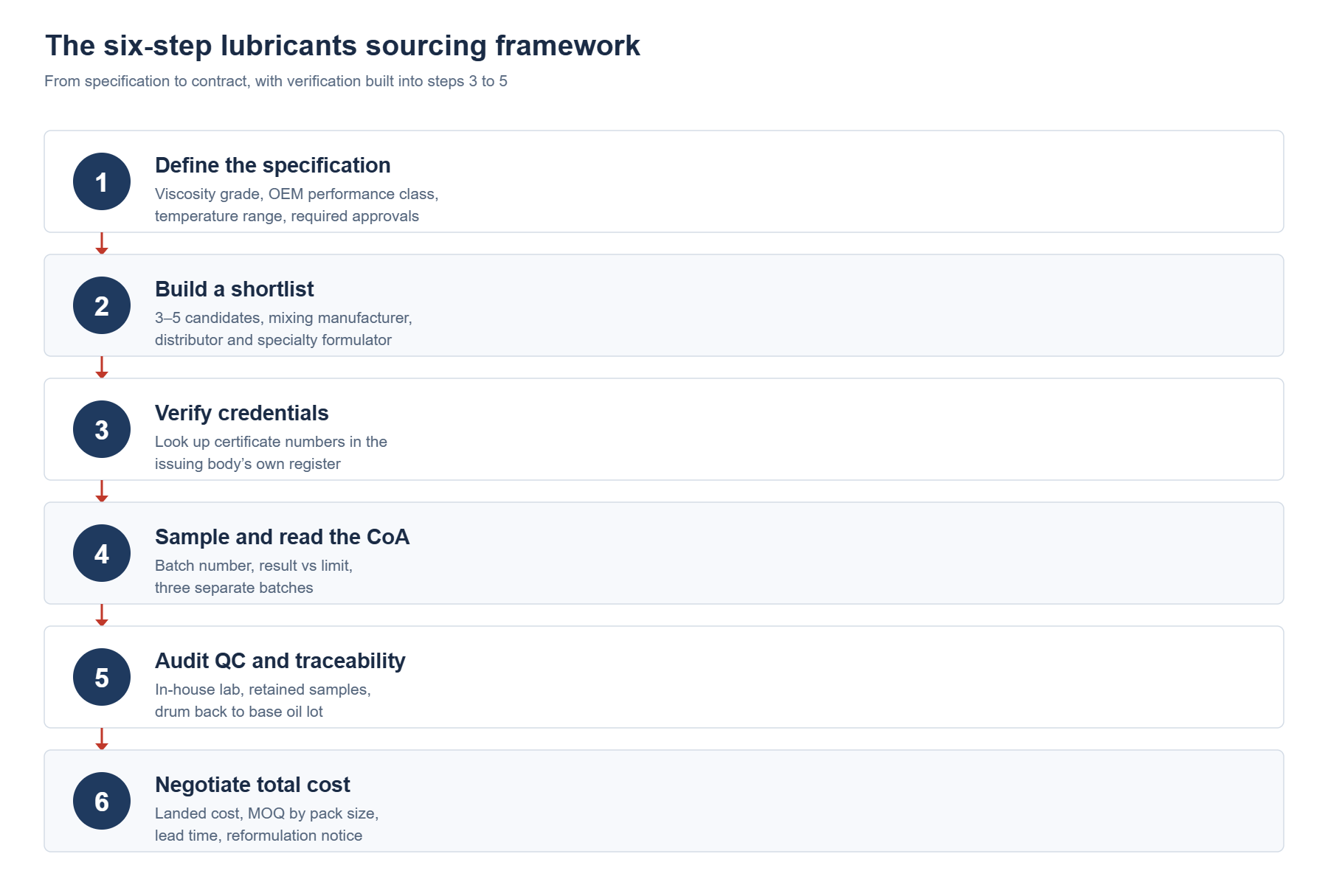
The six-step lubricants sourcing framework
Step 1. Define the specification before you contact anyone
Write the requirement in the equipment maker’s own terms, not in brand names. A usable specification states four things: viscosity grade (ISO VG or SAE), the performance class the OEM requires, the operating temperature range, and any approval that is contractually required.
Two errors happen at this stage. The first is specifying by the brand currently in use. That locks you to one supplier and hides what the equipment actually needs. The second is specifying viscosity grade alone. Two oils of the same ISO VG can behave completely differently across a temperature range, because the grade fixes viscosity at 40°C only.
If your selection involves greases rather than oils, thickener type matters as much as grade. Our guide to grease types and the polyurea vs lithium grease comparison cover where each thickener belongs.
Step 2. Build a shortlist of three to five candidates
Include more than one supplier type. A shortlist of three distributors tells you only about distributor pricing. A shortlist containing a manufacturer, a distributor and a specialty formulator tells you what the market actually offers.
Three to five candidates is the working range. Fewer than three gives you no price reference. More than five means the verification work in Steps 3 to 5 will not get done properly, and skipping verification is worse than a narrow shortlist.
Step 3. Verify credentials rather than collect them
A certificate PDF proves nothing on its own. Every claim a supplier makes has an independent register you can check, and checking takes minutes.
- API licences for engine oils such as SP and CK-4. Verify the licence number in API’s own online directory. An unlicensed product may still meet the specification, but it has not been independently confirmed.
- ISO management certificates. Each carries an issuing body and a certificate number. Certification bodies maintain searchable registers. An accredited certificate that cannot be found in one warrants a question.
- OEM approvals such as Parker-Denison or Bosch Rexroth. Approvals are granted per product, not per company. Confirm the approval covers the exact grade you are buying, not a sister product.
- Test reports. Ask which laboratory produced them and whether it is accredited. In-house results are legitimate, but they are not third-party evidence.
Here is our own position, stated so you can run this same test on us. Anhui Zhongtian Petrochemical Co., Ltd holds ISO 9001:2015 quality management (registration 62825Q9372R0S), ISO 14001:2015 environmental management (62825E9373R0S) and ISO 45001:2018 occupational health and safety (62825S9374R0S). All three were issued on 25 April 2025 and run to 24 April 2028. The scope is specific: intelligent production and sales of high-performance lubricating oils and greases. The certifying body is Zhongtian Hongtu International Certification Co., Ltd, accredited under CNCA-R-2020-628, and the records are searchable at cnca.gov.cn. Parker-Denison approvals across our anti-wear hydraulic oil range are held per grade rather than across the range: the standard L-HM grade holds HF-1 and HF-2, while the high-cleanliness, high-pressure, ashless high-pressure and L-HV low-temperature grades hold HF-0. Ask us for the approval covering the exact grade on your order, and apply the same test to any other supplier. Do not take those numbers on trust. Look them up. That is the entire point of this step.
Step 4. Request samples and read the Certificate of Analysis properly
A Certificate of Analysis, or CoA, is the batch-specific test record for the material you are actually buying. It is the single most useful document in lubricants sourcing, and it is routinely filed without being read. Every value on it maps to a test method and a failure mode.
| CoA line | Test method | What it tells you | Warning sign |
|---|---|---|---|
| Kinematic viscosity @40°C | ASTM D445 | Whether the oil is the grade it claims | Outside the ISO 3448 ±10% band for the stated grade |
| Viscosity index | ASTM D2270 | How much viscosity changes with temperature | Materially below the product datasheet value |
| Flash point | ASTM D92 | Volatility and contamination | Unexpectedly low, which can indicate light-fraction contamination |
| Pour point | ASTM D97 | Lowest temperature at which it still flows | Higher than specified for a cold-climate application |
| Total acid number | ASTM D664 | Additive level and oxidation state | Elevated in new oil, which suggests age or contamination |
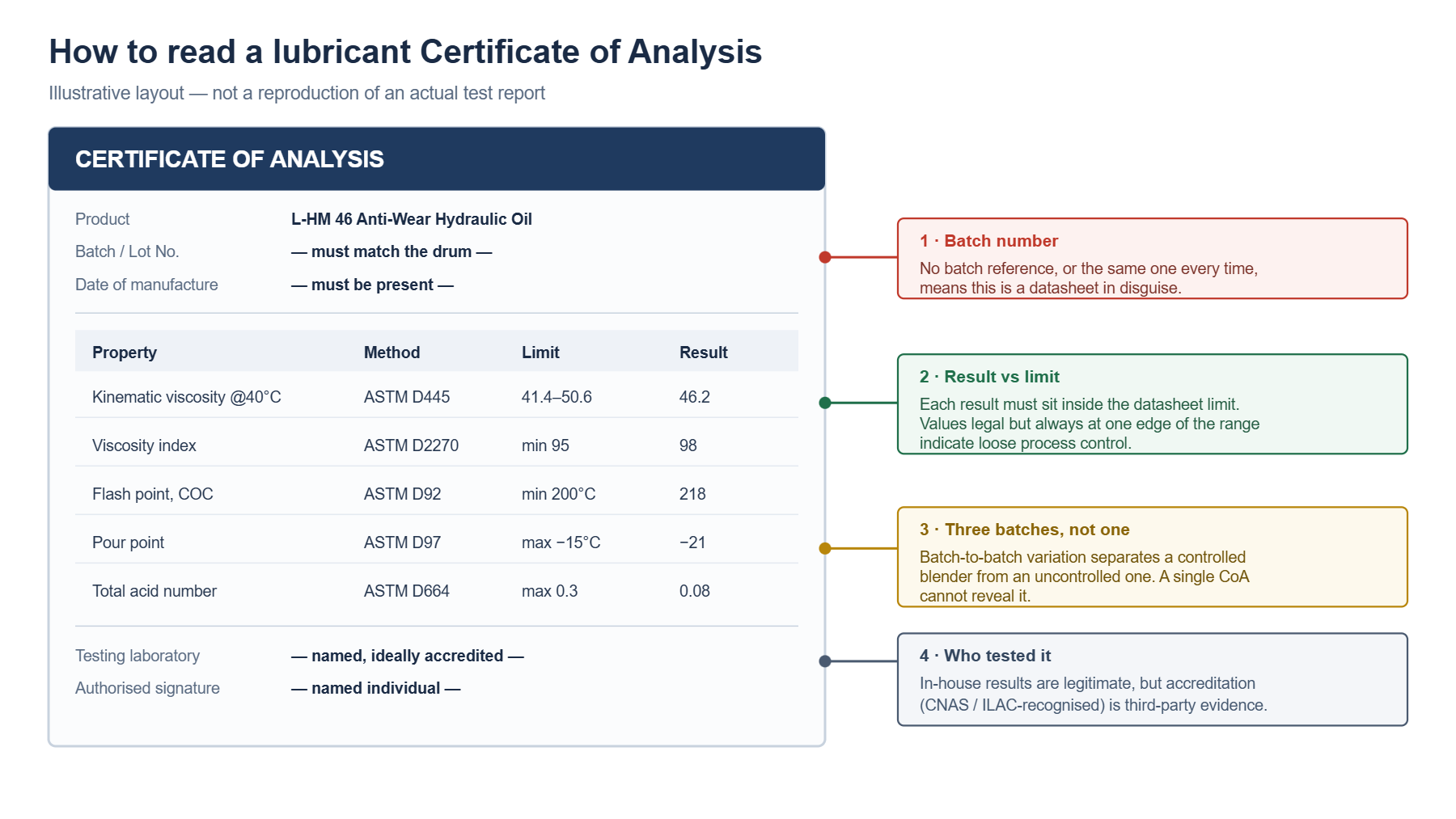
Three checks turn a CoA from paperwork into evidence.
- Does the CoA carry a batch number that matches the drum? A CoA with no batch reference, or a generic one reused across shipments, is a datasheet in disguise.
- Do the values sit inside the product datasheet limits? Compare the CoA against the published TDS. Values that are legal but consistently at one edge of the range indicate loose process control.
- Do successive batches agree? Ask for CoAs from three separate batches. Batch-to-batch variation is what separates a controlled blender from an uncontrolled one, and a single CoA cannot reveal it.
If a supplier cannot produce a CoA that survives these three checks, the commercial discussion is premature. Ask for the document before you ask for the price. For our own products, published technical data sheets state the specification limits, and batch-specific CoA, TDS and MSDS documents are issued on request. Ask for them by grade and batch rather than accepting a generic datasheet.
Step 5. Audit quality control and batch traceability
Verification in Step 3 confirms that a supplier had a capability at audit time. Step 5 confirms they exercise it on every batch. You are looking for four things, whether by video call, third-party audit or site visit.
- In-house laboratory. Can they test viscosity, flash point and acid number themselves, or is testing outsourced per batch?
- Retained samples. Is a sample of every production batch kept, and for how long? Retained samples are what make a later dispute resolvable.
- Batch traceability. Can they trace a drum number back to the base oil lot and the additive lot?
- Raw material control. Are base oils and additive packages bought to specification from named suppliers, or on price from the spot market?
Our own practice, offered as an example of what to ask for. Testing is performed in-house by a Group testing arm accredited under CMA and CNAS as a state-authorized third-party institution, rather than outsourced batch by batch. CNAS is a signatory to the ILAC Mutual Recognition Arrangement, so those reports carry outside China. On raw material control, additive packages come from Afton Chemical, Infineum, Lubrizol, Chevron and ExxonMobil. Base oils come from Shell, S-OIL, GS Caltex, SK, Sinopec, PetroChina, CNOOC and Formosa Plastics. Named tier-one raw material suppliers are something a buyer can verify. “High-quality base oil” is not.
Step 6. Negotiate on total cost, MOQ and logistics
Unit price is the smallest of the numbers that matter. The comparison that decides the contract is landed cost per litre delivered to your plant, set against expected service life.
Settle these points before signing: minimum order quantity by pack size, lead time for stock items and for custom blends, who pays freight and under which Incoterm, and whether CoA, TDS and safety data sheets ship with every consignment. One more is forgotten more often than any of those. Does the supplier have to notify you if they reformulate the product? A reformulation you learn about from a bearing failure is a contractual failure, not a technical one.
How this works with us, as a worked example of the terms you should be pinning down. Our standard minimum order quantity is 20 units, meaning 20 packaging units, so the volume it represents depends on the pack size you choose. Catalogue grades are packed in 1 L, 1 QT, 4 L, 1 Gal, 18 L, 5 Gal and 200 L. Trial orders below that minimum are negotiable. We would rather run a small first order than have you commit blind. Lead time is 3 to 7 days when the grade is in stock and 10 to 20 days when it is not, depending on quantity, with 15-day expedited delivery available for small and urgent orders. OEM and private-label production with custom packaging is supported, quoted separately from the standard minimum. Our guide to which tiers are negotiable walks through each step from a free sample to a full container.
One general point applies to any supplier, not just to us. A minimum expressed in units means something very different for 1 L bottles than for 200 L drums. Resolve the unit in writing before you budget.
Supplier scorecard: turning judgement into a number
Score each shortlisted supplier on five weighted dimensions. Have procurement, maintenance and a technical reviewer score independently, then compare. Divergence between scorers is itself informative, because it usually marks the risk nobody has resolved.
| Dimension | Weight | Score 1–5 on |
|---|---|---|
| Technical capability | 25% | Formulation depth, in-house lab, engineer access, OEM approvals held |
| Quality system | 25% | Certification verified, CoA per batch, retained samples, batch traceability |
| Delivery reliability | 20% | Lead-time record, capacity headroom, stock policy, packaging options |
| Cost competitiveness | 15% | Landed cost per litre, payment terms, price stability history |
| Service and support | 15% | Documentation completeness, response time, oil analysis support, training |
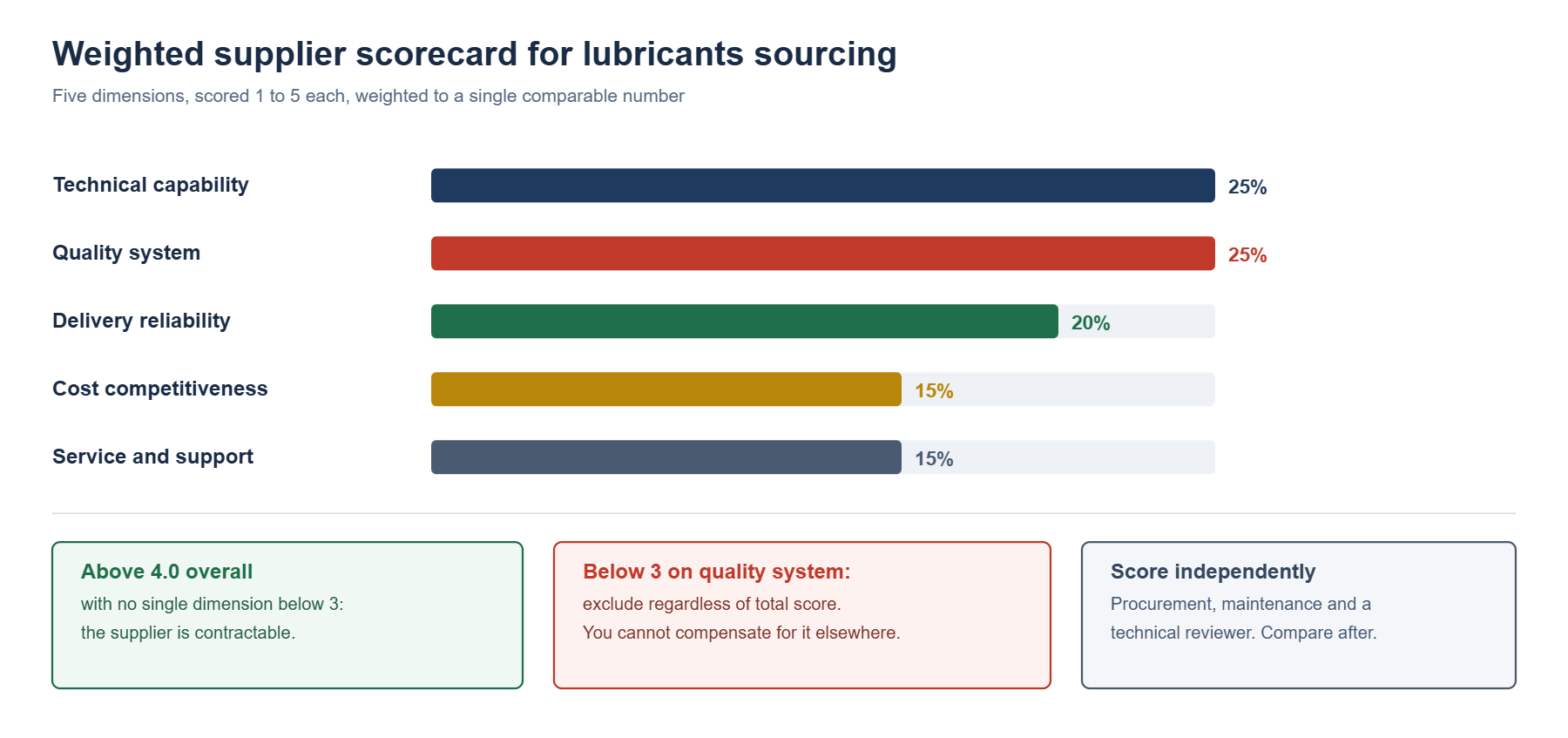
How to read the result. A supplier scoring above 4.0 with no dimension below 3 is contractable. Any supplier scoring below 3 on quality system should be excluded regardless of total score. That dimension is the one you cannot compensate for elsewhere.
Red flags in lubricants sourcing
Ten signals that justify pausing a purchase. None is proof of a problem on its own. Two or more together usually means the supplier’s process is not under control.
- A CoA that carries no batch number, or the same values on every shipment
- Refusal to supply CoAs from three separate batches
- Certification claimed, but the certificate number cannot be located in any register
- An OEM approval quoted for the company rather than for the specific grade
- A price materially below the market with no explainable reason. Base oil is a commodity, and margin has a floor
- Product reformulated without notice
- No published technical data sheet, or a TDS with ranges so wide they cannot fail
- Safety data sheet missing, outdated, or not in the destination country’s required language
- Packaging that arrives unsealed, undated, or without batch marking
- No named technical contact, only sales
Several of these overlap with the operational obstacles we cover in five key challenges in purchasing high-quality lubricants.
Cross-border lubricants sourcing: what changes
Importing lubricants adds three cost and compliance layers that domestic sourcing does not have. Most guides are written from a single-country perspective and omit them entirely.
- Tariff classification. Lubricating products generally fall under HS heading 3403, while base and petroleum oils generally fall under 2710. Classification drives the duty rate, and misclassification creates retrospective liability. Confirm the code with your customs broker for your destination, because rates and interpretations vary by country.
- Dangerous goods handling. Whether a lubricant is regulated for transport depends on flash point and composition. Many industrial oils are unregulated by sea and air. Some solvents and aerosols are not. The supplier’s safety data sheet states the transport classification, so read it before booking freight.
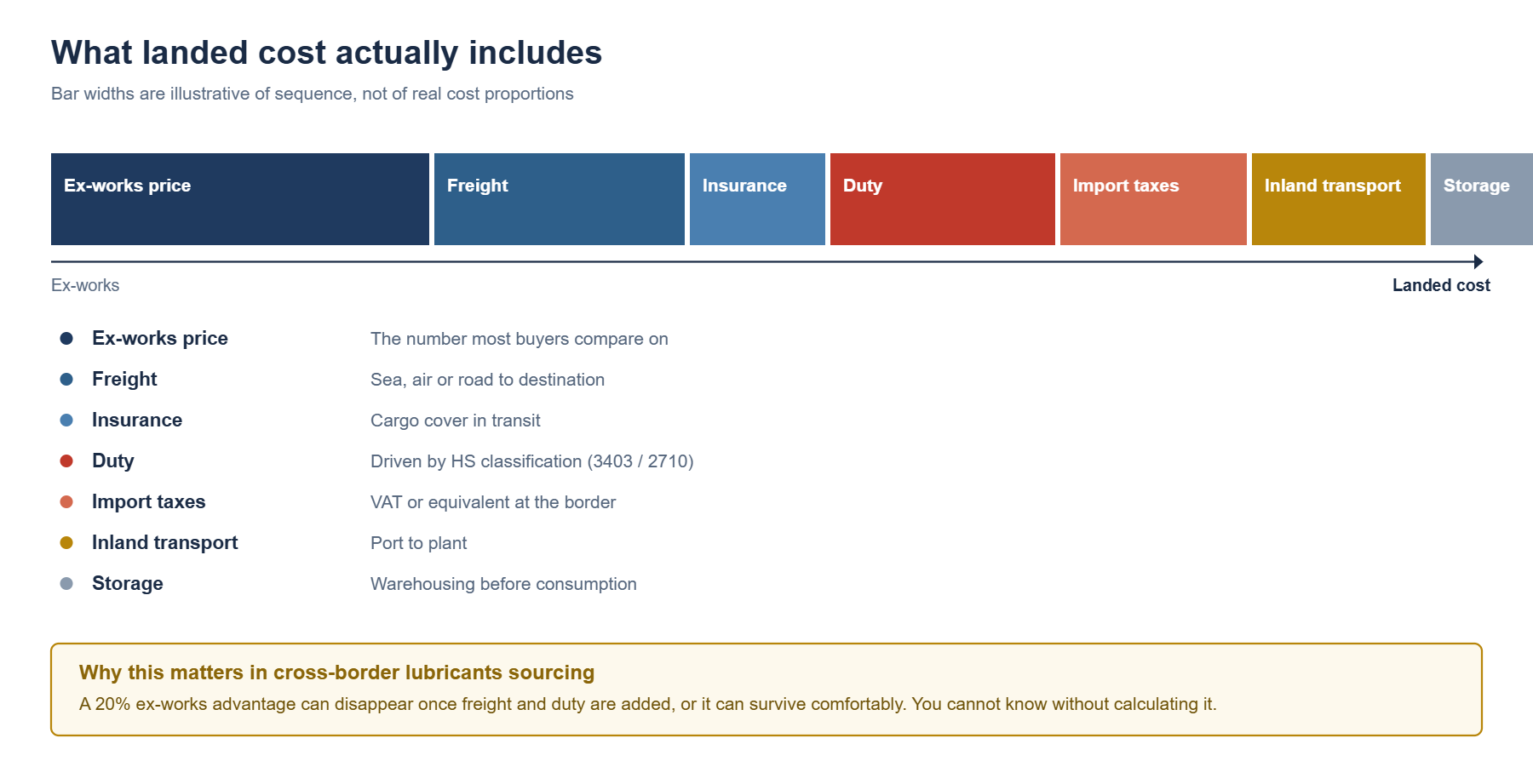
- Landed cost. Build the comparison as ex-works price plus freight, insurance, duty, import taxes, inland transport and storage. A 20% ex-works advantage can disappear once freight and duty are added, or it can survive comfortably. You cannot know without calculating it.
Sourcing from China deserves a specific note. The advantages are blending capacity, price, and willingness to run custom formulations at moderate volumes. The risks are verification distance and variable quality control across a fragmented supplier base. That is precisely why Steps 3 to 5 matter more, not less, when buying cross-border. Ask for third-party laboratory confirmation on the first shipment rather than relying on the supplier’s own CoA alone.
Frequently asked questions
How do I find a reliable lubricant supplier?
Build a shortlist of three to five candidates across different supplier types, then verify rather than trust. Check certification numbers in the issuing body’s register. Confirm OEM approvals apply to the specific grade. Request Certificates of Analysis from three separate batches. Score the candidates on a weighted scorecard before you start negotiating.
Weighted score = Σ (dimension score × weight)
| Supplier | Technical | Quality | Delivery | Cost | Service | Weighted Score |
|---|---|---|---|---|---|---|
| A | 5 | 4 | 4 | 3 | 5 | 4.25 |
| B | 4 | 5 | 3 | 5 | 3 | 4.15 |
What certifications should a lubricant supplier have?
Expect a quality management certification such as ISO 9001 as a baseline. Beyond that, the certifications that matter are application-specific: API licences for engine oils, OEM approvals such as Parker-Denison for hydraulic fluids, and NSF registration for food-grade lubricants. A supplier holding many certificates that are irrelevant to your application has told you nothing useful.
How do I verify lubricant quality before purchasing?
Request a batch-specific Certificate of Analysis and compare each value against the published technical data sheet. Confirm that kinematic viscosity (ASTM D445) sits within the ISO 3448 band for the stated grade, then check viscosity index, flash point and pour point against the datasheet. For a first shipment from a new supplier, send a retained sample to an independent laboratory.
What is the difference between a lubricant manufacturer and a distributor?
A manufacturer blends the product and controls the formulation, batch records and quality system directly. A distributor buys finished product and resells it, usually holding local stock across several brands. Manufacturers suit volume, custom formulation and private label. Distributors suit small mixed orders and fast local replenishment.
Are cheaper lubricants worth it?
Sometimes. Base oil is a commodity, and a lower price can reflect lower overhead or a shorter supply chain rather than lower quality. The test is not the price itself but whether the CoA and batch consistency support the claim. Compare on cost per operating hour rather than price per litre, and treat a price with no explainable basis as a red flag.
What is a typical minimum order quantity for industrial lubricants?
MOQ depends on supplier type and pack size. Distributors typically sell by the drum or pail with no meaningful minimum. Manufacturers set minimums by production batch, which is why manufacturer pricing improves sharply with volume. Custom formulations carry the highest minimums because a blend run cannot be split. For reference, our own standard minimum is 20 packaging units across pack sizes from 1 L to 200 L, with trial orders negotiable below that.
Sourcing from Zhongtian
Anhui Zhongtian Petrochemical has manufactured lubricating oils and greases since 1998. We run intelligent production lines with an annual capacity of 200,000 tonnes of lubricating oils and 500,000 tonnes of lubricating greases, hold over 100 patents, and produce more than 2,000 product types. Our R&D centre in Hefei represents an investment of close to CNY 200 million and works with Tsinghua University, the University of Science and Technology of China, and the Research Institute of Petroleum Processing.
For buyers applying the framework above, here are the checkable facts. We export to more than 100 countries and regions across Europe, the Americas, Japan, South Korea, South Asia and Southeast Asia. Additive packages come from Afton Chemical, Infineum, Lubrizol, Chevron and ExxonMobil. Base oils come from Shell, S-OIL, GS Caltex, SK, Sinopec, PetroChina, CNOOC and Formosa Plastics. Our testing arm is CMA- and CNAS-accredited. Industrial users include KOBELCO and HITACHI excavators, Chery, JAC, Dongfeng Motor, SINOTRUK, Foton, Conch Cement, Heli Forklift, Zenith Steel, Rockcheck Steel and Shaanxi Coal Group.
Product coverage runs from L-HM, L-HV and L-HS hydraulic oils through L-CKC to L-CKE gear oils, L-DAB and L-DAJ compressor oils and L-TSA turbine oils, to greases spanning lithium, polyurea, bentonite, PFPE and ultra-high-temperature grades.
Send us your equipment type, the OEM-specified grade and your operating temperature range. Our technical team will specify against your duty cycle rather than quote from a catalogue page. Contact Zhongtian Petrochemical.
Reference standards cited: ISO 3448 (viscosity classification) and ISO 6743-4 (hydraulic fluid families). Test methods referenced are ASTM D445, D2270, D92, D97 and D664.
Published by Anhui Zhongtian Petrochemical Co., Ltd, No. 27 Xingye Road, Susong Economic Development Zone, Anhui, China, a lubricants manufacturer since 1998. Zhongtian’s research institute is led by chief scientist Li Yadong, Academician of the Chinese Academy of Sciences, with Professors Guo Xiaochuan, Xu Tongwen, Cui Peng and Hu Xianguo, professor-level senior engineers Liu Qinglian and Zong Ming (director of the research institute), and chairman Gao Xiaomou, researcher, on the technical panel. The Group operates an Anhui Provincial Key Laboratory, an academician workstation and a postdoctoral research station, and its testing arm is CMA- and CNAS-accredited. Last reviewed 17 September 2026.
Related reading
- How to vet a lubricant supplier: a 5-point framework — the scoring detail behind step four above.
- Which industrial lubricant suppliers does AI actually recommend — why an AI shortlist is a starting point, not a verification.
- Global vs Chinese grease manufacturers compared — how the two supplier types differ on cost, lead time and documentation.
- Bulk lubricant purchasing — volume economics once a supplier has passed the checks.
- How to become a lubricant distributor — the same evaluation applied from the distribution side.
- Anhui Zhongtian Petrochemical company profile — our own certifications, capacity and test capability, stated so you can verify them.