





This viscosity index calculator takes an oil’s kinematic viscosity at 40 °C and 100 °C, returns its VI to ASTM D2270 and estimates the viscosity at your operating temperature. The other two tabs match a grade across ISO VG, AW, HM, HLP, CKC, AGMA and SAE, and convert between cSt, SUS, stokes and centipoise. It is free and needs no sign-up.
VI only changes the SAE comparison. Our mineral L-HM hydraulic oils run VI 95–107; our L-HV oils 138–148.
Methods: ISO 3448, ASTM D2270, ASTM D341, ASTM D2161, SAE J300, SAE J306. Results are estimates for comparing oils. Confirm against the product data sheet and the equipment maker’s specification before you buy or substitute.
Choosing a grease instead of an oil? Use our grease selector.
What viscosity index tells you
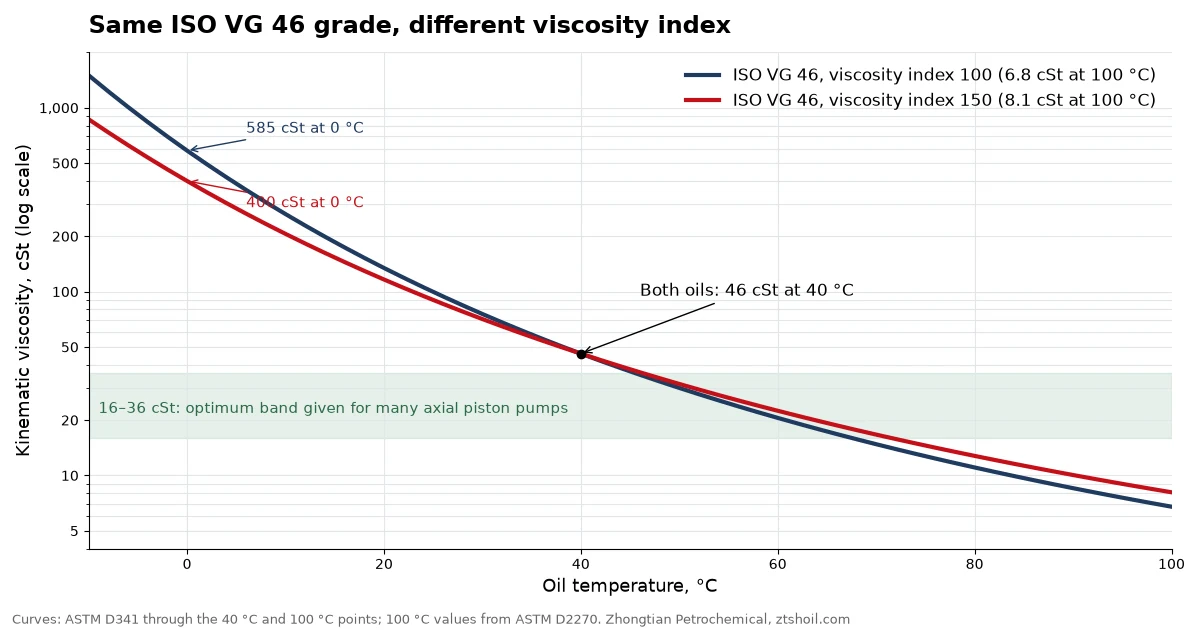
Viscosity index describes how much an oil’s viscosity changes with temperature. Two ISO VG 46 oils both measure 46 cSt at 40 °C. At a viscosity index of 100 the oil is about 585 cSt at 0 °C and 6.8 cSt at 100 °C. At 150 it is about 400 cSt at 0 °C and 8.1 cSt at 100 °C. The higher the index, the less the oil thickens on a cold start and the less it thins when hot. The grade number alone does not show this, so run the 40 °C and 100 °C figures from the data sheet through the viscosity index calculator above before you compare two oils.
ISO VG viscosity grades at 40 °C
ISO 3448 defines each grade by its midpoint kinematic viscosity at 40 °C, with a window of ±10 %. Any oil whose measured 40 °C viscosity falls inside the window may carry that grade number.
| Grade | Minimum, cSt at 40 °C | Maximum, cSt at 40 °C |
|---|---|---|
| ISO VG 2 | 1.8 | 2.2 |
| ISO VG 3 | 2.7 | 3.3 |
| ISO VG 5 | 4.5 | 5.5 |
| ISO VG 7 | 6.3 | 7.7 |
| ISO VG 10 | 9 | 11 |
| ISO VG 15 | 13.5 | 16.5 |
| ISO VG 22 | 19.8 | 24.2 |
| ISO VG 32 | 28.8 | 35.2 |
| ISO VG 46 | 41.4 | 50.6 |
| ISO VG 68 | 61.2 | 74.8 |
| ISO VG 100 | 90 | 110 |
| ISO VG 150 | 135 | 165 |
| ISO VG 220 | 198 | 242 |
| ISO VG 320 | 288 | 352 |
| ISO VG 460 | 414 | 506 |
| ISO VG 680 | 612 | 748 |
| ISO VG 1000 | 900 | 1100 |
| ISO VG 1500 | 1350 | 1650 |
| ISO VG 2200 | 1980 | 2420 |
| ISO VG 3200 | 2880 | 3520 |
How the viscosity index calculator works
Viscosity index. ASTM D2270 compares your oil’s 40 °C viscosity with two reference oils that have the same 100 °C viscosity: L, with a VI of 0, and H, with a VI of 100. For 100 °C viscosities from 2 to 70 cSt the calculator interpolates the L and H values from the standard’s Table 1; above 70 cSt it uses the standard’s equations. Oils above VI 100 are calculated with Procedure B. The calculator reproduces the three worked examples in the standard.
Viscosity at other temperatures. The curve is the ASTM D341 (Walther) relation drawn through your 40 °C and 100 °C points. Inside that range it is a good estimate; well below 0 °C or above 100 °C, treat it as an approximation and ask for measured data.
Saybolt seconds. SUS follows ASTM D2161. A common shortcut multiplies cSt at 40 °C by about 4.63, but SUS is quoted at 100 °F (37.8 °C), where the oil is thicker. For an ISO VG 46 oil at VI 100 the shortcut gives about 213 SUS; working from the viscosity at 100 °F gives about 237 SUS, roughly 10 % higher.
SAE grades. SAE J300 (engine oils) and SAE J306 (axle and manual transmission oils) grade by kinematic viscosity at 100 °C. ISO VG is set at 40 °C, so the SAE grade an ISO oil lines up with depends on its viscosity index. That is why the Grade equivalents tab asks for one.
The same number is not the same oil
AW 46, HM 46, HLP 46 and L-HM 46 all describe the same viscosity window, but each name sits on a different performance specification with its own wear, oxidation, filterability and water-separation tests. When a maintenance manual names a specification, match the specification. See how to verify an AW 46 equivalent and why L-HM and L-HV of the same grade are not interchangeable.
FAQ
Is AW 46 the same as ISO VG 46?
It has the same viscosity window: 41.4 to 50.6 cSt at 40 °C. AW is a trade description for anti-wear hydraulic oil and does not tell you which wear or oxidation tests the oil passed, so compare the HM, HLP or L-HM specification on the data sheet as well.
What SAE grade is ISO VG 68?
At a viscosity index of 100, ISO VG 68 runs about 8.1 to 9.3 cSt at 100 °C. That is close to SAE 20 on the engine oil scale and SAE 75 to 80 on the gear oil scale, judged on the 100 °C test only. A higher VI pushes it up the SAE scale.
What is a good viscosity index for hydraulic oil?
It depends on the temperature range. Our mineral L-HM anti-wear hydraulic oils run VI 95 to 107, which suits plants that stay within a moderate range. Our L-HV low-temperature oils run VI 138 to 148 for equipment that starts cold and runs hot.
What viscosity should a hydraulic pump run at?
Bosch Rexroth gives 16 to 36 cSt as the optimum operating viscosity for its axial piston pumps, with a wider continuous range and a separate cold-start limit in each pump’s data sheet. Enter your reservoir temperature in the calculator to see where your oil sits, then check the figure in your own pump’s manual.
Sources
- ISO 3448, Industrial liquid lubricants: ISO viscosity classification. iso.org
- ASTM D2270, Standard practice for calculating viscosity index from kinematic viscosity at 40 °C and 100 °C. astm.org
- ASTM D341, Viscosity-temperature equations and charts for liquid petroleum or hydrocarbon products.
- ASTM D2161, Conversion of kinematic viscosity to Saybolt Universal viscosity.
- SAE J300, Engine oil viscosity classification. sae.org
- SAE J306, Automotive gear lubricant viscosity classification. sae.org
- Bosch Rexroth, axial piston pump data sheets (for example RE 91520, A17FO), operating viscosity νopt 16 to 36 mm²/s.
- Zhongtian Petrochemical product data: L-HM and L-HV viscosity index ranges from our construction machinery oils manual (March 2026); grades offered from each product page’s typical data table.