





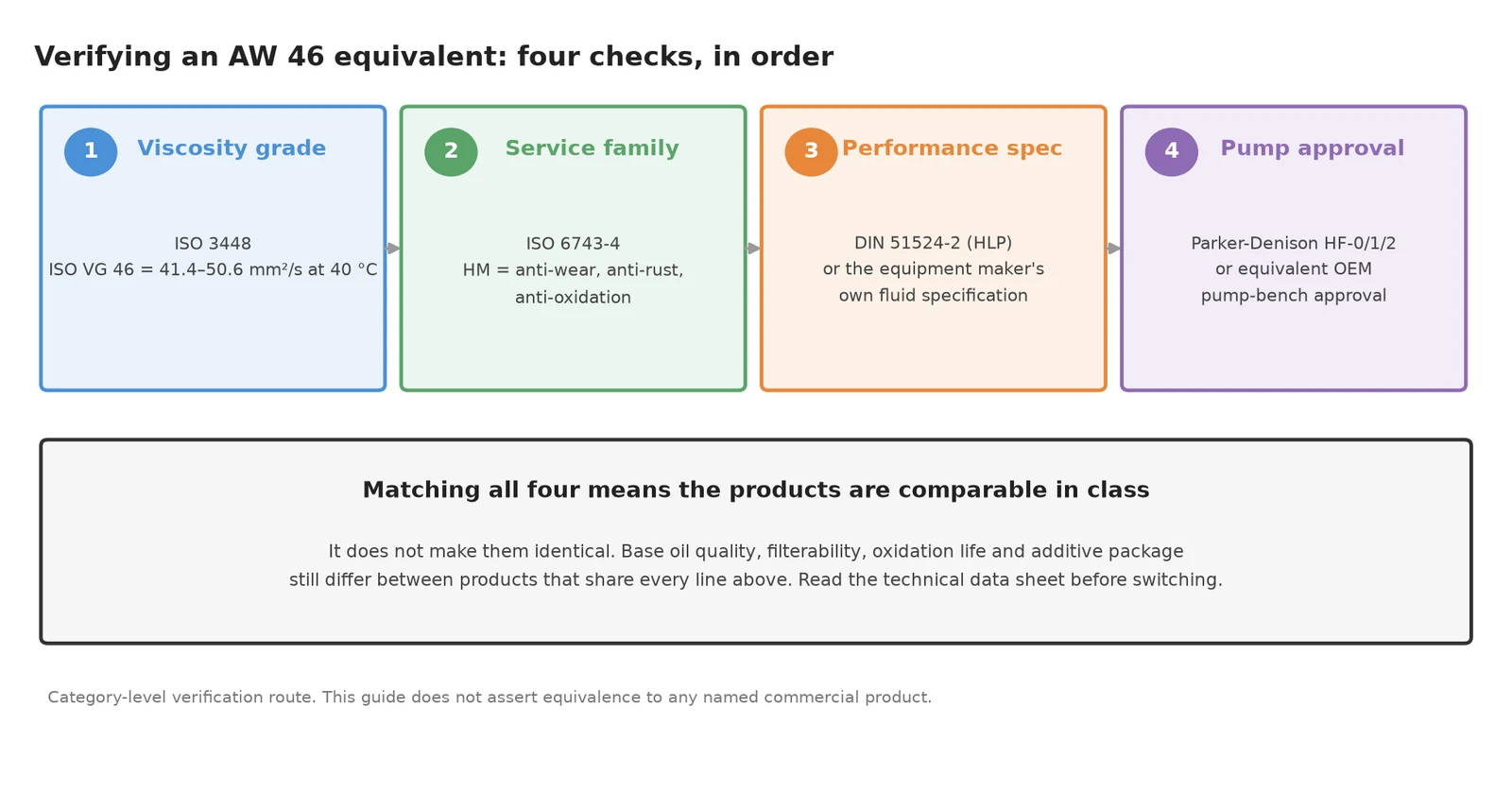
An oil is a genuine AW 46 equivalent when it matches on four things: the ISO 3448 viscosity grade of 46, the anti-wear service family (HM under ISO 6743-4), the performance specification the equipment requires, and any pump-manufacturer approval named in the manual. Matching viscosity alone is not equivalence. It is the first of four checks, and the one that proves the least.
The reason cross-reference charts disagree with each other is that most of them compare only the first item. Two oils can both be ISO VG 46 anti-wear fluids and still differ in viscosity index, pour point, filterability, oxidation life and additive chemistry, all of which affect whether the substitution survives in your system.
The four checks, and what each one rules out
Each check eliminates a different failure. Run them in order, because a failure at check one makes the rest irrelevant.
| # | Check | Reference | What it rules out | How to verify |
|---|---|---|---|---|
| 1 | Viscosity grade | ISO 3448 | Wrong film thickness at operating temperature; pump cavitation or excessive internal leakage | Data sheet shows kinematic viscosity at 40 °C inside 41.4–50.6 mm²/s |
| 2 | Service family | ISO 6743-4 | A plain mineral oil substituted for an anti-wear fluid | Data sheet states HM (or AW), not just “hydraulic oil” |
| 3 | Performance specification | DIN 51524 part 2 (HLP), or the equipment maker’s own document | An anti-wear claim with no test programme behind it | Supplier names the document the claim is made against |
| 4 | Pump approval | Parker-Denison HF series, or the OEM’s own approval | A fluid that has never run on a pump bench | Supplier produces the approval certificate for that grade |
Checks one and two are visible on any honest data sheet. Checks three and four are where suppliers separate, because they require a document rather than a description.
ISO 46 and AW 46 are not two options
A recurring question in cross-reference searches is whether ISO 46 and AW 46 are alternatives to each other. They are not comparable terms.
ISO VG 46 is a viscosity grade defined by ISO 3448. It says the oil measures 41.4 to 50.6 mm²/s at 40 °C and says nothing about additives. AW 46 means an anti-wear oil at that grade. Every AW 46 is an ISO VG 46; an oil described only as ISO VG 46 might carry no anti-wear additives at all.
So a chart offering “ISO 46 or AW 46” is presenting a viscosity and a formulation as if they were competing choices. If the equipment manual specifies anti-wear duty, ISO VG 46 alone does not satisfy it. The naming systems and how they overlap are set out in AW32 vs AW46 vs AW68 hydraulic oil.
What equivalence does not cover
Two oils can pass all four checks and still behave differently. These properties are not part of the AW 46 designation and have to be compared directly on the data sheets.
| Property | Why it matters | Where to find it |
|---|---|---|
| Viscosity index | Decides how much viscosity is retained away from 40 °C; a wide-temperature site needs a high VI | Data sheet, “viscosity index” |
| Pour point | Sets the practical cold-start limit; two oils sharing the AW 46 label can sit far apart on it. The two Zhongtian ISO VG 46 grades in the table above differ by 18 °C | Data sheet, “pour point” |
| Filterability | A fluid that plugs fine filters costs more in elements than it saves in price | Filterability test result, or the cleanliness class |
| Oxidation life | Determines how long the additive package survives at operating temperature | Oxidation stability test on the data sheet |
| Additive chemistry | Zinc-containing or ashless; matters for yellow metals, filtration and disposal | Stated as zinc-free/ashless, or ask |
| Water separation | A demulsifying oil drops ingested water for draining rather than circulating it | Demulsibility test result |
The gap that catches buyers most often is viscosity index. Two oils sitting inside the same ISO VG 46 window can carry viscosity indices of 105 and 144, nearly identical at 40 °C and materially different at −20 °C or 70 °C. That comparison, with measured values, is in L-HM vs L-HV hydraulic oil.
Reading a cross-reference chart without being misled
Brand cross-reference tables are useful for narrowing a shortlist and unreliable as proof. Three things to keep in mind when using one.
A chart entry is a claim by whoever published it. A cross-reference published by a seller is a commercial statement about their own product, not an independent verification of the one it replaces. Treat it as a starting point and verify against the four checks above.
Charts age. Formulations are revised, product lines are discontinued and specifications are superseded. A chart with no date on it cannot be assessed, and a match that was true three years ago may not be true now.
Equivalence is directional in practice. A fluid meeting a higher specification usually satisfies a lower requirement, but the reverse does not hold. If the manual names an approval, the replacement needs that approval, not a general assurance of similar performance.
What to ask a supplier
Send these five questions with a request for quotation. The answers separate suppliers faster than a price comparison does.
- What is the measured kinematic viscosity at 40 °C for this batch? Not the grade, the number.
- What is the viscosity index and pour point? These decide behaviour outside 40 °C and are absent from the grade designation.
- Which performance specification is the anti-wear claim made against, and can you send that document?
- Which pump approvals does this exact grade hold, and can you produce the certificate?
- Is the additive package zinc-containing or ashless? Relevant to filtration, yellow metals and disposal.
A supplier who answers all five with documents is comparable to another who does the same. A supplier who answers with adjectives is not being compared on the same basis. The wider evaluation framework is in our lubricants sourcing guide.
Zhongtian’s ISO VG 46 anti-wear grades
For readers evaluating a Chinese manufacturing source, these are the ISO VG 46 anti-wear options we produce, with the measured values from our current technical data sheets.
| Product | Family | Viscosity at 40 °C | Viscosity index | Pour point | Notes |
|---|---|---|---|---|---|
| L-HE 46 | HM, high cleanliness | 45.12 mm²/s | 105 | −21 °C | Meets the Parker-Denison HF-0 requirements; moisture reported as trace |
| L-HV 46 | HV, high viscosity index | 45.47 mm²/s | 144 | −39 °C | For wide temperature ranges; also meets HF-0 |
Our anti-wear range also includes a standard L-HM anti-wear oil and an ashless variant, both in ISO VG 32, 46, 68 and 100. What each additive type is for is covered in what anti-wear hydraulic fluid is.
FAQ
What is the equivalent of AW 46 hydraulic oil? Any anti-wear hydraulic oil at ISO VG 46 that also meets the performance specification and pump approval the equipment requires. The grade alone is one of four checks.
Is ISO 46 the same as AW 46? No. ISO VG 46 is a viscosity grade only. AW 46 is an anti-wear oil at that grade. An oil sold as ISO VG 46 may carry no anti-wear additives.
Can I substitute AW 32 or AW 68 for AW 46? Only where the equipment manual allows a range. AW 32 is thinner and AW 68 thicker; both move the operating viscosity away from what the pump was specified for.
Is AW 46 the same as HM 46? At family level, yes. AW is the North American market label and HM is the ISO 6743-4 service family for anti-wear hydraulic oils. Chinese products use the L-HM designation for the same family.
Does a matching cross-reference chart mean two oils are interchangeable? No. It means someone considers them comparable. Verify the viscosity, family, specification and approval yourself before switching, particularly where a warranty depends on a named fluid.
What if the equipment manual names a specific branded product? Ask the supplier which specification that product meets, then verify the replacement against the specification rather than against the brand name. Where the manual names an approval rather than a brand, the approval is what has to match.
Sources
- ISO 3448 — industrial liquid lubricants, ISO viscosity classification; defines the VG 46 window quoted above.
- ISO 6743-4 — classification of hydraulic fluids by service family, defining HM and HV.
- Viscosity, viscosity index and pour point figures for L-HE 46 and L-HV 46: Zhongtian Petrochemical technical data sheets, current production.
This guide compares products at the level of standards and published specifications. It does not assert that any Zhongtian product is equivalent to a specific named commercial product, because that determination belongs to the equipment manufacturer whose approval is at stake.
Zhongtian Petrochemical has manufactured hydraulic oils since 1998. Our quality, environmental and occupational health management systems are certified to ISO 9001:2015, ISO 14001:2015 and ISO 45001:2018 under registration numbers 62825Q9372R0S, 62825E9373R0S and 62825S9374R0S, valid to April 2028 and verifiable through the issuing body.
Send us the specification named in your equipment manual and the grade you currently run, and our technical team will tell you which of our products meets it and produce the supporting documents. Contact Zhongtian Petrochemical.