




Zhongtian Petrochemical technical sales. First published 30 April 2025, rewritten 6 October 2026 with the current product data sheet and our internal training material.
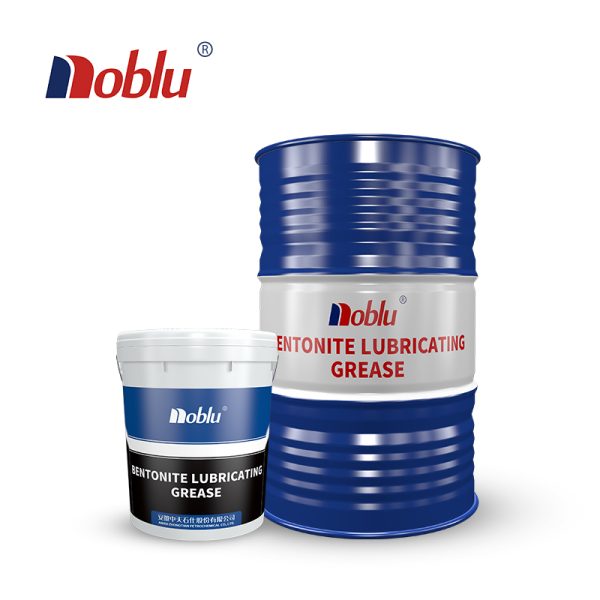
Bentonite grease is a grease thickened with organically treated bentonite clay instead of a metal soap. The clay does not melt, so the grease has no true dropping point, and its upper temperature limit is set by the base oil and the surface treatment on the clay rather than by the thickener. That is why the data sheet still prints a dropping point, why the grease survives in a furnace bearing and fails in a fast one, and why you cannot top it up with whatever grease is on the shelf. This page sets out the limits printed on our data sheet, the duties it is specified for, the duties where it is the wrong choice, and how to read it against lithium, lithium complex and polyurea grease. Why a high dropping point is not a working limit is explained, with data sheet figures, in our grease dropping point guide.
What a clay thickener does differently
A soap grease holds its oil in a fibre network made from a metal soap, and that network collapses at a defined temperature, which the dropping point test records. Our training material puts bentonite grease in the other family, the inorganic thickeners, together with silica gel. The clay is treated with a surfactant so that it swells in oil and builds a plate structure; that structure has no melting point, so the grease keeps its shape well past the temperature at which a lithium soap would have run out of the bearing. The same material notes the trade-offs that come with it: the heat resistance depends on the surfactant and the base oil, the low-temperature behaviour depends on the base oil chosen and on how much thickener is used, the mechanical stability varies with the surfactant type, and the protection against corrosion on metal surfaces is slightly weaker, so a rust inhibitor is added in the formulation.
Why the data sheet shows a dropping point for a non-melting grease
Our bentonite grease product page lists a dropping point of at least 270 °C by GB/T 4929, and our internal training teaches that bentonite grease has no dropping point. Both statements are right, and the difference matters when you write a specification. The test heats a cup of grease until the first drop falls through the orifice; with a soap grease that drop appears when the soap melts. With a clay grease the thickener never melts. A drop can still fall, but it is separated base oil rather than a collapsed structure, a point ASTM D566 makes in its own scope (greases with non-soap thickeners “can, without a change in state, separate oil”; the method was withdrawn in 2023 in favour of D2265), and if no drop falls before the method’s practical ceiling the data sheet reports a minimum, which is what the “at least 270 °C” row on ours means. Treat it as a threshold, not a transition: an identity check that the drum contains a clay grease, not a working temperature. The rating to use for duty is the service range printed on the product page, minus 30 °C to 250 °C, and even that needs the qualification below. ASTM makes the same point for soap greases in the scope of D2265: above 200 °C the dropping point has no correlation with the maximum operating temperature.
What actually limits a bentonite grease at the top end is oil loss. The base oil evaporates and bleeds faster as the housing gets hotter, and the clay structure stays behind, dry and hard, which is the dry, caked residue found when a clay-greased furnace-door or kiln bearing is opened after the oil has gone. The two rows on our data sheet that speak to this are evaporation (99 °C, 22 h, at most 1.5 percent) and steel-mesh oil separation (100 °C, 24 h, at most 5 percent for grades 1 and 2, 3 percent for grade 3). Our training describes the steel-mesh test as the measure of oil separation at service temperature, so for a hot, slow bearing it is the row to watch, and the reason to shorten the relubrication interval rather than wait for the grease to “melt”, which it never will.
The limits on our data sheet, and which belong in your spec
These are the rows printed on our product page for the three grades. The page labels them typical of normal production, so ask for the batch certificate before you copy any row into a purchase specification.
| Row on the data sheet | Grade 1 / 2 / 3 | Method | Put it in the spec? |
|---|---|---|---|
| Appearance | black, smooth, even | visual | No; identity only |
| Worked penetration, 0.1 mm | 310 to 340 / 265 to 295 / 220 to 250 | GB/T 269 (cone penetration, ASTM D217 principle) | Yes; it fixes the NLGI grade |
| Dropping point | at least 270 °C | GB/T 4929 | Yes, as an identity check only |
| Steel-mesh oil separation, 100 °C, 24 h | at most 5 / 5 / 3 percent | SH/T 0324 | Yes, for hot and slow bearings |
| Evaporation, 99 °C, 22 h | at most 1.5 percent | SH/T 0337 | Yes, for duty above about 150 °C |
| Water loss, 38 °C, 1 h | at most 10 percent | SH/T 0109 (washout, ASTM D1264 principle) | Yes, if the bearing sees water |
| Rust prevention, 52 °C, 48 h | pass | GB/T 5018 | Yes; this is the row that covers the weaker natural rust protection of a clay grease |
| Service temperature | minus 30 °C to 250 °C | manufacturer rating | Treat as a rating, not a test |
Two qualifications. The product page does not print the base-oil viscosity, and for a clay grease that number decides both the low-temperature behaviour and the bleed rate at the top end, so ask for it. And the 250 °C figure is a rating for the grease, not a promise for the interval: our technical department has confirmed for our complex lithium and polyurea grades that the printed upper figure is a continuous limit, but at the top of any range the relubrication interval has to shorten, and the steel-mesh row tells you how fast.
What bentonite grease is specified for
Our product page lists the duties: bearings running under high temperature, heavy load and nuclear radiation, and the bearings, gears and other parts of high-temperature equipment in metallurgy and mining. Our training adds vehicle chassis, wheel bearings and high-temperature bearings, and notes that inorganic thickeners are the ones that can offer radiation resistance and resistance to chemical media. The common thread in those duties is a hot housing with a slow shaft that cannot be relubricated often.
| Duty | Fit | Why |
|---|---|---|
| Kiln-car, furnace-door and oven-conveyor bearings | Fits | Nothing melts; the limit is oil loss, which the interval controls |
| Slow, heavily loaded bearings in metallurgy and mining | Fits | High dropping-point identity, grade 2 or 3 consistency, rust test passed |
| Bearings near radiation sources | Fits, with a test | The product page names it; ask us for the dose history before quoting |
| Wheel hubs and chassis points on vehicles in hot climates | Fits | Named in our training; water loss at most 10 percent covers road spray |
| High-speed bearings, electric-motor bearings | Not the first choice | A clay grease does not release its oil back into the contact after shear the way a polyurea or lithium complex grease does, and our training notes that its mechanical stability depends on the surfactant used; polyurea grease is the usual answer for sealed motor bearings |
| Bearings that get direct water spray or steam | Check first | Water loss of 10 percent is a washout figure, not a spray-off figure; calcium sulfonate complex grease is the family built for water and heat together |
| Centralised lubrication lines in cold plants | Check first | Low-temperature pumpability depends on the base oil; ask for the viscosity and test the line |
| General plant maintenance at mild temperature | Not worth it | You pay for heat resistance the bearing never uses, and the grease will not mix with what is already there |
Bentonite grease vs lithium grease, lithium complex and polyurea
The question we get most often is “bentonite grease vs lithium grease”, and the honest answer is that they are rarely competing for the same bearing. The table uses our own grades so the numbers are comparable; the lithium figures are the typical values on our multipurpose lithium grease page, the complex lithium and calcium sulfonate complex rows come from our printed 2026 steel-industry manual, and the polyurea row from its product page.
| Grease family (our grade) | Thickener | Dropping point | Service range | Where it wins | Where it loses |
|---|---|---|---|---|---|
| Bentonite grease 1# / 2# / 3# | organically treated clay | at least 270 °C (GB/T 4929), non-melting | minus 30 °C to 250 °C | hot, slow, inaccessible bearings; radiation | fast bearings; mixing with anything else; weaker natural rust protection |
| Multipurpose lithium grease 2# | lithium 12-hydroxystearate soap | 175 °C (GB/T 4929) | minus 20 °C to 120 °C | cost, availability, broad compatibility | anything above about 120 °C |
| Extreme-pressure complex lithium 2# / 3# | lithium complex soap | 270 / 280 °C (GB/T 3498) | minus 30 °C to 220 °C continuous | shock load, re-greaseable hot bearings | direct water, price against simple lithium |
| Polyurea grease 2# | polyurea (non-soap organic) | at least 260 °C (GB/T 3498) | minus 20 °C to 220 °C continuous | sealed-for-life motor bearings, low bleed | changeover from lithium needs a full purge |
| Calcium sulfonate complex 2# / 3# | calcite in overbased sulfonate | at least 300 °C (GB/T 3498) | minus 40 °C to 230 °C | water, heat and load together | pumpability, price |
Read the dropping-point column with care. The lithium figures are real transitions; the bentonite figure is a test ceiling. If the bearing runs at 130 °C and can be re-greased on schedule, complex lithium or polyurea will usually do the job at lower cost and with a grease the rest of the plant already stocks. Bentonite earns its place when the bearing is hotter than 220 °C, when it turns slowly, or when it cannot be reached, and when the plant accepts that it is a one-grease housing.
Bentonite grease substitute and equivalent: what to answer
Buyers ask for “an equivalent” in two situations, and they need different answers.
If the existing grease is a bentonite grease from another supplier, the equivalent is another bentonite grease of the same NLGI grade and a base-oil viscosity in the same band, and the changeover still needs a purge, because compatibility charts only compare thickener families and say nothing about the base oil, additives or clay treatment of the two actual products. Ask the incumbent supplier for the base-oil viscosity; if they will not give it, ask for the steel-mesh and evaporation rows and match those.
If the question is “can I replace bentonite grease with something easier to stock”, the answer depends on the housing temperature and the interval. Up to 220 °C with scheduled relubrication, our complex lithium or polyurea grades are the usual substitutes; where water arrives with the heat, calcium sulfonate complex grease is the better fit. Above 220 °C, slow, or near radiation, there is no soap-based substitute on our list, and the right move is to keep the bentonite grease and tighten the interval.
Changing over: there is no mixing step
Our printed 2026 steel-industry manual carries the same note for every grease in it: do not mix with other greases, do not heat before use. For a clay grease the note is not a formality. The usual guidance across grease families is that clay thickeners are incompatible with soap thickeners, and when the two meet the structure can soften and bleed or harden and stop flowing. The published compatibility charts also disagree with one another, as Lubes’n’Greases documented when it compared them, so treat any chart, including the matrix on our grease types guide, as a starting assumption and let a mixing test on the two actual products decide.
The procedure that works in a hot bearing is the same one we describe for switching from lithium to polyurea: clean out what you can reach, fill with the new grease while the shaft turns, keep purging at the relief port until the discharge is the colour of the new grease, then shorten the first interval and inspect the discharge once more. Our bentonite grease is black, as the product page lists it, while other suppliers’ clay greases are often amber or tan. Against a yellow or red soap grease the purge is easy to judge by colour; against another dark clay grease it is not, which is one more reason to ask for the incumbent’s data sheet before you quote.
Frequently asked questions
What is bentonite grease used for?
Slow, hot, heavily loaded bearings that are hard to reach: kiln cars, furnace doors, oven conveyors, metallurgical and mining equipment, and bearings near radiation sources. Our internal training material also lists vehicle chassis points and wheel bearings.
Is bentonite grease better than lithium grease?
Above about 120 °C, yes; the simple lithium grease is out of its range. Between 120 °C and 220 °C with scheduled relubrication, complex lithium or polyurea usually serves better and costs less. Bentonite wins above 220 °C, at low speed, and where the bearing cannot be reached.
Why does the data sheet give a dropping point if the grease does not melt?
Because the test is run and reported for every grease. For a clay grease nothing melts; any drop is separated oil, so the data sheet reports a minimum, at least 270 °C on ours, rather than a melting point. Use it to confirm identity, not to set a working temperature.
Can I mix bentonite grease with lithium or polyurea grease?
No. Clay and soap thickeners are generally incompatible, our manual says not to mix any of our greases, and the published charts disagree with each other. Purge the housing and run a mixing test if any carry-over is unavoidable.
Is bentonite grease the same as moly grease?
No. Bentonite is a thickener; molybdenum disulfide is a solid additive that can be put into a grease with any thickener. Our bentonite grease contains no moly unless the data sheet says so, and our molybdenum disulfide lithium grease is a lithium grease with moly, not a clay grease.
Is bentonite grease waterproof?
It resists washout: our data sheet limits water loss to 10 percent at 38 °C for one hour. That is a washout figure, not a spray-off figure, and our training notes that a clay grease’s natural rust protection is weaker than a soap grease’s, which is why the rust test row matters for wet duty.
What NLGI grade should I ask for?
By the usual convention, grade 2 for most bearings, grade 3 where the grease must stay put on a vertical shaft or at the top of the range, and grade 1 for centralised lines and cold starts, since our training notes that thickener dosage also sets the low-temperature behaviour. Our 1#, 2# and 3# correspond to NLGI 1, 2 and 3; the worked penetration ranges are 310 to 340, 265 to 295 and 220 to 250.
Send us the housing temperature, not just the grease name
Tell us the bearing’s measured temperature, its speed, the current grease and whether the housing has a relief port, and we will say whether bentonite grease is the right family, which grade, and what interval to start with. The batch certificate for the drums you receive comes with the quote.