




Zhongtian Petrochemical technical sales. Published 6 October 2026. Manual figures from the 2026-03-10 edition; product-page figures as read on 1 October 2026.
Calcium sulfonate complex grease is a grease whose thickener is overbased calcium sulfonate converted into calcite particles, so the thickener itself carries part of the extreme-pressure and rust protection and the grease keeps its structure in water. A changeover to it can fail at the bearing housing even when the data sheet is right. This page gives the limits printed in our 2026 manual, where our own documents disagree, the mixing rule, and what to watch at the relief port while the old grease comes out.
What it is, in two sentences
The thickener starts as an overbased calcium sulfonate detergent whose calcium carbonate is converted to calcite crystals of about 100 to 400 nanometres; a complexing acid, 12-hydroxystearic acid in almost every commercial formulation, lets the thickener content fall to roughly 15 to 35 percent against 40 to 50 percent in a simple calcium sulfonate grease, as the STLE review by Wayne Mackwood sets out. The layered calcite shears under load, which is why the family is known for high four-ball loads, high dropping points, water resistance and rust protection, and why its weak points are price, pumpability and loss under direct water spray, as Lubrizol’s Bill Ward describes. Our own grade also carries an added extreme-pressure and anti-wear package, according to the product description in our manual.
What calcium sulfonate complex grease is specified for, and where it is the wrong grease
It is the right grease where water, heat and load arrive together and the bearing turns slowly enough that pumpability does not decide. Our 2026 steel-industry manual lists the duties it is specified for: hot-rolling and cold-rolling mill bearings; the turntable, mould, secondary cooling zone and segment roller tables of continuous casters; tension levellers and pendulum shears; conveyor roller tables; and, outside steel, medium- and low-speed bearings, gears and chains under high temperature and heavy load, high-speed giant couplings, and parts in contact with water, steam, acid or alkali. A buyer’s own wording shows the same logic from the other side. A marine-equipment buyer asked us for five 15 kg pails to test on vessel deck gear, and wrote the spec as NLGI 2, dropping point above 250 °C and water spray-off below 10 percent, delivered FOB.
| Duty | Fit | Why |
|---|---|---|
| Caster segments, roll-neck bearings, wet conveyors | Fits | Water, heat and load together; the thickener carries part of the EP and rust protection |
| Deck machinery and salt spray | Fits | Rust protection sits in the thickener as well as in the additive; our sales training names complex calcium and calcium sulfonate for seawater exposure |
| Slow, heavily loaded bearings up to 230 °C | Fits | Rated to 230 °C on both our manual and product page |
| High-speed, lightly loaded bearings | Usually not | A lighter, lower-viscosity grease is the usual choice, and the price is hard to justify |
| Centralised systems with long, cold lines | Check first | Our product page describes pumpability as a strength; Ward’s point is that it depends on the base oil chosen, so test the actual line at its lowest temperature |
| Dry, mild duty where a multipurpose lithium grease has been fine | Not worth it | You pay for water and EP performance the bearing never uses |
Both grades are in the manual; grade 2 is the common choice, as Mackwood notes. Tell us whether the housing is hot, vertical or leaking and we will say which grade.
The limits in our manual, and which belong in your purchase spec
These are the rows printed for our calcium sulfonate complex grease in the 2026-03-10 edition of our steel-industry manual. The manual heads the table “typical data” and labels the value column “quality index”, with the limits written as at-least or at-most figures; the product page labels its own table typical of normal production. Before you copy any row into a specification, ask us which figure the batch certificate is released against, and write the spec in the notation the certificate uses.
| Row in the manual | Limit, grade 2 / grade 3 | Method family | Put it in the spec? |
|---|---|---|---|
| Worked penetration, 0.1 mm | 265 to 295 / 220 to 250 | Cone penetration (ASTM D217 principle) | Yes; it fixes the NLGI grade |
| Dropping point | at least 300 °C | Wide-range dropping point (ASTM D2265 principle) | Yes, as an identity check, see below |
| Copper strip, 100 °C, 30 h | no green or black change | Copper corrosion | Yes, if the bearing has yellow-metal cages |
| Steel-mesh oil separation, 100 °C, 24 h | at most 5 percent | Static bleed | Yes, for long storage or slow relubrication |
| Water washout, 38 °C, 1 h | at most 4 percent | Washout from a bearing (ASTM D1264 principle) | Yes, for wet duty |
| Shear stability, 100,000 strokes | differs from the worked penetration by at most 40 units of 0.1 mm | Prolonged working | Yes, for vibrating or long-interval duty |
| Rust prevention, 52 °C, 48 h | pass | Bearing rust test | Yes, for wet or salt duty |
| Four-ball weld load | at least 3,089 N | Four-ball EP (ASTM D2596 principle) | Yes, for shock load |
| Four-ball wear scar, 392 N, 60 min | at most 0.55 / 0.60 mm | Four-ball wear | Yes, for continuous heavy load |
| Service temperature | up to 230 °C | Manufacturer rating | Treat as a rating, not a test |
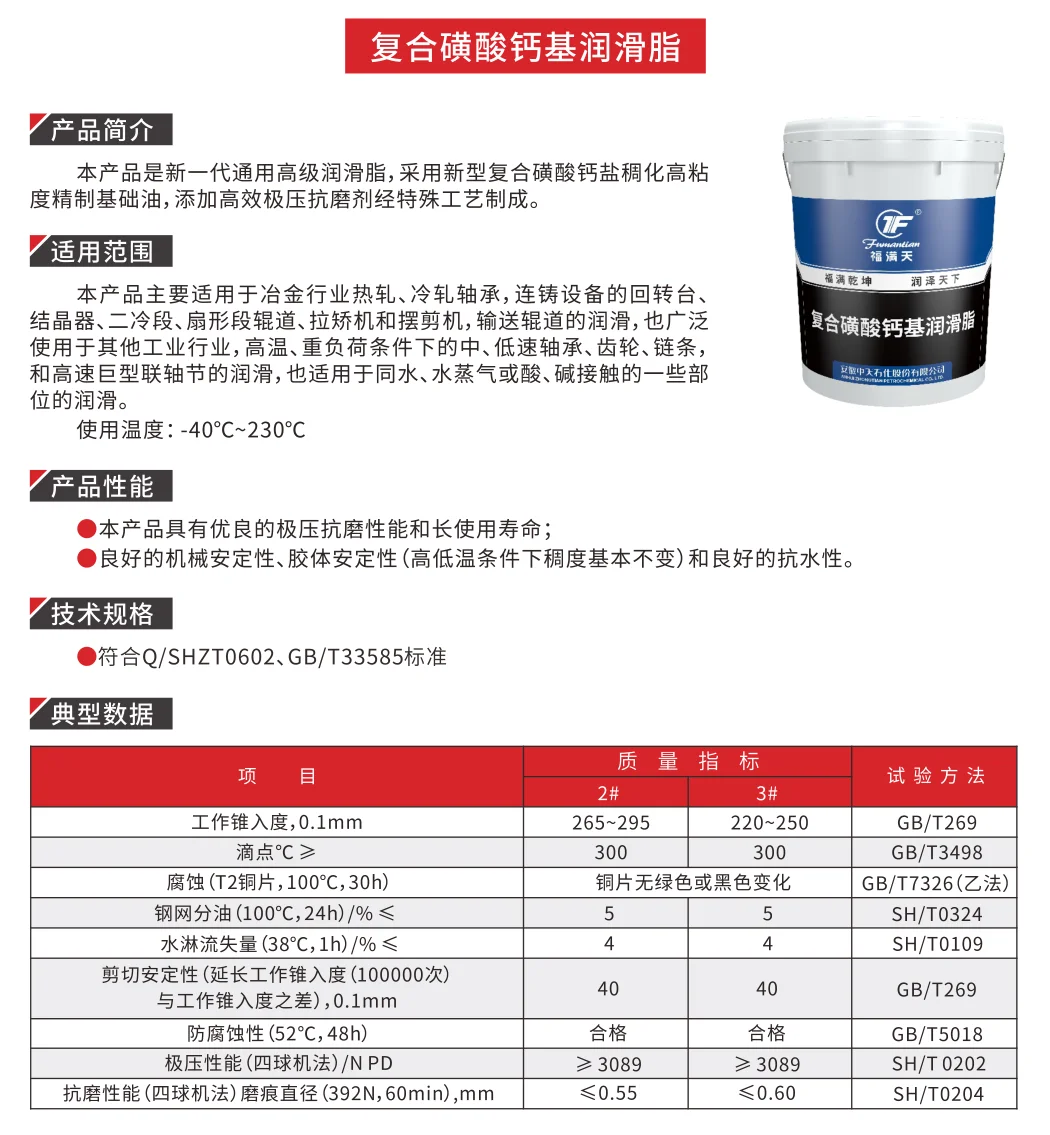
Read two ASTM notes alongside it. By ASTM’s own note on the method, a dropping point above 200 °C has no correlation with the maximum operating temperature; use it to confirm the grease is what the label says, and use the 230 °C rating plus the bearing’s measured temperature to decide the duty. And the washout test, by ASTM’s scope statement, has no established correlation with field service; the spray test in ASTM D4049 is the one ASTM says suggests correlation with roll-neck bearing service, so ask for a spray-off figure as well if your bearing sees direct water. We have not published a spray-off value for this grade; ask whether the batch has one.
Our two documents do not agree on every row, and you should know where before you write a spec. The 2026 manual rates the grease from minus 40 °C; the older product page says minus 30 °C. The manual limits water washout to 4 percent; the product page says 5. The manual allows 5 percent steel-mesh oil separation; the product page allows 3. The manual writes shear stability as a difference in penetration units, the product page as a percentage change rate of at most 10 percent; converted, 10 percent of a grade 3 penetration is roughly 22 to 25 units, so the product page’s limit is the tighter one. Neither document prints the base-oil viscosity. For any of those rows, ask for the current technical data sheet and the batch certificate for the drums you will receive.
Can you mix it with lithium grease?
Test it, or clean it out. The compatibility table compiled by Chemtura and reproduced in the STLE review rates calcium sulfonate complex greases as generally fully compatible with anhydrous calcium and lithium complex products, with the note that the outcome depends on the ratio, the degree of mixing, the temperature and contamination, and that a critical application should be tested. That sentence covers lithium complex. For a simple lithium grease, which is what most plants mean by “lithium grease”, the sentence does not cover it, and the compatibility matrix in our own sales training marks the pair as not tested, so there is no published chart you can lean on. For polyurea and several other pairs the charts from different makers disagree with each other, as David Turner of Shell, co-chairman of the NLGI technical committee, explains in Machinery Lubrication; treat those pairs as untested too. The matrix we publish on our grease types guide is one of those charts, and carries the same caveat.
The test that settles it is ASTM D6185. It mixes the two greases 50:50, then 10:90 and 90:10 as the practice requires, and compares the dropping point, the penetration after 100,000 strokes and the penetration after a 70-hour soak at 120 °C with each grease alone. Turner states the pass conditions: the mixture’s dropping point is not significantly lower than either grease, its worked consistency stays within the range of the two, and its change in consistency after heat storage falls within the range of the two greases’ own changes. DuPont’s Molykote guidance adds what a failing pair typically shows: a softening of one to two NLGI grades after working. ASTM’s significance note describes the result in a bearing: the mixture most often softens, sometimes hardens, and in the worst case the thickener and oil separate until grease runs out of the housing.
Our position is the one printed on page 27 of our manual: do not mix with other greases. The rule we teach our own sales staff adds two points: clean the old grease out before the new one goes in, and never share grease guns, pails or scoops between products, because the mixture that forms in the tool ends up in the bearing.
How to change over: the housing decides, not the chart
Whether you can change to calcium sulfonate complex grease cleanly depends on three things about the housing, in this order.
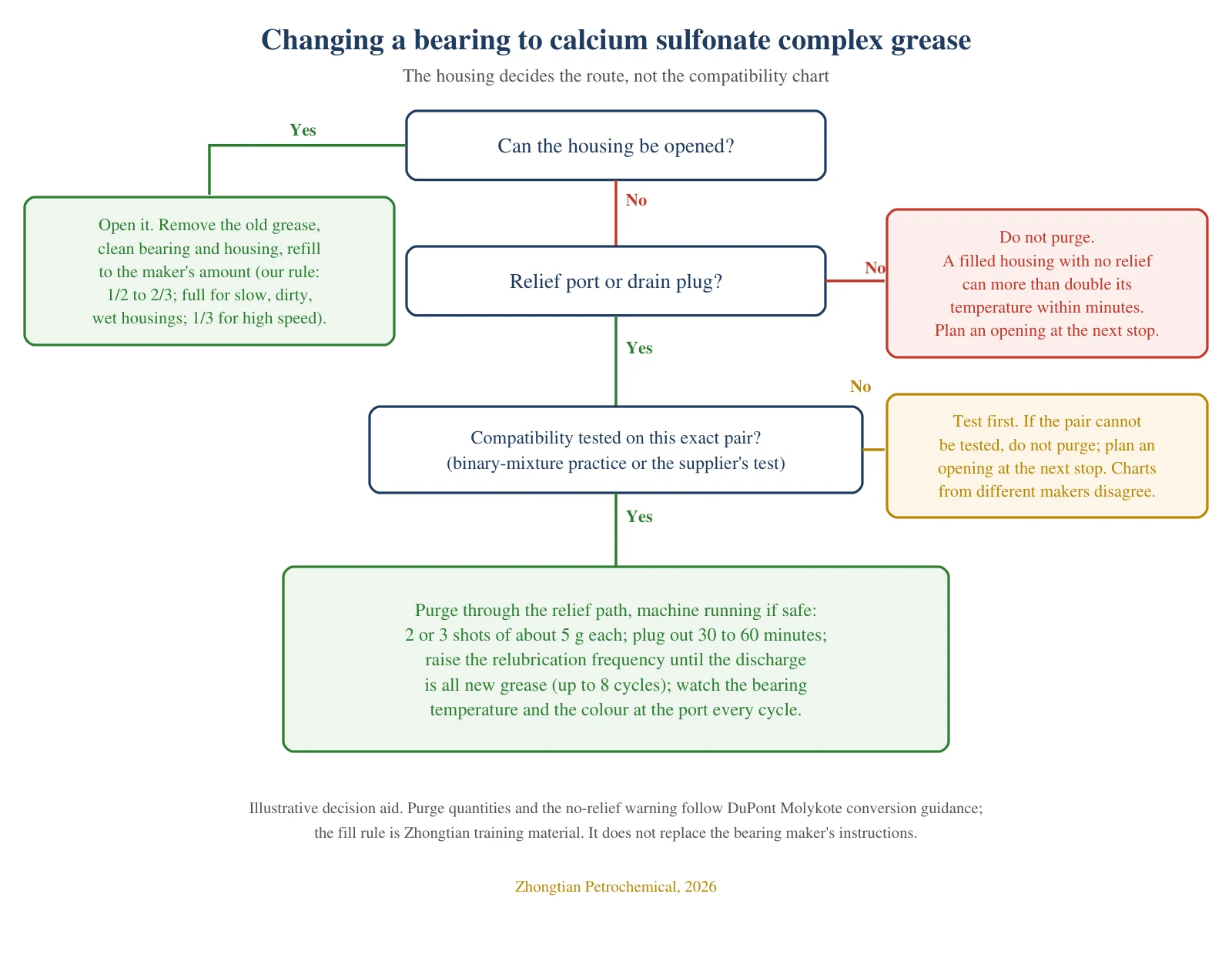
- Can the housing be opened? If yes, open it, remove the old grease, clean the bearing and housing, and refill to the amount the bearing maker specifies. Our training material gives one half to two thirds of the free space as the general rule, a full fill for slow bearings in dirty, wet housings, and about one third for high-speed bearings. This is the only route that does not depend on compatibility at all, and it is the route ASTM records equipment makers recommending.
- If it cannot be opened, does it have a relief port or drain? Purging only works through a relief path. DuPont’s guidance is explicit about the alternative: filling a bearing that has no relief can push the rolling elements through packed grease, with the temperature more than doubling within minutes.
- If you must purge, test compatibility first. A binary-mixture result by the ASTM practice above, or the supplier’s test on that exact pair, is the condition for running old and new grease together in a working bearing. If the pair cannot be tested, do not purge; plan an opening at the next stop.
The purge itself follows the routine relubrication sequence Mobil publishes for rolling-element bearings, which is the same mechanical sequence a changeover uses: with the machine running if that is safe, remove the drain plug, clean out hardened grease, pump new grease until the old grease is purged and new grease appears, then leave the plug out at operating temperature until draining stops, which Mobil puts at 10 to 30 minutes. DuPont’s conversion protocol adds the quantities and the interval rule: two or three shots of a quarter ounce each (DuPont prints this as 5 g; a quarter avoirdupois ounce is nearer 7 g); plug out for 30 to 60 minutes; relubrication frequency raised until the discharge is all new grease, which can take up to eight cycles; bearing temperature watched throughout. We have not logged a purge count per bore size on a customer’s bearing, so the DuPont figure is the only published number we can point to; if your housing is large, expect the upper end. If the bearing is fed from a centralised line, DuPont’s guidance is to take conversion advice from the supplier rather than purge by shots; send us the line length, the lowest line temperature and the pump type with the enquiry.
How to tell the old grease is out
Nobody can see inside a sealed housing, so the judgement is made at the relief port and on the temperature trend. Colour is a weak guide. Mackwood notes that complex calcium sulfonate grease is more opaque than simple calcium sulfonate grease, and in the same review calls colour the least reliable way to identify a grease, so do not rely on memory of what the old grease looked like. Before the first shot, smear the old grease and the new grease side by side on a card, label it, and keep it with the log; judge the port discharge against that card. Compare consistency from cycle to cycle at the same temperature, not against the pail, because grease leaving a hot port is always softer than grease at ambient.
| What you see at the port | What it means | What to do |
|---|---|---|
| Discharge matches the old smear on the card | Old grease still filling the path | Continue the cycle; do not shorten the interval below the purge plan |
| Discharge streaked, two colours, softer than the previous cycle at the same temperature | Mixing zone; softening across cycles is the first sign ASTM describes for an incompatible pair | Keep the plug out longer; if it softens again on the next cycle, stop and open the housing |
| Discharge uniform and matching the new smear, consistency steady across two cycles | Transition complete at the port | Return to the normal interval; log the date and the batch number |
| Bearing temperature rises and stays up after a shot | Overfill, a blocked relief path, or an incompatible mixture churning | Stop adding grease; clear the relief port; let it run plug-out until the temperature returns; if it rises again, open the housing |
| Mostly oil with little thickener, over two consecutive cycles | Separation; the mixture, or the old grease, has lost its structure | Stop purging and plan an opening; a thin oily discharge in the first minutes plug-out is normal bleed from hot grease |
| Nothing comes out after repeated shots | Dry bearing, blocked relief, or grease leaving by another path such as a seal or a motor winding | Check the port is clear before another shot, as Mobil’s procedure requires; look for grease at the seals |
What the discharge can tell you about ageing, hardening and oil separation in general is covered in why grease hardens or separates. Keep two records. Note the bearing temperature before the first shot and at each cycle, because a steady rise is one signal that does not need an opened housing. And keep the batch certificate for the new grease with the log; a dropping-point check, or a quarter-scale penetration, on a port sample gives a trend against the certificate, not a pass or fail, because a port sample is worked, hot and mixed with the old grease.
Before you order
Send us three things with the enquiry: how the bearing is relieved (open housing, drain plug, relief fitting, or none), the name of the grease in it now, and the housing temperature in service. We reply with the grade, the current technical data sheet with the batch certificate format you will receive, and whether we would purge that housing or open it. A generic request-for-quotation checklist is in our calcium sulfonate versus lithium cost guide; equivalents to other makers’ greases, by published data only, are in our grease cross-reference chart; how long an unopened pail keeps is in grease shelf life.
Frequently asked questions
What is calcium sulfonate grease good for?
Bearings, gears, chains and couplings that run slowly or at moderate speed under heavy load, with water, steam or salt present, up to the 230 °C rating of our grades. The duties in our manual are continuous-caster segments, mill bearings, roller tables and parts in contact with water, steam, acid or alkali. It is not worth its price in dry, mild duty.
What is calcium sulphonate complex grease?
A grease thickened with overbased calcium sulfonate converted to calcite particles and complexed with a hydroxystearic acid, so that the thickener itself provides part of the extreme-pressure and rust protection. Our grades are made to limits that include a dropping point of at least 300 °C, water washout of at most 4 percent and a four-ball weld load of at least 3,089 N.
Can you mix calcium sulfonate grease with lithium grease?
Only after a compatibility test on that pair, by the mixing practice in ASTM D6185 or the supplier’s equivalent. Published charts rate calcium sulfonate complex as generally compatible with lithium complex, give no rating for simple lithium grease, and disagree with each other on other pairs. Our manual says do not mix; where the housing can be opened, clean it out instead.
Where should you not use moly grease?
In any bearing whose maker excludes solid additives, and in a housing you are changing to a different thickener without cleaning it out first. Our molybdenum disulphide lithium grease is specified for centralised systems on large metallurgical and chemical equipment under heavy load, heat and humidity, rated from minus 20 to 120 °C, which is 110 °C below the calcium sulfonate complex rating.
Our quality system is certified to ISO 9001:2015 under registration 62825Q9372R0S, valid to 24 April 2028, and the group’s testing company holds CMA and CNAS accreditation, so a batch certificate can be checked against an accredited laboratory’s report.