





Written 15 October 2026. Figures transcribed from report QT0102474-2026, report (2026) Wanjian SH No. 07979 and SAMR’s result notice of 29 September 2026. Checked by Zhongtian’s quality control department.
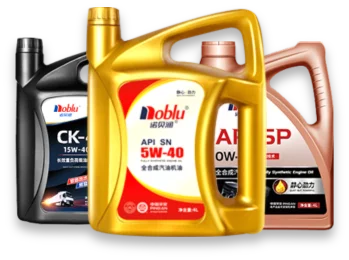
In 2026, two Chinese market regulators bought gasoline engine oils made by Anhui Zhongtian Petrochemical from online stores and sent them to government testing institutes, and neither institute found a nonconformity in any item tested. The State Administration for Market Regulation (SAMR) had a fully synthetic SN 5W-40 produced by Zhongtian tested against China’s national gasoline engine oil standard, and the Anhui Administration for Market Regulation had a synthetic SN 10W-40 produced by Zhongtian tested against the company’s own standard. By Zhongtian’s own records, this is the eleventh consecutive year in which its products have passed government spot checks; the two 2026 reports are shown below.
How the two spot checks were run
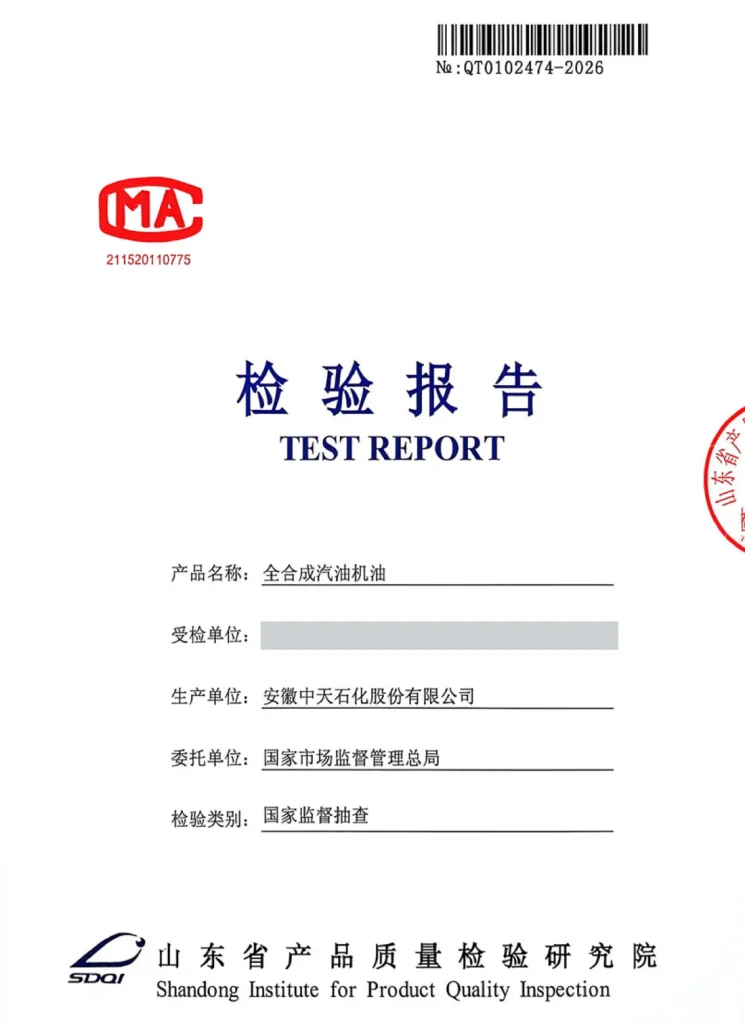
A supervision spot check is a test the regulator orders, on a sample that a sampling body appointed by the regulator takes from the market, so the manufacturer does not choose the bottle. In both checks the 4 L packs were bought through online retail listings, sealed, and passed to a testing institute accredited under China’s CMA scheme; the CMA mark and the institute’s certificate number are printed at the top of both report covers.
| National check | Anhui provincial check | |
|---|---|---|
| Commissioned by | State Administration for Market Regulation | Anhui Administration for Market Regulation |
| Product | Fully synthetic gasoline engine oil, SN 5W-40, 4 L | Synthetic gasoline engine oil, SN 10W-40, 4 L |
| Production date of the sample | 13 May 2026 | 24 October 2025 |
| Sampled | 20 July 2026, by the Tianjin Institute of Product Quality Supervision and Testing Technology | 13 August 2026, by the Anhui Product Quality Supervision and Inspection Research Institute |
| Tested by | Shandong Institute for Product Quality Inspection (CMA 211520110775), 3 August to 3 September 2026 | Anhui Product Quality Supervision and Inspection Research Institute (CMA 231200110769), 17 to 26 August 2026 |
| Judged against | GB 11121-2025, the company standard Q/SHZT 203-2021, and SAMR’s 2026 rules for engine oil spot checks | The company standard Q/SHZT 203-2021 and Anhui’s 2026 rules for engine oil spot checks |
| Report | QT0102474-2026, issued 22 September 2026 | (2026) Wanjian SH No. 07979, issued 28 August 2026 |
| Conclusion | Items tested conform to the national standard; no nonconformity found. SAMR result notice, 29 September 2026: qualified | Items tested conform to Q/SHZT 203-2021; no nonconformity found |
GB 11121-2025 is China’s national standard for gasoline engine oils, issued on 30 June 2025 by SAMR and the Standardization Administration of China; it took effect on 1 July 2026, replacing the 2006 version, 19 days before the national sample was taken. To check the laboratories without relying on Zhongtian, look up each institute’s CMA certificate number in the inspection-body directory of the Certification and Accreditation Administration of China; to check a report itself, send its number to the institute that issued it.
SN 5W-40 fully synthetic: the national results, item by item
The national laboratory tested ten properties of the fully synthetic SN 5W-40 produced by Zhongtian, and every result sat inside its limit. The limits below are those of the national standard as printed in the report; the report prints the same limits for the company standard on every item except the 150 °C foam sequence and phosphorus, where the company-standard column is blank.
| Property | Limit | Result | What the property tells a buyer |
|---|---|---|---|
| Cold-cranking viscosity at -30 °C | 6,600 mPa·s max | 4,640 mPa·s | How easily the engine turns over on a cold start |
| Pumping viscosity at -35 °C | 60,000 mPa·s max | 21,000 mPa·s | Whether the oil pump can draw oil at very low temperature |
| Kinematic viscosity at 100 °C | 12.5 to under 16.3 mm²/s | 14.19 mm²/s | That the oil is a “40” at running temperature |
| Flash point, open cup | 200 °C min | 239 °C | Fire safety in storage and handling |
| Pour point | -35 °C max | -41 °C | The lowest temperature at which the oil still flows |
| Evaporation loss, Noack, 250 °C for 1 h | 15 % max | 7.1 % | How much oil boils off in a hot engine |
| Foaming tendency / stability at 24 °C, 93.5 °C, 24 °C after, 150 °C | 10/0, 50/0, 10/0, 100/0 mL max | 5/0, 15/0, 5/0, 75/0 mL | Whether foam forms, and whether it stays |
| Mechanical impurities | 0.01 % max | None (below 0.005 %) | Particles from production or packing |
| Water | Trace max | None | Contamination in the pack |
| Phosphorus | 0.06 % min | 0.0750 % | A floor the standard sets for this oil category |
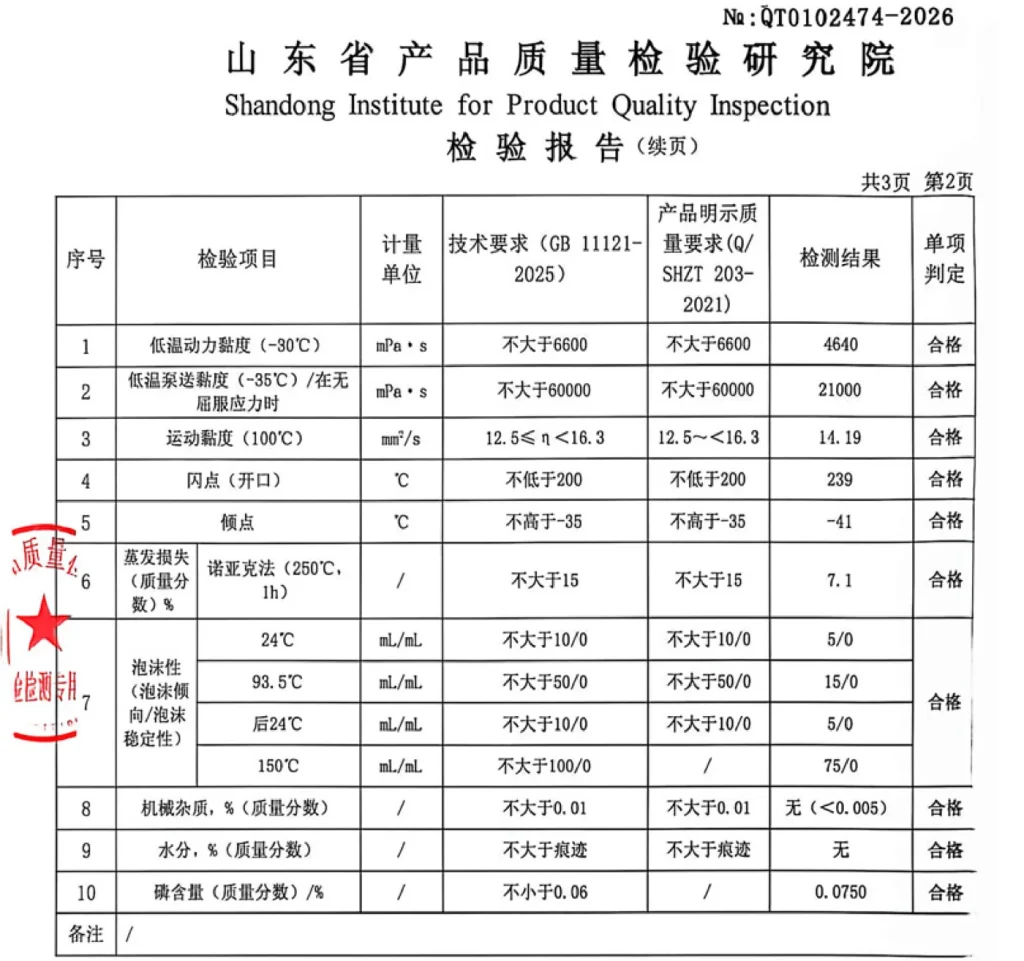
The three viscosity limits in the table are the numbers SAE J300 sets for a 5W-40, so the result also confirms, independently, that the oil meets the low-temperature and 100 °C viscosity limits of the grade on the label; J300’s high-temperature high-shear limit was not part of this check. The cold-cranking figure of 4,640 mPa·s is about 30 % under its ceiling, and the Noack loss of 7.1 % is under half the 15 % allowed. A lower Noack figure means less oil lost to evaporation at high temperature, so ask any China engine oil manufacturer for this number alongside the viscosity grade.
SN 10W-40 synthetic: the Anhui provincial results
The Anhui laboratory tested nine properties of the synthetic SN 10W-40 produced by Zhongtian against the company standard Q/SHZT 203-2021, reported phosphorus without a limit or verdict, and found no nonconformity. This sample was older: it was produced on 24 October 2025 and taken on 13 August 2026, so the results describe oil about ten months after production.
| Property | Limit | Result |
|---|---|---|
| Cold-cranking viscosity at -26 °C, as printed | 7,000 mPa·s max | 4,460 mPa·s |
| Pumping viscosity at -30 °C | 60,000 mPa·s max | 13,300 mPa·s |
| Kinematic viscosity at 100 °C | 12.5 to under 16.3 mm²/s | 13.78 mm²/s |
| Pour point | -30 °C max | -39 °C |
| Water | Trace max | None |
| Foaming tendency / stability at 24 °C, 93.5 °C, 24 °C after | 10/0, 50/0, 10/0 mL max | 0/0, 10/0, 0/0 mL |
| Evaporation loss, Noack, 250 °C for 1 h | 16 % max | 11.4 % |
| Mechanical impurities | 0.01 % max | None |
| Flash point, open cup | 206 °C min | 226 °C |
| Phosphorus, reported without a limit or verdict | None | 0.0636 % |
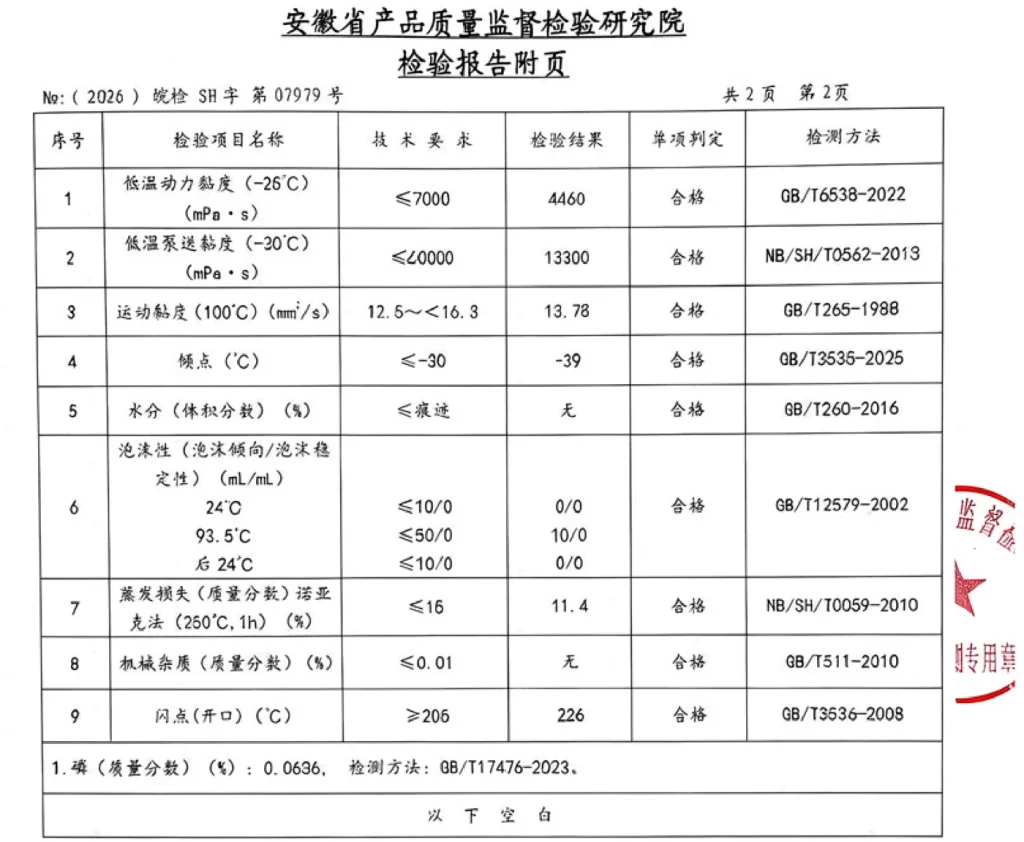
The pumping-viscosity and 100 °C limits match those of SAE J300 for a 10W-40; the cold-cranking test in this report was run at -26 °C, one degree colder than the J300 temperature for a 10W. Cold-cranking viscosity of 4,460 mPa·s against 7,000, pumping viscosity of 13,300 against 60,000, and a pour point 9 °C below its limit are the figures a distributor selling into cooler regions should check first.
How to read a Chinese spot-check report before you import
A Chinese spot-check report tells an importer more than a supplier’s own certificate of analysis, because the regulator’s sampling body chose the sample, but only when it is read for four things. Use this check on Zhongtian’s two reports and on any other supplier’s.
| Check on the report | Where it appears | What to look for |
|---|---|---|
| Who commissioned the test | Cover, “client” | A market regulator, national or provincial, for a supervision spot check; a company as client usually means the supplier ordered the test itself |
| How the sample was taken | Page 1, sampling body, date and site | Taken by the regulator’s appointed sampling body from the market; a sample “sent by the client” proves only the bottle that was sent |
| Which standard the oil was judged against | Page 1, “judgement basis” or “test criteria” | The national standard, the company’s own standard, or both; ask for the company standard’s limits if only that one is cited |
| What the conclusion covers | Page 1, “conclusion”, and the results page | Wording such as “no nonconformity found” covers the items listed, not engine tests or properties that were not measured |
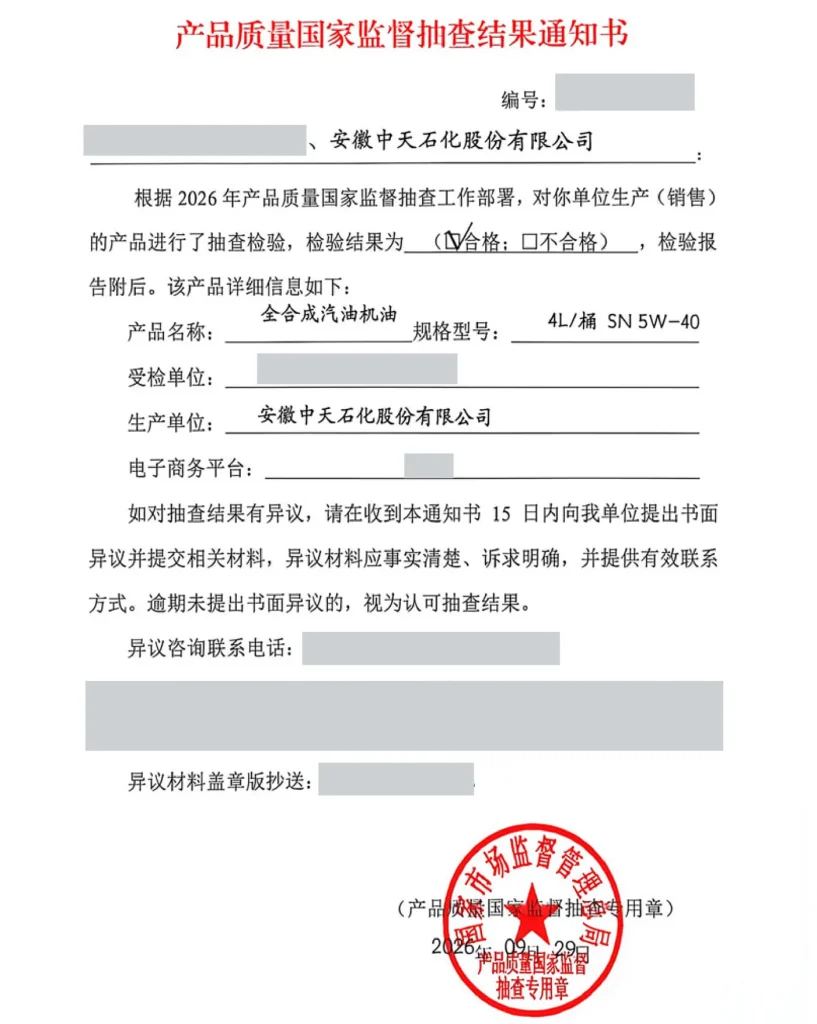
The fourth check carries the most weight. Neither report includes engine sequence tests, deposit tests or high-temperature high-shear viscosity, so a pass confirms the oil’s physical and chemical properties against the listed limits; engine performance is a separate question that the data sheet and batch certificate must answer. A spot check is also not an API certification: use of the API marks on a bottle is licensed separately through API’s Engine Oil Licensing and Certification System, and neither report addresses it, so raise API-marked bottles before the quotation if your market requires them.
Is Chinese engine oil good quality?
Chinese engine oil quality depends on the producer, not on the country, and the strongest evidence is a regulator’s test on a sample the producer did not choose. By that measure, the two oils above, both produced by Zhongtian, passed every item tested in 2026, one of them against China’s new national standard. For quick checks on a used or new oil sample at the workshop, see these simple checks on engine oil quality; for import decisions, use the four report checks above.
The common mistake: trusting the sample the supplier picked
The common mistake is accepting a certificate of analysis issued on a sample the supplier chose and sent, as if it described every drum that follows. A spot-check report removes that gap for the batch the regulator bought, and it leaves one question open that only your own process can close: ask for the batch certificate of the shipment you actually receive, and compare its viscosity and Noack figures with the limits above. The two reports describe the two retail packs the regulators bought; for the grade you order, the data sheet and the batch certificate of your shipment are the documents that describe your oil. Quote report number QT0102474-2026 or (2026) Wanjian SH No. 07979 in your enquiry and we will send a masked copy of that report with the technical data sheet of the grade you are pricing. Request the reports and a quotation.