





Read a grease label that boasts a 260°C dropping point and it is easy to assume the grease works at 260°C. It does not. Dropping point is the temperature at which grease gets soft enough to drip. It marks structural collapse, not a service rating. Continuous operating temperature, the number that actually governs equipment life, sits far below it, because long before the thickener melts, the base oil oxidizes, evaporates, and gives up.
The working rule most engineers use: subtract 30 to 50°C from the dropping point to estimate a safe continuous ceiling, and treat the base oil’s oxidation life as the real limit. A companion article works through this margin in detail in dropping point vs operating temperature. This page maps it onto real product tiers.
The two temperatures, kept separate
Two failure modes hide behind one word, “heat”:
- Structural failure. The thickener softens and grease drips out of the bearing. Dropping point predicts this.
- Chemical failure. The base oil oxidizes and evaporates, leaving a hard, dry residue that no longer lubricates. Oxidation stability predicts this, and it almost always arrives first.
A grease can hold its shape (high dropping point) while its oil is already spent. That is why dropping point alone is a trap, and why the thickener chemistry, which sets both the ceiling and whether there is a “melt” at all, is where selection really happens.
A real temperature ladder
Zhongtian’s grease range makes the hierarchy concrete. Note how the top of the ladder is occupied by thickeners that barely have a dropping point, because they do not melt in the conventional sense:
| Grease | Continuous range | Dropping point | Where it fits |
|---|---|---|---|
| Multi-purpose lithium | −20 to 120°C | 170–180°C | General bearings, moderate heat |
| Automotive lithium | −20 to 120°C | ≥180°C | Chassis, hubs, wheel bearings |
| Aluminum complex | −20 to 160°C | 235–240°C | Food-adjacent, water-heavy, moderate heat |
| HP-2 blue high-temp | −20 to 200°C | ≥260°C | Steel mills, kilns, hot heavy load |
| HP-X blue high-temp | −20 to 220°C | ≥270°C | Higher-temp continuous casting, sintering |
| HEP specific blue | −30 to 220°C | 310°C typical | Severe high-temp friction points; four-ball PD ≥3089 N |
| Polyurea | −20 to 220°C | ≥260°C | Sealed hot bearings, no coking |
| EP lithium complex | −30 to 220°C | 270–280°C | Hot plus heavy shock load |
| Bentonite (clay) | −30 to 250°C | Non-melting | Kilns, furnace doors, nuclear-radiation environments |
| Ultra-high-temperature | to 600°C | None | Furnace-door gears, baking-oven bearings |
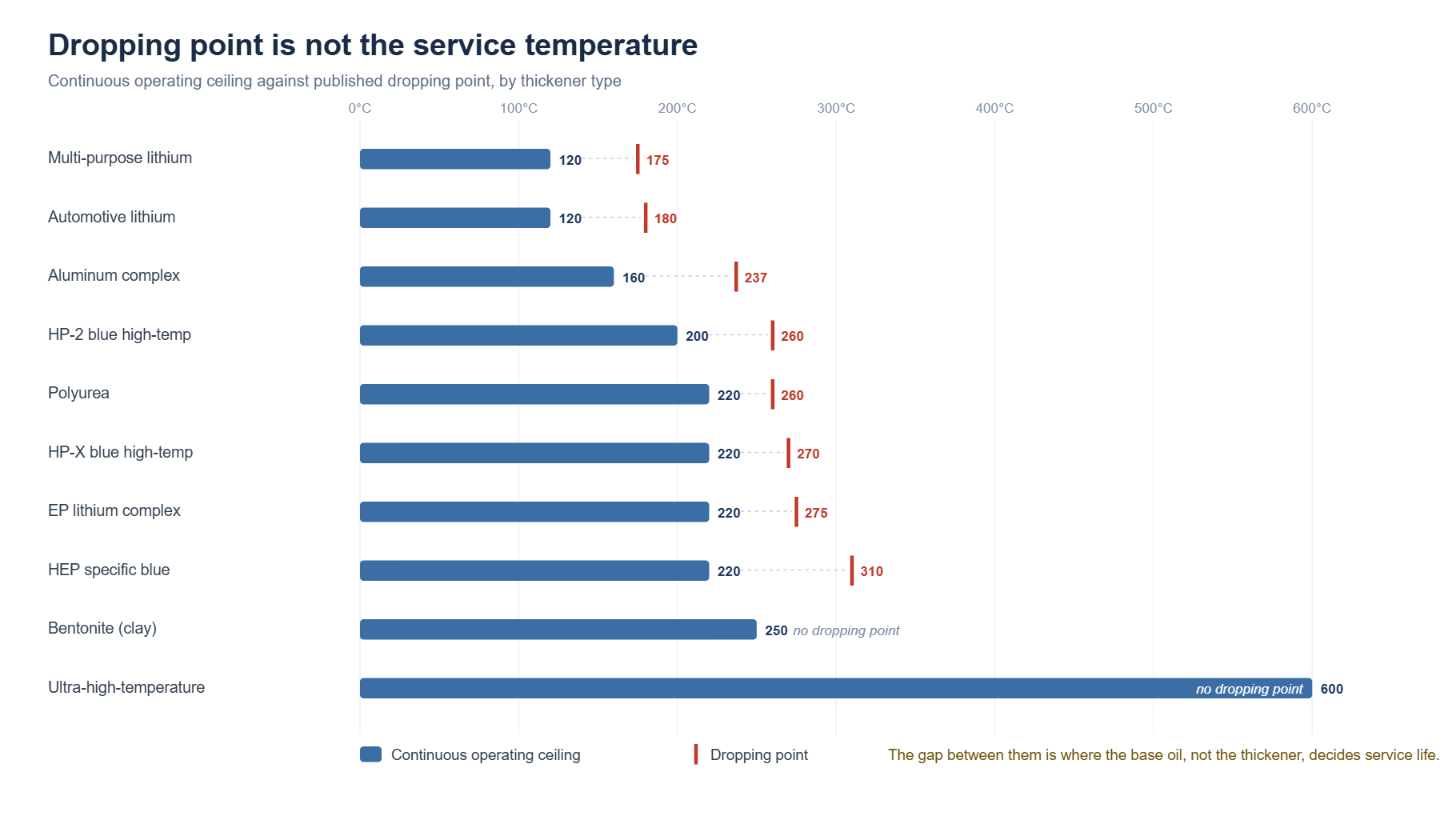
Two entries deserve a second look. Bentonite grease uses a clay thickener that has no melting point, so heat cannot make it drip and so it serves where organic thickeners have long since failed, including radiation environments where synthetic chemistry degrades. Ultra-high-temperature grease pairs a synthetic oil with an inorganic thickener and solid lubricants to reach 600°C, where the base oil is doing the surviving because no soap could.
How to actually choose
Ignore the headline dropping point and answer three questions in order:
- What is the true metal temperature, not the ambient? A bearing near a furnace runs far hotter than the room. Measure it.
- Is oxidation life or structural stability the binding limit? Continuous high heat kills the oil first, so weight oxidation stability and choose a synthetic-based or high-temperature thickener.
- Is there load or shock on top of heat? Heat plus impact needs EP performance from the EP lithium complex tier, with its four-ball weld data, rather than a plain high-temp grease.
If the point is hot but sealed and long-life, polyurea’s no-coking behavior often beats a higher-dropping-point soap grease, a distinction covered in whether lithium grease can handle high heat.
FAQ
What is the difference between dropping point and operating temperature? Dropping point is where grease softens enough to flow, which is structural failure. Operating temperature is where it can work continuously without the oil oxidizing away, typically 30–50°C below the dropping point.
Which grease has the highest temperature rating? Non-melting thickeners lead: bentonite (clay) grease serves to around 250°C with no true dropping point, and inorganic-thickened ultra-high-temperature grease reaches 600°C.
Can I use a high-dropping-point grease everywhere? No. A high dropping point signals structural stability but says nothing about oxidation life, load capacity, or low-temperature behavior. Match the full property set to the application.
Why does high-temperature grease harden in service? The base oil has oxidized and evaporated, leaving concentrated thickener. It is a chemical failure, and it means the oil’s oxidation life, not the dropping point, was the real limit.
Measure this before anyone specifies a grease
Every recommendation on this page collapses if the temperature it is built on is the wrong one. Ambient air near a furnace, a kiln or a continuous caster tells you almost nothing about what the bearing steel is doing. Before asking a supplier to specify anything, take three readings and write them down:
- Metal temperature at the housing, taken with a contact probe or an infrared reading on the housing itself rather than on the guard or the surrounding air, at the hottest point of the duty cycle rather than at start-up.
- How long it stays there. A bearing that touches 190°C for ninety seconds each cycle is a different problem from one that sits at 170°C all shift, because oxidation is cumulative and peak temperature is not.
- What else is acting on the point: shock load, washdown, dust, or a vertical shaft that lets softened grease leave. These decide the thickener before the temperature does.
With those three, the ladder above resolves to one or two candidates rather than a category. Without them, any dropping point on any label is just a number on a label. Figures quoted here come from Zhongtian technical data sheets and product manuals in current production; dropping point is measured to GB/T 3498, the Chinese method corresponding to ASTM D2265, which reports the temperature at which grease becomes fluid enough to drip rather than a service rating. Send us the three readings and we will specify against them.