





Here is a rule that runs against every instinct: pouring GL-5 into a gearbox that specifies GL-4 is not an upgrade. It can be damage. The number does not mark a quality tier. It marks an additive level tuned for a different kind of gear, and using the “better” one in the wrong place attacks the very parts it is supposed to protect.
There is also a second thing most GL-4 vs GL-5 comparisons never mention, and it changes what you should ask a supplier for. We will get to it in the third section.
What the two specifications actually describe
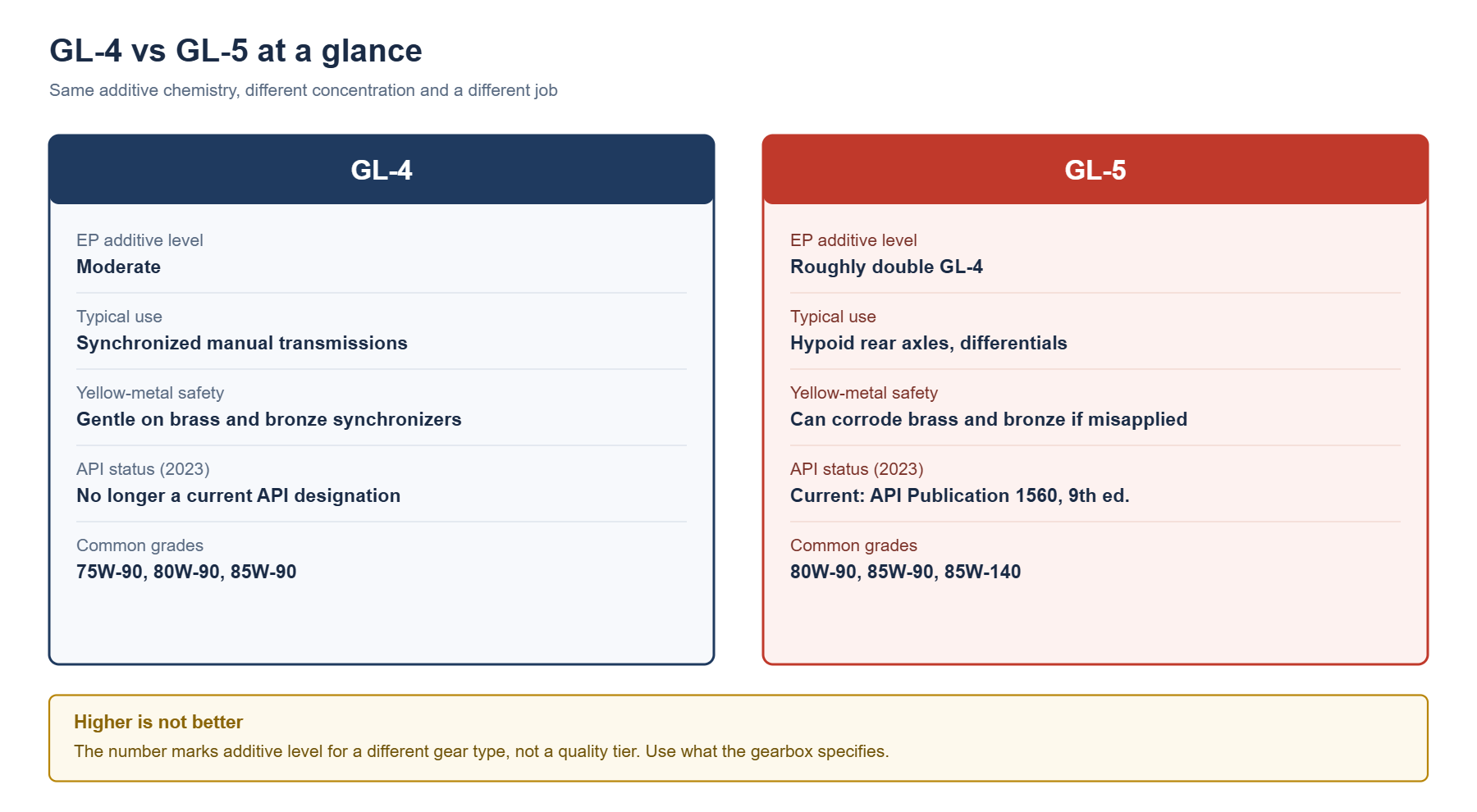
Both are API gear-oil service categories, and the practical difference is the concentration of extreme-pressure (EP) additive, usually sulfur-phosphorus chemistry that forms a sacrificial film under crushing tooth loads.
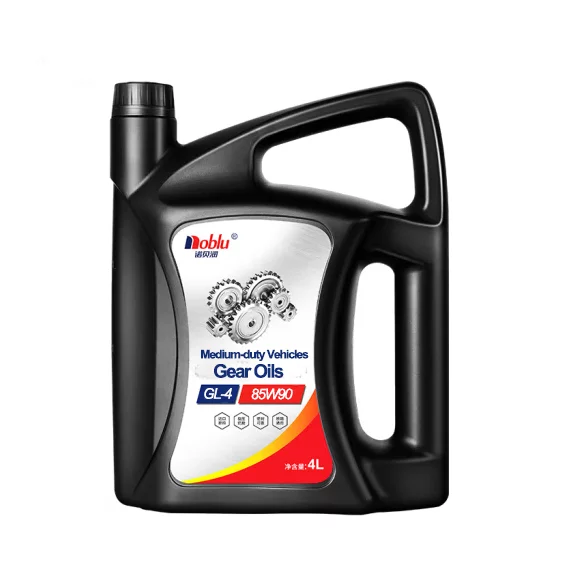
- GL-4: moderate EP level, historically defined for spiral-bevel axles under moderate-to-severe conditions, and widely used in the spur, helical and bevel gears of manual transmissions. Zhongtian’s GL-4 gear oil is offered in 75W-90, 80W-90 and 85W-90 for the manual gearboxes of trucks, cars, buses and construction machinery.
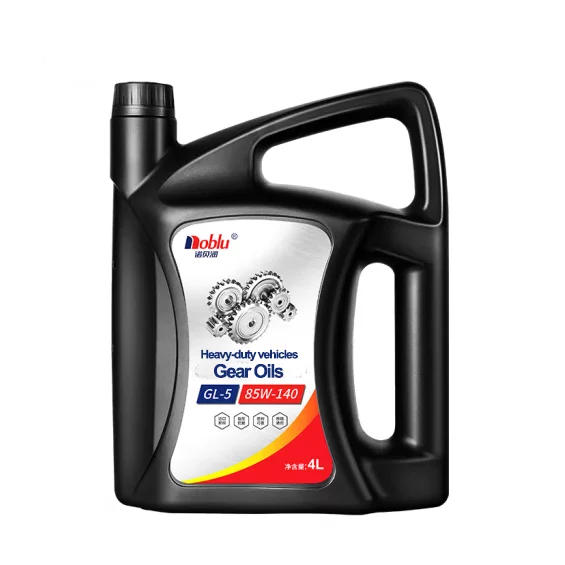
- GL-5: roughly double the EP additive, built for hypoid gears in rear axles and differentials, where the teeth slide under extreme pressure. Zhongtian’s GL-5 gear oil comes in 80W-90, 85W-90 and 85W-140 for heavy-duty hypoid rear-axle service.
Same family, different job. And the extra additive is exactly where the trap sits.
One clarification that prevents a common ordering error: an API category is not a viscosity grade. Gear-oil viscosity grades such as 80W-90 are defined separately by SAE J306. “GL-5” and “85W-140” answer two different questions, and a purchase order needs both.
What API actually says about GL-4 today
Most comparisons present GL-4 and GL-5 as two current, parallel standards. They are not. API Publication 1560, 9th edition (November 2023), lists API GL-5 as the only API automotive gear-lubricant service designation in current use. GL-1, GL-2, GL-3, GL-4, GL-6 and MT-1 are retained for historical and compatibility reference only.
For GL-4 specifically, API notes that the test hardware needed to verify GL-4 performance is no longer available. GL-4 survives as a commercial label and an OEM requirement, but there is no active API verification programme behind it.
This does not mean GL-4 oils are obsolete or that you should stop buying them. Gearbox makers still specify GL-4, and the yellow-metal reason below is still real. What it changes is the evidence you should ask for:
- Treat “API GL-4” on a drum as a manufacturer’s claim of meeting GL-4 requirements, not as an API licence. No supplier holds one.
- Ask what the claim rests on: bench data, an OEM approval, or an in-house specification.
- Ask for the technical data sheet with actual test values, not a category label.
- Where a gearbox maker names its own fluid specification, that document outranks the API category.
GL-5, by contrast, still has an active performance basis: ASTM D7450 defines the requirements for rear-axle gear lubricants intended for API GL-5 service. If you are comparing two GL-5 products, that is the document their claims should trace back to.
The yellow-metal problem
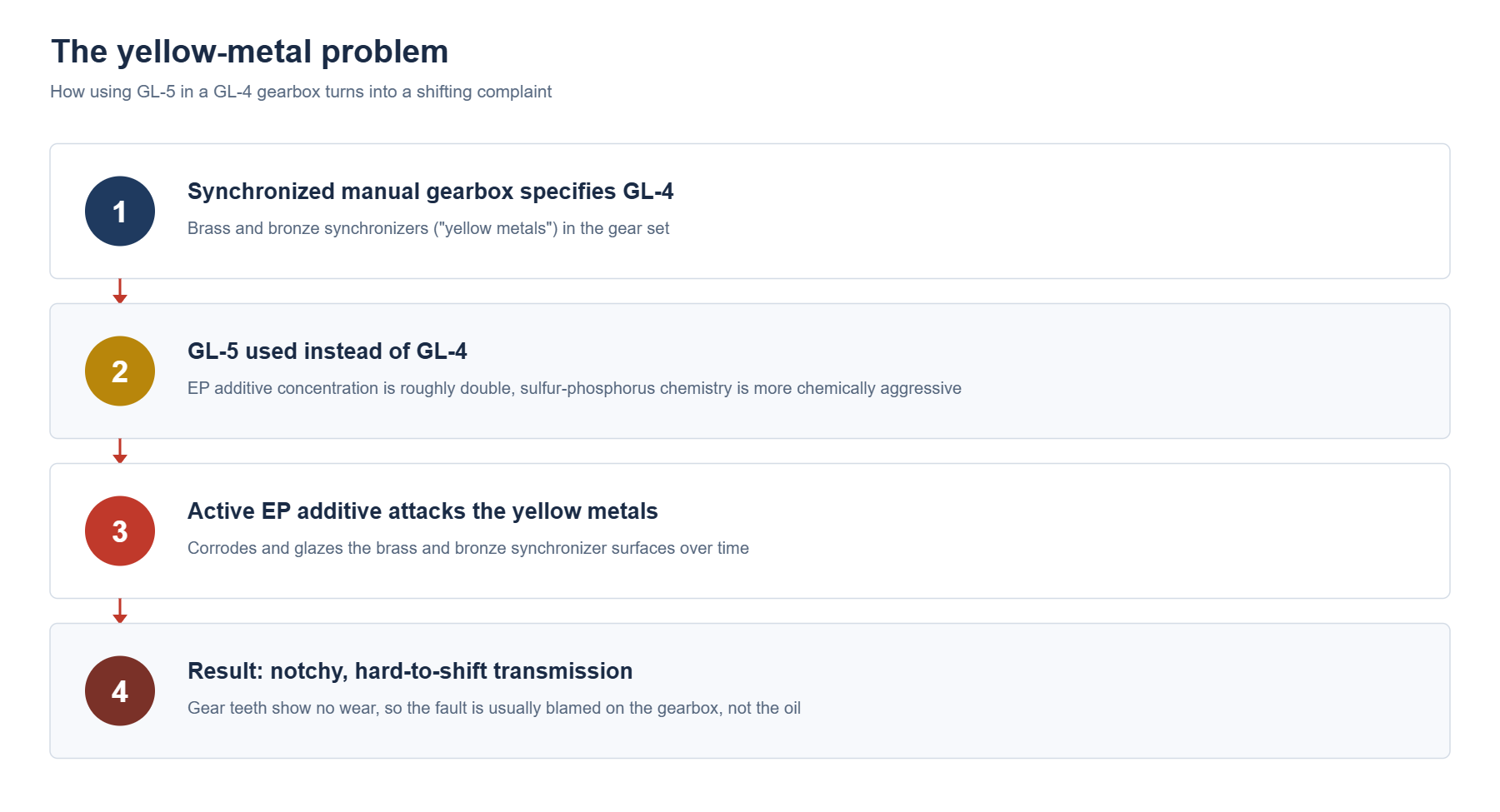
Manual transmissions contain brass and bronze synchronizers, the “yellow metals” that let you shift smoothly. Active sulfur-phosphorus EP additives, at the higher GL-5 concentration, can be chemically aggressive toward those alloys.
Over time a GL-5 oil in a synchronized manual box can corrode and glaze the synchros. The symptom is a transmission that grows notchy and hard to shift long before any gear tooth wears out. That is why the fault is usually blamed on the gearbox rather than the oil. A GL-4 oil carries enough EP for its gear set while staying gentle on the brass. That is not a weaker oil; it is the correctly matched one.
This is also why a dedicated manual transmission fluid (MTF) exists as a separate product rather than treating gear oil as one-size-fits-all.
When “GL-4 or GL-5” is not the whole question
Some axles and transmissions call for a GL-5 that is additionally described as MT-1 or “yellow-metal safe,” meaning the EP chemistry has been formulated to be less corrosive to brass. Others genuinely specify GL-5 in a synchronized box. The point is never “avoid GL-5.” It is use what the gearbox specifies.
| Component | Typical spec | Why |
|---|---|---|
| Synchronized manual transmission | GL-4 (or the OEM’s own MTF spec) | EP level sufficient for the gears without attacking brass synchronizers |
| Hypoid rear axle / differential | GL-5 | High sliding pressure needs the full EP package; no yellow metals at risk |
| Transaxle (combined box and diff) | Check the manual, often GL-4 or a dual-rated fluid | One sump serves two duties with opposite requirements |
| Industrial enclosed gear drive | Not GL-4/GL-5 at all: ISO 6743-6 (L-CKC / L-CKD) | API GL categories are automotive; industrial gearboxes use a different system |
That last row deserves emphasis. Buyers regularly ask for “GL-5” for a plant gearbox. Industrial enclosed gear drives are classified under ISO 6743-6, and Zhongtian’s L-CKC medium-load industrial gear oil sits in that system, not the API one. Asking for the wrong classification family is a slower, quieter version of the same mistake this article opened with.
The pattern worth remembering
A higher number in a lubricant specification almost never means “better in every case.” It means “different service conditions.” The same logic decides hydraulic oil selection, where two drums with an identical ISO VG can behave completely differently. That is the case we work through in L-HM vs L-HV hydraulic oil.
Match the specification to the component. Then match the viscosity grade to the operating temperature. Two decisions, not one.
The questions below cover the specific GL-4 vs GL-5 cases that come up most often once a buyer has the basic rule.
FAQ
Can I use GL-5 instead of GL-4? Only where the manufacturer allows it or the product is explicitly rated yellow-metal safe. In a synchronized manual gearbox that specifies GL-4, a standard GL-5 risks corroding the brass synchronizers and producing hard shifting.
Is GL-4 discontinued? The oils are not. The API designation is no longer in current use, and API states the hardware to verify GL-4 performance is unavailable. Gearbox makers still specify GL-4, and suppliers still build to it, but the label is a manufacturer claim rather than an API-verified category.
Does GL-4 mean the same as 75W-90? No. GL-4 is a service category; 75W-90 is a viscosity grade defined by SAE J306. A product can be 75W-90 GL-4 or 75W-90 GL-5. Always specify both.
What about GL-6 and MT-1? Both are historical designations no longer in current API use. MT-1 addressed non-synchronized heavy-duty truck transmissions; GL-6 covered very high pinion-offset gears whose designs largely disappeared. Neither should be treated as a general manual-transmission approval.
What should I put on a purchase order? The API category or OEM specification, the SAE viscosity grade, the pack size, and a request for the technical data sheet with the batch. If a supplier cannot produce a TDS for the exact grade, that is the signal to slow down, a point we cover in our lubricants sourcing guide.
Sources
- API gear-oil service designations: summary of API Publication 1560, 9th edition (November 2023), including current-use status and the GL-4 test-hardware note.
- ASTM D7450: performance specification for rear-axle gear lubricants intended for API GL-5 service.
- SAE J306: automotive gear lubricant viscosity classification.
- ISO 6743-6: classification for industrial enclosed gear-drive lubricants (the L-CK family).
Zhongtian Petrochemical has manufactured gear oils since 1998 and holds ISO 9001, ISO 14001 and ISO 45001 certification. If you are matching an oil to a specific gearbox, send us the equipment make, the specification in the manual and the operating temperature range, and our technical team will specify against them. Contact Zhongtian Petrochemical.