





TDS vs SDS vs CoA comes down to this: a TDS describes the product, an SDS describes its hazards, and a CoA reports what one batch measured.
- TDS (technical data sheet): one per grade; performance figures, often typical values
- SDS (safety data sheet): 16 sections on hazards, handling, storage and transport; one sheet may cover a whole product family
- CoA (certificate of analysis): one per production batch; test results against limits, tied to a batch number
- For your purchase spec: write limits, not typical values, and accept each delivery on its batch CoA
What is the difference between a TDS, an SDS and a CoA?
The three documents answer different questions: the TDS says what the product is designed to do, the SDS says how to handle it safely, and the CoA says what the batch you received actually measured. A buyer who asks for “the specs” usually needs all three, but for different decisions: the TDS to choose the grade, the SDS to receive and store it, and the CoA to accept or reject a delivery.
| TDS | SDS | CoA | |
|---|---|---|---|
| Question it answers | Is this grade right for my machine? | How do I store, handle, ship and dispose of it? | Does this batch meet the limits? |
| Covers | One product or grade range | A product or a family of similar products | One production batch |
| Numbers inside | Typical values, sometimes limits | Typical or range values for safety purposes | Measured results, with limits and test methods |
| Changes when | The formulation or the published data changes | Hazard information or regulations change | Every batch |
| Cannot prove | That your delivery matches it | Performance or grade | Anything about other batches |
Summary of how the three documents are used in lubricant purchasing. SDS sections follow the GHS-based 16-section format used in US and other national rules; TDS and CoA formats are set by each supplier.
So TDS vs SDS is not a contest: neither document can stand in for the other, and neither can stand in for a CoA.
What does a lubricant technical data sheet tell you?
A technical data sheet tells you what a grade is made of, what it is for, and the figures the maker publishes for it; read whether those figures are typical values or limits before you rely on them. Two TDS from the same supplier can present numbers very differently, and Zhongtian’s own sheets show both styles.
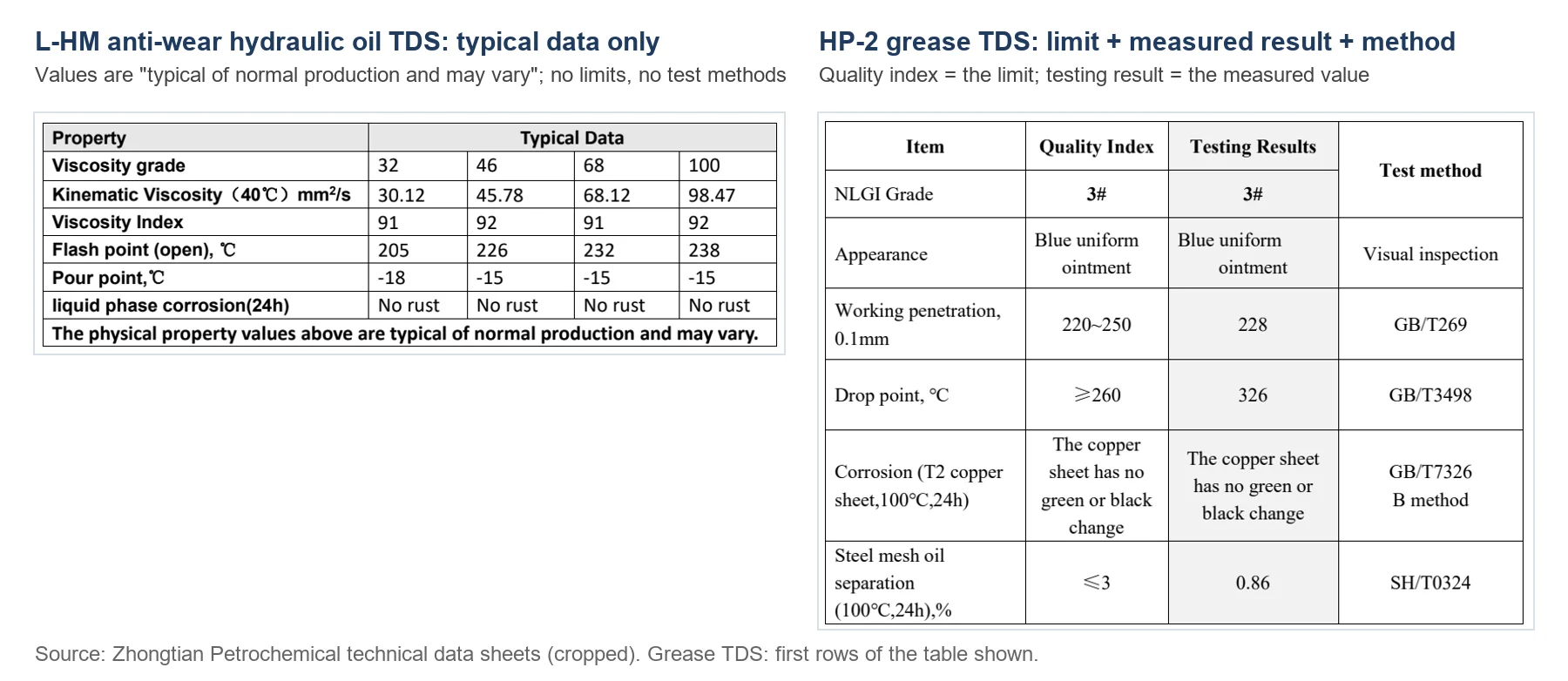
The TDS for our Гидравлическое противоизносное масло L-HM (regular type) gives one row of typical data per viscosity grade: for ISO VG 46, a kinematic viscosity of 45.78 mm²/s at 40 °C, a viscosity index of 92, an open-cup flash point of 226 °C and a pour point of −15 °C. Under the table it states that the values are typical of normal production and may vary. That sentence is the most important line on the sheet: these are not minimums, and no batch is promised to hit them.
The TDS for our HP-2 blue high temperature lithium complex grease works differently. Each property has a quality index (the limit), a testing result and the test method. For example:
| Свойство | Quality index (limit) | Testing result | Что это вам говорит |
|---|---|---|---|
| Класс NLGI | 3 | 3 | Consistency grade of the grease this sheet covers |
| Проходимость при обработке: 0,1 мм | 220–250 | 228 | Inside the NLGI 3 band |
| Dropping point, °C | ≥ 260 | 326 | Well above the limit; not an operating temperature |
| Steel mesh oil separation, 100 °C, 24 h, % | ≤ 3 | 0.86 | How much oil bleeds out in storage |
| Four-ball extreme pressure (PD), N | ≥ 2,452 | 3,089 | Weld load in the four-ball test |
Figures from Zhongtian’s HP-2 TDS; each tested row on the sheet names its Chinese national (GB/T) or petrochemical industry (SH/T) test method.
A sheet laid out like this looks like a certificate of analysis, but it is still a TDS: it describes the product, and the testing result column shows a measured value, not the result for the drums you are buying. Our guide to Классы смазок NLGI explains the penetration bands behind the grade number. When you compare suppliers, put their TDS side by side only after checking that each row uses the same test method and conditions, because the same property tested two ways gives two numbers. Chinese suppliers usually cite GB/T or SH/T methods, many of which are adapted from ASTM or ISO methods; ask which method each one corresponds to before you compare it with an ASTM result from your own lab.
Which number belongs in your purchase specification?
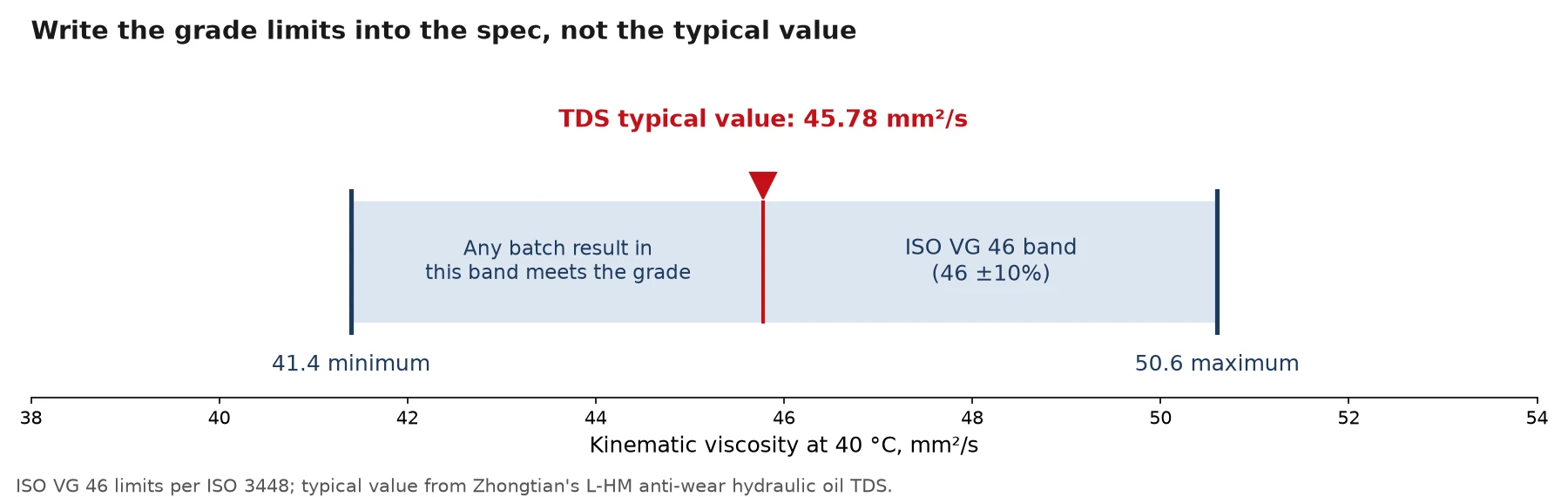
Write the limits into your purchase specification, never the typical value from a TDS. A typical value is the middle of normal production; a limit is the line a batch must not cross. A spec written as “kinematic viscosity 45.78 mm²/s” invites a dispute over every batch that reads 45.1 or 46.9, even though both are normal.
For a hydraulic oil, the viscosity grade already gives you the limits. ISO 3448 classifies industrial oils by kinematic viscosity at 40 °C, with each grade spanning its midpoint ±10 %: ISO VG 46 runs from 41.4 to 50.6 mm²/s, as the Anton Paar viscosity table lists it. Viscosity itself is measured by the capillary method in ASTM D445 or its ISO equivalent. Our Таблица классов вязкости ISO lists the band for every grade.
Batch-to-batch variation inside a grade is normal. We train our sales staff to explain to customers that, within one viscosity grade, viscosity varies slightly with raw-material batches and production, and that a higher or lower reading inside the grade is not by itself a sign of better or worse quality. What matters is that the result sits inside the limit for the property and grade you ordered.
What does a safety data sheet cover, and why is it not a specification?
A safety data sheet covers hazards, first aid, fire fighting, spills, handling, storage, transport and disposal, in 16 fixed sections; it is written for safety and compliance, not for choosing or accepting a grade. The US Hazard Communication Standard, 29 CFR 1910.1200, lists the 16 headings in order, from identification and hazard identification to transport, regulatory and other information.
Two rules in that standard matter to importers of lubricants:
- Who is responsible: paragraph (d)(1) requires chemical manufacturers and importers to classify the chemicals they produce or import; paragraph (g)(1) then requires them to obtain or develop a safety data sheet for each hazardous chemical, and (g)(2) requires it to be in English. If you import into the US, classifying the product is your job as the importer, not only the overseas supplier’s.
- One sheet, many products: paragraph (g)(4) allows one safety data sheet to cover complex mixtures with similar hazards and contents. That is why a supplier may send one SDS for a whole family of oils.
Zhongtian’s SDS for lubricating oils and for lubricating greases have 16 sections, in Chinese and English, with a version number and release date on the first page. Each covers a family: the grease SDS, for example, names consistency grades from No. 000 to No. 3. Section 9 of each gives broad ranges rather than grade figures, so do not use it as a grade figure. Take grade figures from the TDS and batch figures from the CoA. Our SDS assess the products against China’s list of dangerous goods, find that they are not dangerous goods, and state that land, sea (IMDG) and air (IATA) transport are not regulated. That is a Chinese assessment; if your country applies its own classification rules, check the sheet against them before the first shipment arrives.
What should a certificate of analysis for oil or grease show?
A certificate of analysis should identify one batch and report, for each property, the test method, the limit, the measured result and a pass or fail, signed and dated by the laboratory. If any of these is missing, ask for it before you accept the delivery, because a CoA without limits or methods cannot be checked against your specification.
Check these lines on every CoA:
- Product and grade: the same name and viscosity or NLGI grade as your order.
- Batch or lot number: matching the number printed on the drums or pails you received.
- Production and test dates: the test date should follow production and come before shipment.
- Test items, methods, limits and results: one row per property, as on the HP-2 TDS above, so you can see each result against its limit.
- Laboratory and signature: who ran the tests, and whether that laboratory is accredited.
At Zhongtian, each production batch gets its own certificate of analysis, issued by our group’s testing company, which holds CNAS accreditation. CNAS, the China National Accreditation Service for Conformity Assessment, is a signatory to the Соглашение о взаимном признании МАЛАК for testing laboratories accredited to ISO/IEC 17025, the arrangement under which accreditation bodies in signatory economies recognise each other’s accredited laboratories.
Keep one limit of the CoA in mind: it describes the batch it names and nothing else. Our guide to Chinese government spot-check reports explains why an importer should not treat a CoA on a supplier-chosen sample as proof for every drum that follows. Match batch numbers on every delivery.
What if your own lab result does not match the CoA?
Do not reject the batch on the first mismatch: quarantine it, notify the supplier within your contract’s claim period, and check that both labs used the same test method on a clean, representative sample. Differences between two labs often come from sampling, contamination after delivery, storage, or a different test method rather than from the oil itself. Standard test methods such as ASTM D445 publish a reproducibility limit: the difference between two labs’ results on the same sample that should be exceeded only about once in twenty cases. A gap inside that limit is not a mismatch.
When a customer reports a result that does not match our CoA, we handle it in this order:
- Record the batch number, the customer’s test report and the condition of the sample.
- Retest the retained sample of that batch, where one is still held.
- Look for the cause in production, storage, transport, sampling and the test method used.
- Explain the findings to the customer.
- Agree the remedy: return, replacement or technical guidance.
Before you send a complaint to any supplier, ask whether its retained sample of your batch is still held; retention depends on the supplier’s storage practice, so ask early. For a wider checklist of what to ask a lubricant supplier, from accredited testing to documents, see our система оценки поставщиков смазочных материалов.
Часто задаваемые вопросы
Is an MSDS the same as an SDS?
Yes, in content it is the older name. OSHA’s brief on safety data sheets explains that the Hazard Communication Standard, revised in 2012, calls them SDSs, formerly MSDSs, and that the information is largely the same except that SDSs must now follow a consistent 16-section format.
What does TDS stand for on a lubricant?
Technical data sheet: the product’s description, applications and published properties. In water treatment, TDS means total dissolved solids, which is unrelated.
What is the difference between a CoA and a certificate of conformance?
A certificate of conformance states that goods conform to a specification; a CoA lists the measured results behind that statement. If your contract or customs file needs numbers, ask for the CoA.
Can I get the CoA before the goods ship?
The CoA exists once the batch has been tested, so ask for it before you pay the balance, with the batch number that will be printed on your drums.
Источники и примечания
- US OSHA, Hazard Communication Standard, paragraph (g) (SDS duties, English language, 16 headings, one SDS for similar mixtures), and the OSHA brief on safety data sheets.
- ISO viscosity classification standard for industrial liquid lubricants; VG 46 limits as tabulated by Anton Paar.
- ASTM test method for kinematic viscosity of transparent and opaque liquids.
- ILAC MRA signatory listing for CNAS, testing laboratories accredited to the ISO standard for testing laboratories.
- Zhongtian Petrochemical: L-HM anti-wear hydraulic oil TDS, HP-2 high temperature lithium complex grease TDS, and SDS for lubricating oil and lubricating grease (SDS dated January 2026). Figures are as printed on those documents; TDS typical values are not batch results.
- Batch CoA practice and the complaint procedure described here are Zhongtian’s own, as confirmed by the company in November 2026.