





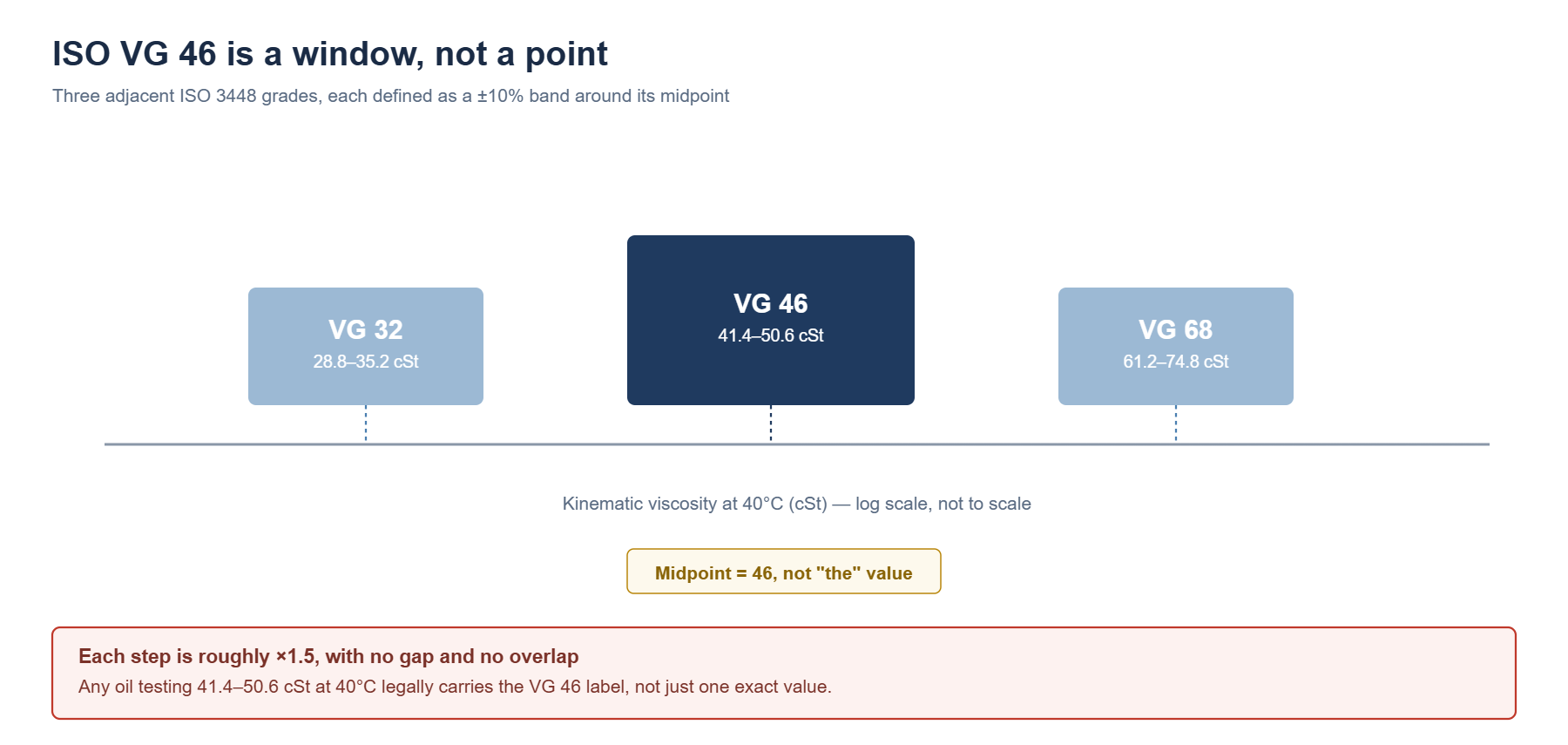
Most people read ISO viscosity grades like “ISO VG 46” as “this oil is 46.” It is not. VG 46 is a band: any oil whose kinematic viscosity at 40°C falls between 41.4 and 50.6 cSt qualifies. That ±10% window is deliberate, and misreading it as a precise value causes two of the most common lubrication mistakes: assuming two VG 46 oils are identical, and trying to convert an ISO grade into an SAE grade. Both misunderstand what the number is.
Where the number comes from
ISO 3448 defines viscosity grades by one measurement: kinematic viscosity at 40°C, in centistokes. Each grade is named for the midpoint of its window and spans ±10% around it. The grades step in a geometric progression of roughly 1.5×, so each is meaningfully thicker than the last with no wasteful overlap.
40°C is not arbitrary. It approximates the operating temperature of much industrial equipment, so the grade describes viscosity where the oil actually works, not cold in the drum.
The full ISO 3448 chart
| ISO VG | Midpoint (cSt @ 40°C) | Range (cSt @ 40°C) | Common use |
|---|---|---|---|
| 10 | 10 | 9.0–11.0 | Spindle oils, low-temp hydraulics |
| 22 | 22 | 19.8–24.2 | Light hydraulics, some compressors |
| 32 | 32 | 28.8–35.2 | Hydraulics, light circulating |
| 46 | 46 | 41.4–50.6 | The industrial workhorse: hydraulics, bearings |
| 68 | 68 | 61.2–74.8 | Bearings, gears, heavier hydraulics |
| 100 | 100 | 90–110 | Light gear oils, circulating |
| 150 | 150 | 135–165 | Industrial gears |
| 220 | 220 | 198–242 | The common industrial gear grade |
| 320 | 320 | 288–352 | Heavy gears |
| 460 | 460 | 414–506 | Heavy/slow gears |
| 680 | 680 | 612–748 | Very heavy gear, open drives |
VG 32, 46 and 68 dominate industrial hydraulics because they land squarely in the operating window of typical pumps. Real product ranges show the chart in use: Zhongtian’s L-CKC gear oil spans VG 100 to 680, with measured kinematic viscosities (102.14 cSt at VG 100, up to 681.40 at VG 680) sitting close to the midpoint of their grade rather than at the edge of the window. That is worth checking on any data sheet: a product blended near the edge of its grade has less margin before a normal batch variation puts it outside.
What the window looks like on a real datasheet
The window concept stops being abstract once you put two real products from the same VG grade side by side. Here is measured data from Zhongtian’s own technical data sheets for VG 46, one anti-wear grade and one low-temperature grade:
| Property (ISO VG 46) | L-HE high-cleanliness anti-wear (HM family) | L-HV low-temperature |
|---|---|---|
| ISO 3448 window | 41.4 – 50.6 cSt @ 40°C | |
| Measured viscosity @ 40°C | 45.12 cSt | 45.47 cSt |
| Viscosity index | 105 | 144 |
| Pour point | −21°C | −39°C |
| Flash point (open) | 226°C | 205°C |
Both numbers land inside the same 41.4–50.6 cSt window, and that part of the label is nearly interchangeable. The viscosity index is not: 105 versus 144 means the L-HV oil holds its viscosity far more consistently as temperature swings, which is the entire subject of L-HM vs L-HV hydraulic oil. The ISO VG label alone cannot tell you this. You have to read past it.
The two mistakes the window prevents
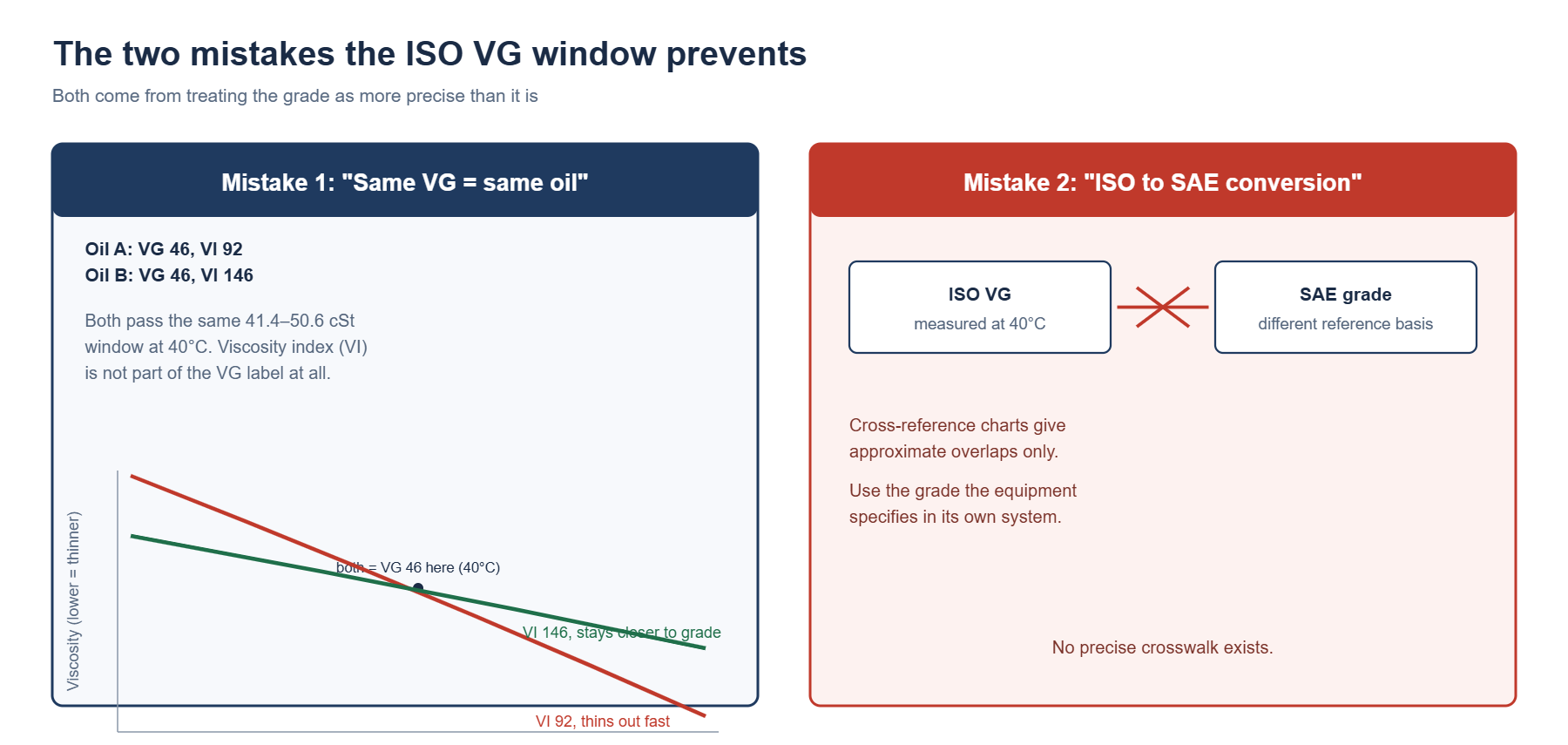
“Two VG 46 oils are the same.” They share thickness at 40°C and nothing else guaranteed. Their behavior at −10°C or +90°C depends on viscosity index, which the VG grade does not capture. A VG 46 with VI 92 and one with VI 146 are the same grade and completely different oils, the entire subject of L-HM vs L-HV hydraulic oil. The grade tells you one point on the curve; VI tells you the curve.
“What’s the SAE equivalent of VG 46?” There is no clean conversion, because the two systems measure at different temperatures. ISO VG uses 40°C; SAE engine grades reference 100°C and cold-crank behavior; SAE gear grades use their own scale. Cross-reference tables give rough overlaps for orientation, but treating a conversion as exact is how the wrong oil ends up in a system. Use the grade the equipment specifies in its own system rather than translating.
| ISO VG | SAE crankcase (approx.) | SAE gear lube (approx.) | AGMA (approx.) |
|---|---|---|---|
| 46 | 15W | 75W | 1 |
| 68 | 20W | — | 2 |
| 100 | 30 | 80W-90 | 3 |
| 150 | 40 | — | 4 |
| 220 | 50 | 90 | 5 |
| 460 | — | 85W-140 | 7 |
Selecting a grade
Start from the equipment maker’s specified VG, which already reflects the bearing loads, speeds and temperatures. Only deviate for a documented reason: a hotter-than-standard ambient may justify one grade up, a cold climate one grade down (paired with adequate VI). Then, within that grade, choose the VI and additive package for your temperature range and duty. Grade sets the thickness; VI and chemistry set the behavior. Chinese product codes work the same way, with the grade number following the family code — L-HM 46, L-HE 46, L-HV 46 — and GB 11118.1-2011 named on the data sheet as the standard the L-HM grades are built to.
Which grades a manufacturer actually stocks
A generic ISO 3448 chart lists every grade from VG 2 to VG 1500. No single product line covers all of them: each formulation is only made in the grades its base stock and additive package support. Knowing the real spread narrows a search fast:
| Product line | ISO VG grades manufactured |
|---|---|
| L-HM anti-wear hydraulic oil | 32, 46, 68, 100, 150 |
| L-HE high-cleanliness anti-wear hydraulic oil | 32, 46, 68, 100 |
| L-HV low-temperature hydraulic oil | 10, 15, 22, 32, 46, 68 |
| L-HS extreme-low-temperature hydraulic oil | 10, 15, 22, 32, 46 |
| L-CKC medium-load industrial gear oil | 100, 150, 220, 320, 460, 680 |
| L-DAJ synthetic screw compressor oil | 32, 46, 68, 100 |
If the grade your equipment manual specifies is not in a line’s range, that is a sign to look at a different product family rather than the nearest available number. The earlier L-CKC industrial gear oil and L-HV hydraulic oil pages carry the full data sheets for each stocked grade.
FAQ
The questions below cover the specific ISO viscosity grades cases that come up once a buyer has the basic window concept.
What does ISO VG 46 mean? An oil with kinematic viscosity of 46 cSt (±10%, i.e. 41.4–50.6) at 40°C. It is a grade window, not an exact figure.
What is the difference between ISO VG 32, 46 and 68? Increasing thickness, roughly 1.5× per step. VG 32 is lighter, VG 68 heavier, VG 46 the common middle for industrial hydraulics.
Can I convert ISO VG to SAE? Not precisely. The systems reference different temperatures. Cross-reference charts give approximate overlaps only; use the grade the equipment specifies in its own system.
Why is viscosity measured at 40°C? Because it approximates the operating temperature of much industrial equipment, so the grade reflects viscosity where the oil actually does its work.
The grade boundaries quoted here are defined in ISO 3448, the international viscosity classification for industrial liquid lubricants; the hydraulic service families that use these grades are set out in ISO 6743-4.
Sources
- ISO 3448: industrial liquid lubricants, ISO viscosity classification.
- ISO 6743-4: classification of hydraulic fluids by service family.
- Engineering ToolBox: ISO-VG viscosity grades, approximate SAE and AGMA crossover reference.
- L-HE and L-HV viscosity, VI, pour point and flash point figures: Zhongtian Petrochemical Engineering Machinery Oil Catalogue, 10 March 2026. These are typical values for normal production, not batch results — request the current technical data sheet for the specific grade before writing any figure into a purchase specification.
- L-CKC kinematic viscosity figures: Zhongtian Petrochemical L-CKC medium-load gear oil product data table.
If you are matching a grade to a specific pump or gearbox, send us the equipment type and its operating temperature range and our technical team will specify against your duty cycle. Contact Zhongtian Petrochemical.