




The NLGI grade answers exactly one question: how stiff a grease is at 25°C. Buyers routinely ask it to answer five others. It cannot. An NLGI 3 grease is not “stronger” than a 2, not more heat-resistant, not longer-lived. It is only firmer. Everything else on your requirements list lives somewhere else on the data sheet.
How the number is made
The National Lubricating Grease Institute scale rests on one test: ASTM D217 worked cone penetration. Work the grease 60 strokes in a standard grease worker, bring it to 25°C, release a standard cone onto the surface, and measure how far it sinks in five seconds, in tenths of a millimeter (dmm). Deep sink, soft grease, low grade. Shallow sink, firm grease, high grade. The “worked” part matters. It mimics the mechanical shearing grease sees in service, so the number reflects working consistency, not jar-fresh texture.
The full chart
| NLGI grade | Worked penetration (dmm) | Consistency | Typical use |
|---|---|---|---|
| 000 | 445–475 | Semi-fluid, nearly pourable | Centralized systems, gear cases |
| 00 | 400–430 | Very soft | Central lube systems, low-temp |
| 0 | 355–385 | Soft | Central systems, cold climates |
| 1 | 310–340 | Soft, smooth | Long grease lines, autolubers |
| 2 | 265–295 | Firm, butter-like | The default: bearings, chassis, general |
| 3 | 220–250 | Firmer | Vertical shafts, hot climates |
| 4 | 175–205 | Very firm | Special sealing / slow-speed |
| 5 | 130–160 | Hard | Niche high-temp / block uses |
| 6 | 85–115 | Block-hard | Slow open journals |
Grade 2 sits mid-scale for a reason: firm enough to stay in a bearing, soft enough to pump through a standard grease gun. When nothing is specified and conditions are ordinary, industry practice defaults to NLGI 2, which is why Zhongtian’s multi-purpose lithium grease is a 2, and the firmer red MP3 lithium grease serves the grade-3 cases of vertical shafts and hotter ambients.
The soft end is real product too: Zhongtian’s semi-fluid lithium grease is offered as 000, 00 and 0 with worked penetrations of 445–475, 400–430 and 355–385, matching the D217 definitions exactly, for centralized systems that need pumpable grease.
What the grade does NOT tell you
- Temperature capability: dropping point, base-oil evaporation, and oxidation stability, covered in high-temperature grease selection.
- Load capacity: base-oil viscosity plus EP additives (four-ball weld, Timken OK).
- Water resistance: thickener chemistry, not grade.
- Low-temperature limit: base-oil pour point and thickener behavior. Two NLGI 2 greases can differ by 40°C in usable cold-start temperature.
- Service life: oxidation stability and bleed characteristics.
Same NLGI grade, different temperature range: real products
The “two NLGI 2 greases can differ by 40°C” claim above is easy to state and easy to doubt. Here it is with real technical-data-sheet numbers from six greases in Zhongtian’s own range, grouped by NLGI grade:
| Product | NLGI grade | Worked penetration | Drop point | Operating range |
|---|---|---|---|---|
| Automotive wheel-hub-unit grease | 2 | 265–295 dmm | ≥180°C | −30°C to 120°C |
| Heavy-duty truck wheel-bearing grease 2# | 2 | 265–295 dmm | ≥280°C | −30°C to 200°C |
| Ultra-high-temperature grease | 2 | 265–295 dmm | No defined drop point (synthetic) | Up to 600°C |
| HP-2 Blue high-temperature grease | 3 | 220–250 dmm | ≥260°C | −30°C to 200°C |
| HP-X Blue high-temperature grease | 3 | 220–250 dmm | ≥270°C | −30°C to 220°C |
| HEP high-temperature wheel-bearing grease | 3 | 220–250 dmm | ≥310°C | −30°C to 220°C |
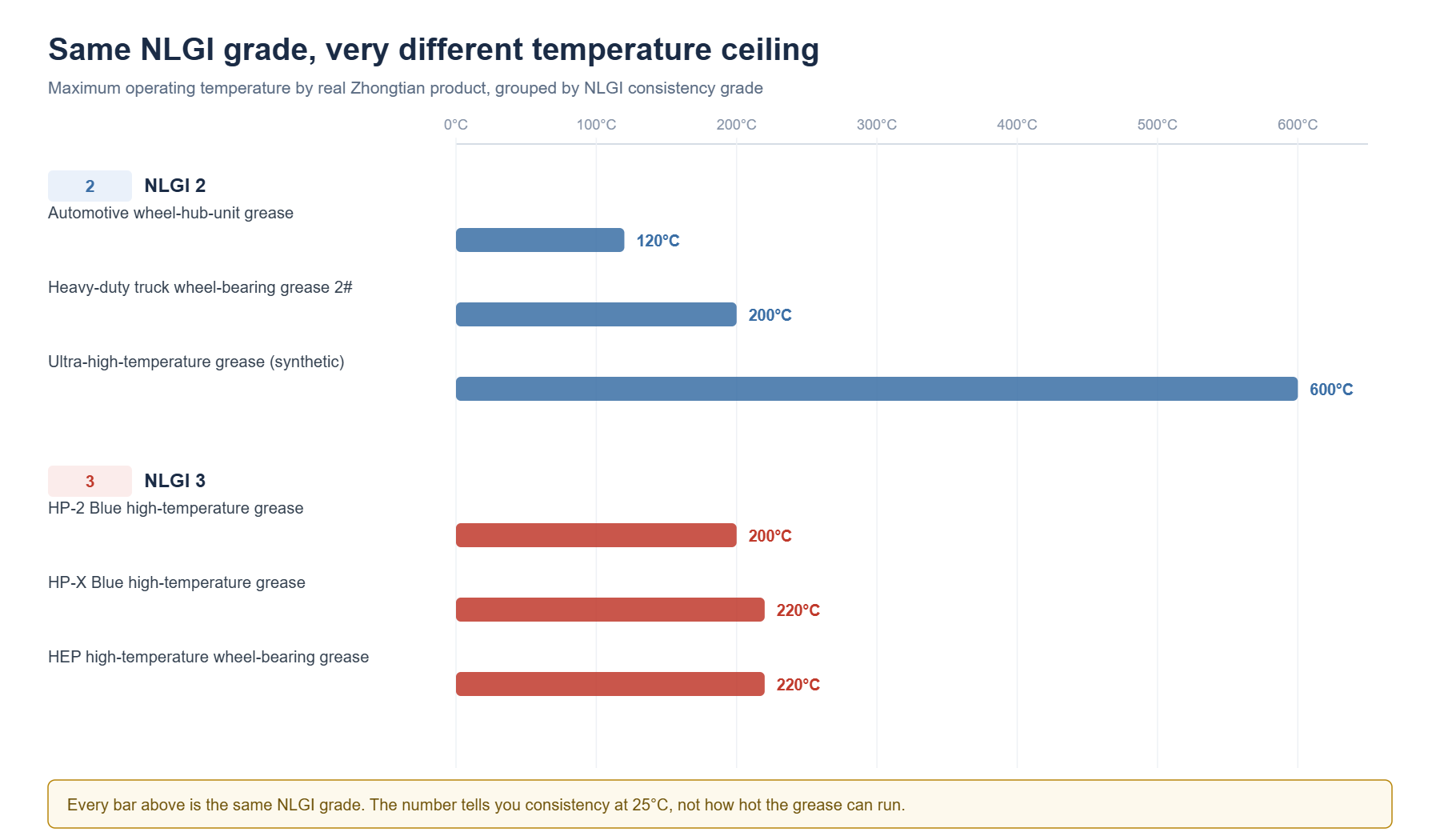
Note the spread inside NLGI grade 2 alone: the wheel-hub-unit and heavy-duty-truck greases are conventional metal-soap products rated to 120°C and 200°C, while the ultra-high-temperature grease is a synthetic base with inorganic thickener rated up to 600°C, at the identical NLGI 2 consistency. If you shopped by NLGI number alone, you would have no way to tell them apart. Drop point and base chemistry, not the consistency grade, decide what a grease can survive.
The oil-separation (“bleed”) test tells a related but different story. HP-2 and HP-X both hold steel-mesh oil separation to ≤3% at 100°C over 24 hours (ASTM/GB equivalent method SH/T0324), a low-bleed result at either NLGI grade. Bleed resistance is a formulation property, tested separately from penetration; two greases at the same NLGI grade can have very different bleed rates.
Pick thickener and base oil for the environment (the map is in the grease types guide), then pick the NLGI grade for the delivery method and geometry.
The cold-weather one-grade rule
A useful field heuristic: below 0°C, grease behaves roughly one NLGI grade stiffer for every 10°C drop. Your NLGI 2 at −20°C handles like a 4 at room temperature, which is why centralized systems in cold climates specify 0, 00 or 000, and why a winter autoluber blockage is usually a grade problem, not a pump problem.
Choosing grade by delivery method
Manual grease gun: 1–3 all pump, 2 standard. Single-point autolubers: 1 typical. Centralized multi-line systems: 0–00, colder installs 000. Vertical or hot points where sling-out is the enemy: 3. Slow open journals: the block grades. Bearing-specific interval and quantity math is in the bearing lubrication guide.
FAQ
What does NLGI 2 mean? Worked penetration of 265–295 dmm per ASTM D217: a firm, butter-like consistency suited to most rolling-element bearings and chassis points. It is the global default grade.
Is a higher NLGI grade better? No. Grades are consistency classes, not quality tiers. “Better” depends on your delivery method, geometry, and climate.
What is an NLGI 3 grease equivalent? Any grease with 220–250 dmm worked penetration is grade 3 by definition; equivalence in service also requires matching thickener, base-oil viscosity, and additives.
Can I mix NLGI grades? Same product family and adjacent grades: usually workable. Different thickeners: treat as incompatible until proven otherwise.
FAQ addendum
If two greases have the same NLGI grade, are they interchangeable? Not necessarily. As the six-product comparison above shows, products at the same NLGI grade can have a wide spread in drop point and operating ceiling, from tens of degrees to hundreds. Match drop point, base chemistry and bleed resistance in addition to the NLGI number.
Sources
- NLGI consistency scale and ASTM D217 worked-penetration method: NLGI grade definitions as codified in the chart above.
- HP-2, HP-X, Ultra-high-temperature grease, HEP high-temperature wheel-bearing grease, heavy-duty truck wheel-bearing grease and automotive wheel-hub-unit grease penetration, drop point and operating range figures: Zhongtian Petrochemical technical data sheets, current production.
If you are matching a product to a specific machine or duty cycle, send us the equipment type and operating conditions and our technical team will specify against them. Contact Zhongtian Petrochemical.