




Oil turns cloudy and everyone notices. By then the water has been at work for a while, because the damage starts long before the milkiness appears, at concentrations you cannot see at all. Water is arguably the most underestimated contaminant in hydraulic and industrial oils, and understanding it starts with the fact that it lives in oil three different ways, each with its own consequences.
The three states of water
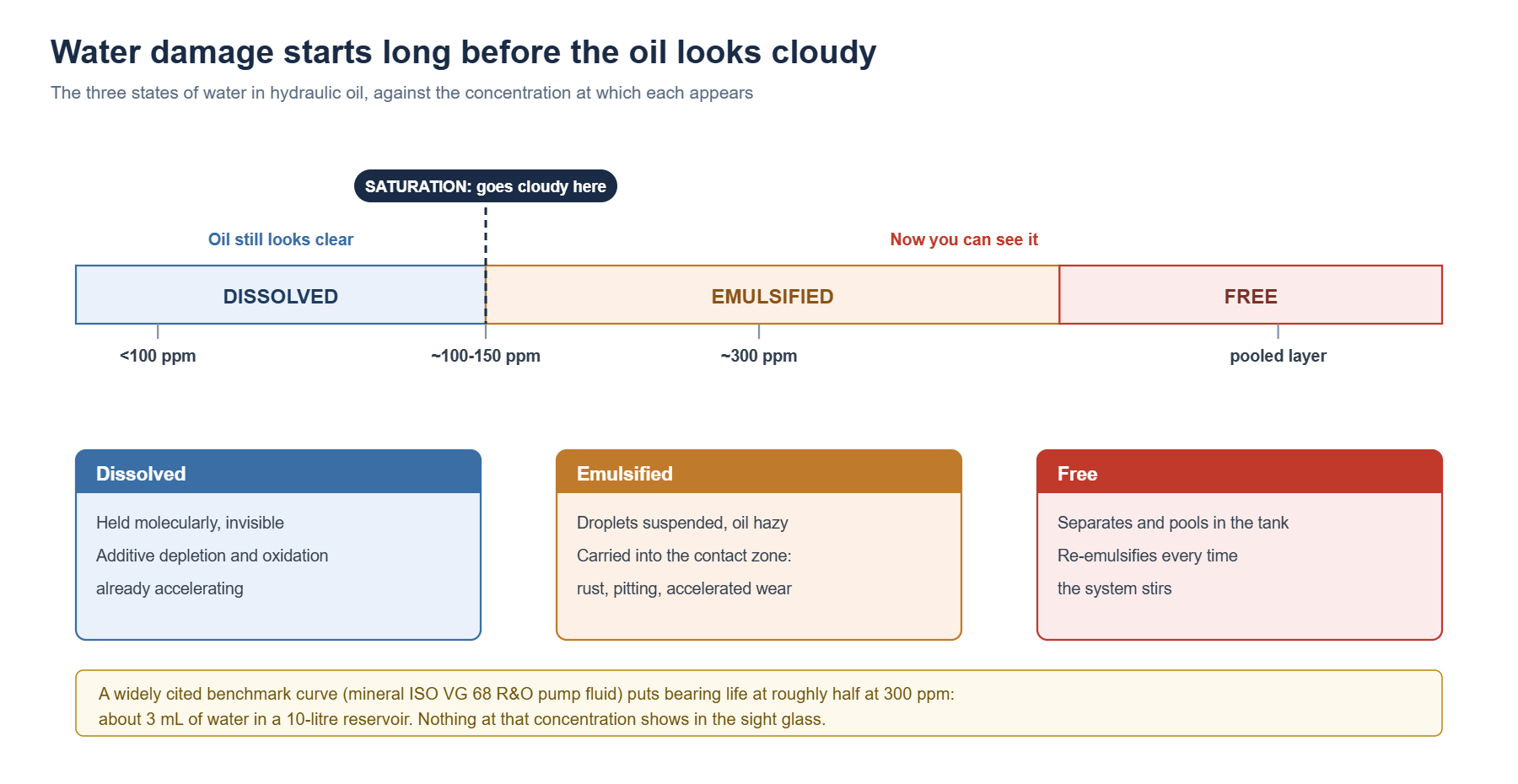
Dissolved water is water held molecularly in the oil, invisible, like humidity in air. Every oil has a saturation point, often a few hundred parts per million, below which water stays dissolved and clear. Even here it is not harmless: dissolved water accelerates additive depletion and, in some fluids, hydrolysis of the additive system.
Emulsified water appears once the oil passes saturation. Now water is suspended as microscopic droplets, and the oil looks hazy or milky. This is the most damaging state, because the droplets carry water into the contact zone, where they disrupt the oil film and cause the rust, pitting and accelerated wear that show up as component failure.
Free water is the excess that separates and pools, usually at the bottom of the reservoir. Destructive on its own, and a standing reserve that keeps re-emulsifying every time the system stirs.
Why small numbers matter
The instinct is to worry only when the oil goes cloudy, that is, at saturation. But damage scales well below it. Water dissolved in the low hundreds of ppm already speeds oxidation, strips additives, and in additive-sensitive fluids begins hydrolysis. Treat cloudiness as a late warning, not a first one.
The scale of the damage surprises most buyers. Most hydraulic oils saturate, the point where excess water stops staying dissolved, at roughly 100 to 150 ppm at operating temperature. A widely cited industry benchmark curve (mineral ISO VG 68 rust-and-oxidation pump fluid) shows bearing life expectancy cut in half at just 300 ppm, equivalent to about 3 mL of water stirred into a 10-liter reservoir. Nothing at that concentration is visible in the sight glass.
| Water concentration | State | Effect |
|---|---|---|
| <100 ppm | Dissolved, oil clear | Additive depletion and oxidation already accelerating |
| ~100–150 ppm | Approaching saturation | Typical saturation point for most hydraulic oils at operating temperature |
| ~300 ppm | Emulsified, oil hazy | Bearing life expectancy cut roughly in half (benchmark curve, ISO VG 68 R&O pump fluid) |
| Free water pooling | Visible layer | Rust, corrosion, and the most severe wear risk |
Finding it before it finds you
Three checks, escalating in precision:
- The crackle test. A drop of oil on a hotplate around 130°C. Crackling or spitting means free or emulsified water is present. Crude, instant, and useful on the shop floor.
- Visual and trend. Persistent haze, a water layer in the sight glass, or a sudden viscosity or foam change all point to water.
- Karl Fischer titration. The laboratory method that returns an actual ppm figure, the only way to catch dissolved water below the visible line and to trend it over time.
Where the water is coming from matters as much as how much: failed heat-exchanger seals, breathing through a hot-then-cold reservoir that inhales humid air, wash-down, and condensation are the usual sources. Fixing the ingress path is the permanent cure; drying the oil is the interim one.
What the oil itself can do
Fluid choice changes how water behaves once it gets in. Demulsibility, the oil’s ability to shed water quickly so it can be drained rather than circulated, is a real, specified property. Zhongtian’s high-pressure anti-wear hydraulic oil is formulated for good water separation “so that oil and water separate quickly,” and its ashless anti-wear grade adds hydrolysis stability that protects the additive system “when the system is subjected to a small amount of water pollution.” A demulsifying oil turns ingested water into a drainable pool at the reservoir bottom instead of a circulating milky emulsion. That is exactly the difference between a quick drain and a wear problem.
As shipped, this is not a theoretical spec: the technical data sheets across Zhongtian’s L-HM anti-wear range and its L-HV low-temperature oil list moisture as “trace”, below the level the standard test reports as a number. That is the baseline you are protecting once the oil is in service; every ppm above it comes from the system, not the drum.
The practical question is which grade actually carries which defence, and within one anti-wear range the answer is not uniform. Zhongtian’s own product literature is specific about it:
| Grade | Stated water-related property | Parker-Denison |
|---|---|---|
| L-HM anti-wear, standard | Neither property is listed | HF-1, HF-2 |
| L-HM anti-wear, high-cleanliness | Water separation, so oil and water separate quickly and the oil avoids emulsifying | HF-0 |
| L-HM anti-wear, high-pressure | Water separation, so oil and water separate quickly and the oil avoids emulsifying | HF-0 |
| L-HM anti-wear, ashless high-pressure | Hydrolytic stability, giving protection when the system takes in a small amount of water | HF-0 |
| L-HV low-temperature | Hydrolytic stability, giving protection when the system takes in a small amount of water | HF-0 |
Read that as two different jobs rather than a ranking. Water separation is about getting water out: the oil sheds it fast enough to pool where a drain valve can reach it. Hydrolytic stability is about surviving the water still in there, so the additive system resists being broken down by it. A machine that takes an occasional slug of water and has somewhere to drain it wants the first. A machine running with a persistent low-level ingress nobody has fixed yet wants the second. Worth asking a supplier which of the two a quoted grade actually claims, because “good water resistance” on its own does not distinguish them.
Acting on it
If oil is cloudy, treat it as an active problem, not a cosmetic one: find and fix the ingress, remove the water (settling, coalescing, or vacuum dehydration depending on volume), and confirm with a crackle or ppm test before trusting the system again. For fluids that must tolerate occasional water, specify demulsibility and hydrolysis stability up front rather than fighting emulsions later. The related cold-weather failure, where the same reservoir that ingests water in summer cavitates in winter, is covered in low-temperature hydraulic fluids.
FAQ
How much water in hydraulic oil is too much? Damage begins below the visible threshold, often in the low hundreds of ppm dissolved. Cloudiness (saturation) is a late warning. Trend the actual ppm and keep it as low as the system allows.
Why is my hydraulic oil milky? Milkiness is emulsified water. The oil has passed its saturation point and water is suspended as droplets. This is the most damaging state and calls for prompt action.
How do I remove water from hydraulic oil? Fix the ingress first, then remove water by settling, coalescing filtration, or vacuum dehydration depending on volume. Confirm with a crackle or Karl Fischer test.
What is demulsibility and why does it matter? It is the oil’s ability to release water quickly so it settles and can be drained. A demulsifying oil keeps water from circulating as a damaging emulsion.
Sources
- The Impact of Water on Pump Bearing Life (Mark Barnes, Des-Case Corporation, Pumps & Systems): saturation point and the 300 ppm / 50% bearing-life benchmark curve.
- Moisture (“trace”) figures for the L-HM anti-wear range and L-HV: Zhongtian Petrochemical technical data sheets, current production.
- Grade-level water separation and hydrolytic stability wording, and Parker-Denison approval levels: Zhongtian Petrochemical industrial oils product manual and construction-machinery lubricants manual, 2026 revision.
Fluid cleanliness and water limits should be read alongside the hydraulic service families in ISO 6743-4 and the pump maker’s own limits, for example those published by Bosch Rexroth.
If you are matching a product to a specific machine or duty cycle, send us the equipment type and operating conditions and our technical team will specify against them. Contact Zhongtian Petrochemical.