




Heat is the quiet killer of hydraulic systems, and it kills twice. It ages the oil. As a rule of thumb, oxidation roughly doubles for every 10°C above about 60°C, so an oil rated for thousands of hours can be spent in a fraction of that. And past roughly 82°C, seals, hoses and the oil’s additives degrade fast, hardening and cracking until leaks and contamination follow. Damage that starts as a temperature reading ends as replaced components.
That “doubles every 10°C” figure is a simplification of the Arrhenius principle applied to lubricant life, and it is useful but not exact: the real rate of change accelerates as temperature climbs, not stays constant. The underlying relationship is closer to Log(L) = kl + 4750/(T+273), where L is life in hours, T is operating temperature in °C, and kl is a constant set by the lubricant’s chemistry. Treat the 10°C rule as a warning sign, not a countdown timer.
| Temperature | What happens |
|---|---|
| 40–60°C | Normal target range for most industrial hydraulic systems |
| Above ~60°C | Oxidation rate rises sharply; oil life shortens well ahead of any visible symptom |
| Sustained above ~82°C | Seal and hose compounds degrade quickly; additive breakdown accelerates; leaks and contamination follow |
The trouble is that “it’s running hot” has a dozen causes, and chasing them at random wastes days. Work the fault tree in order instead.
First, the framing: generation versus rejection
Every overheating problem is one of two things: the system is making too much heat, or rejecting too little. Sort every cause into those two buckets and the diagnosis stops being guesswork.
Heat is made whenever hydraulic energy turns to friction instead of work: internal leakage past worn parts, fluid forced across restrictions, or a pump laboring against a fault. Heat is rejected through the reservoir surface and, mostly, the cooler. Overheating means one side of that balance has shifted.
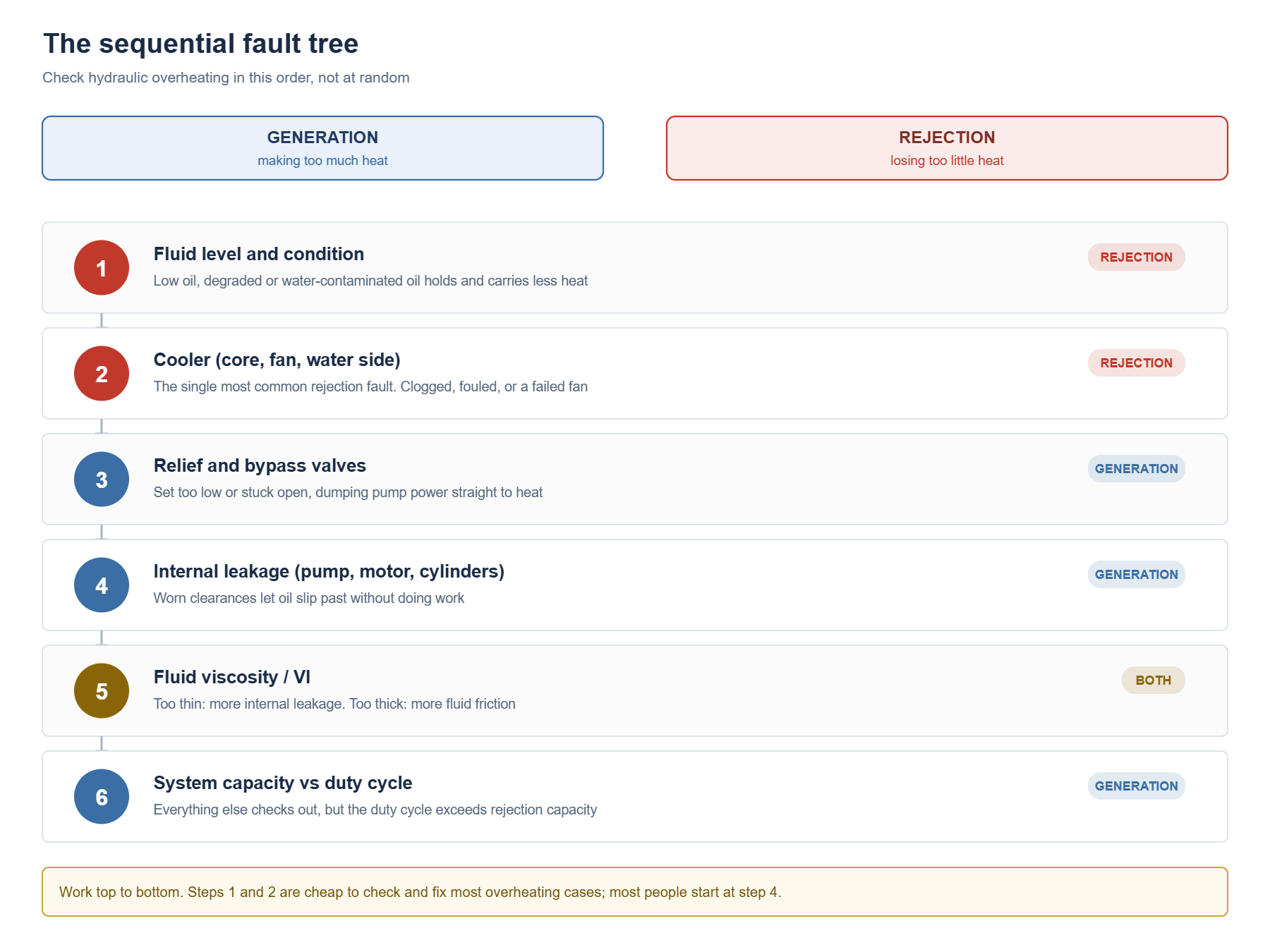
The sequential fault tree
Check in this order, cheapest and most common first:
| Order | Check | Bucket |
|---|---|---|
| 1 | Fluid level and condition | Rejection |
| 2 | Cooler (core, fan, water side) | Rejection |
| 3 | Relief and bypass valves | Generation |
| 4 | Internal leakage (pump, motor, cylinders) | Generation |
| 5 | Fluid viscosity / VI | Both |
| 6 | System capacity vs duty cycle | Generation |
- Fluid level and condition. Low oil means less volume to absorb and carry heat, and a shorter dwell in the reservoir to cool. Top up, and check whether the oil is already degraded or water-contaminated (see water in hydraulic oil); spent oil runs hotter.
- The cooler. The single most common rejection fault. A clogged air-cooler core, a fouled water side, a failed fan, or a closed/scaled water valve all strangle heat rejection. Inspect and clean before assuming anything internal.
- Relief and bypass valves. A relief valve set too low, stuck partly open, or a cracked bypass dumps high-pressure oil straight to tank, converting pump power directly into heat. A relief valve passing continuously is a classic hidden heater. Check settings and for internal leakage.
- Internal leakage in pump, motor or cylinders. Worn clearances let high-pressure oil slip internally without doing work; that lost energy becomes heat. A pump case-drain flow above spec is the tell.
- Wrong oil viscosity. Too thin and internal leakage rises (more heat); too thick and fluid friction rises (more heat). Both ends of the wrong-VG mistake overheat; the grade window is covered in ISO viscosity grades.
- Undersized or overworked system. If everything checks out and it still overheats, the duty cycle may exceed the system’s rejection capacity, and added cooling or a larger reservoir is the structural fix.
Item 5 has a real number behind it. Viscosity grade is not a single figure to memorize; it is a family, and the viscosity index tells you how much that number moves with temperature. Zhongtian’s L-HM anti-wear hydraulic oil spans ISO VG 32 to 100:
| ISO VG | Viscosity at 40°C (mm²/s) | Viscosity index | Flash point | Pour point |
|---|---|---|---|---|
| 32 | 31.32 | 105 | 205°C | −27°C |
| 46 | 46.25 | 99 | 226°C | −21°C |
| 68 | 67.04 | 97 | 232°C | −21°C |
| 100 | 98.74 | 95 | 238°C | −21°C |
A lower viscosity index means the oil thins faster as it heats and thickens faster as it cools, so a VG46 at VI 99 loses usable viscosity sooner than the same VG at a higher VI. That is the gap the wide-VI L-HV oil below is built to close.
Where the oil is, and isn’t, the culprit
It is tempting to blame the fluid, and sometimes it deserves it: wrong viscosity, degraded oil, or water contamination genuinely raise operating temperature. But most overheating is mechanical, a cooler or a valve, and no oil change fixes a clogged heat exchanger. Draw the line honestly: if the fault tree points to a mechanical cause, changing oil only resets the clock on the same problem.
Where the fluid does help is at the margins of temperature range. A high-viscosity-index oil holds usable viscosity across a wider band, so it neither thins into leakage when hot nor thickens into friction when cold. Zhongtian’s L-HV hydraulic oil, with a VI of 138–148, is built for exactly that stability, and its Parker-Denison HF approvals reflect oxidation and thermal performance validated on a pump bench. Better fluid widens the safe window; it does not substitute for a working cooler.
Acting before it costs components
Treat any sustained reading near 82°C as a call to act, not monitor. Work the tree in order: level and oil condition, cooler, relief/bypass, internal leakage, viscosity, then capacity. Fix the mechanical cause where the tree points. Specify a high-VI, thermally stable oil so the fluid is never the weak link. The goal is to catch heat while the fix is a cleaned cooler, not a rebuilt pump and a set of hardened seals.
FAQ
What temperature is too hot for hydraulic oil? Sustained operation above roughly 82°C accelerates seal and additive breakdown; oxidation roughly doubles every 10°C above about 60°C. Most systems target a steady 40–60°C.
What is the most common cause of hydraulic overheating? Reduced heat rejection, most often a clogged or failed cooler (blocked core, dead fan, fouled water side). Check it before internal components.
Can the wrong hydraulic oil cause overheating? Yes. Too thin raises internal leakage; too thick raises fluid friction. Both generate heat. Use the specified viscosity grade with an adequate viscosity index.
Will changing the oil fix overheating? Only if the oil (wrong viscosity, degraded, or water-laden) is the cause. Mechanical faults like a clogged cooler or a passing relief valve are unaffected by an oil change.
Sources
- Predicting Oil and Grease Life (Machinery Lubrication / Noria, Khonsari & Booser, Louisiana State University): the Arrhenius-based oil-life relationship and its stated limits.
Pump and system viscosity limits referenced here follow the hydraulic fluid families defined in ISO 6743-4; component-level operating windows are published by manufacturers such as Bosch Rexroth.
If you are matching a product to a specific machine or duty cycle, send us the equipment type and operating conditions and our technical team will specify against them. Contact Zhongtian Petrochemical.