




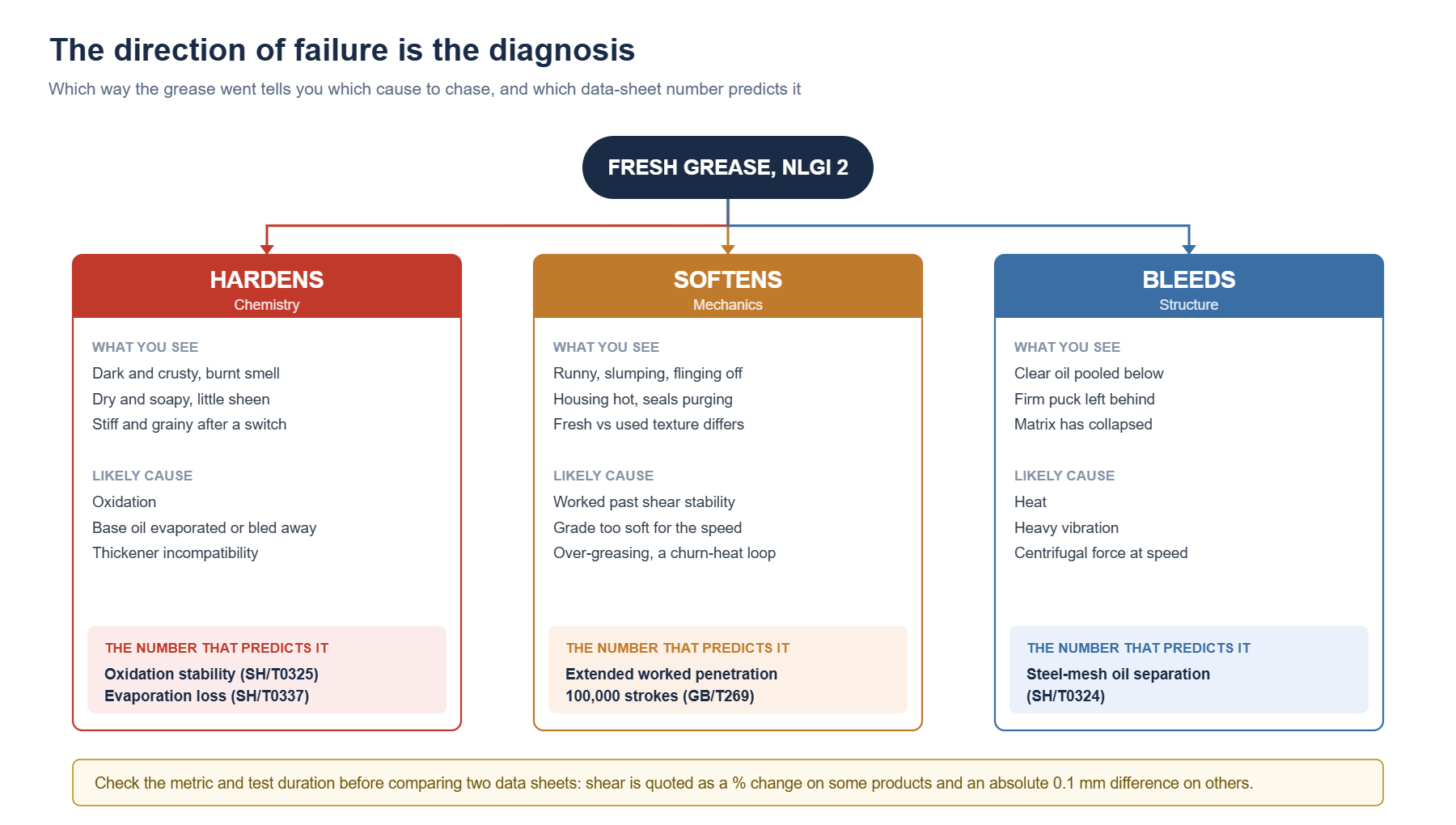
Open a bearing housing and what was NLGI 2 six months ago is now one of three things: a dark brittle crust, a runny mess sliding off the shaft, or a firm puck sitting in a pool of its own oil. Most troubleshooting guides list “causes of grease degradation” as one long pile. The useful move is simpler: the direction of failure is itself the diagnosis. Hardening is chemistry. Softening is mechanics. Bleeding is structure. Read the direction and you have eliminated half the suspects before touching a test kit.
The symptom-to-cause table
| What you see | Direction | Most likely cause | Field check |
|---|---|---|---|
| Dark, crusty, burnt smell | Hardened: oxidation | Over-temperature; extended interval | Crumbles instead of smearing |
| Dry, soapy, little sheen | Hardened: oil loss | Heat evaporated/bled the base oil, thickener left behind | Oil stains below the housing |
| Stiff, grainy, after a product switch | Hardened: incompatibility | Mixed thickeners reacting | Did stiffening follow a grease change? |
| Runny, slumping, flinging off | Softened: shear breakdown | Worked past mechanical stability; wrong grade | Fresh vs. in-service texture differ sharply |
| Runny + housing hot + purging seals | Softened: over-greasing | Excess grease churns, heats, thins, in a loop | Was it “topped up generously” recently? |
| Clear oil pooled, firm remainder | Bleeding | Heat/vibration/centrifugal force wringing out oil | Firm puck left behind = matrix collapsed |
Hardening: the chemistry failures
Oxidation is grease rusting. Heat and oxygen attack the base oil, building varnish; the grease darkens, stiffens, and cracks. Every grease has a temperature budget. Spend above it and oxidation compounds fast. Fix: verify the actual operating temperature against the grease’s rating, shorten intervals, or move up a thermal class, using the real temperature ladder in high-temperature grease selection. A grease’s published oxidation stability (Zhongtian tests pressure-drop to SH/T0325 across its range) is the property that predicts how long it resists this.
Oil-starvation hardening smells different, literally. The base oil has evaporated or bled away, leaving concentrated thickener: a dry, soapy solid. The grease did not burn; it emptied. Fix: a lower-volatility or higher-viscosity base oil, or shorter relube to replenish oil before the sponge runs dry.
Incompatibility hardening is the sneaky one. Two individually good greases whose thickeners react can set up like putty within days of a change. If the timeline matches a product switch, that is likely it. Fix: purge thoroughly when changing families, and check compatibility before switching, the same rule that governs switching to polyurea.
Softening: the mechanical failures
Grease is a sponge of thickener holding oil. Work it violently enough, long enough, and the fibers shear apart. Worked penetration drifts soft, and grease that entered as an NLGI 2 leaves as a 0, flung across the guard. Culprits: vibration beyond the grease’s shear stability, speed too high for the grade, or over-greasing. Excess grease churns, churning makes heat, heat thins the grease, and the loop ends with purged seals and a hot bearing. Fix: right quantity (calculated, not “until it purges”), right grade for the speed, and a thickener with documented mechanical stability.
Bleeding: the structural failure, and its normal twin
Some oil separation is by design. Bleed is how grease lubricates, releasing oil into the contact, and a thin film atop a stored pail is normal (storage judgment lives in grease shelf life). Failure-grade bleeding is different: free oil pooling in service while the remainder stiffens, driven by heat, heavy vibration, or centrifugal force in high-speed housings, the matrix wrung out like a sponge in a fist. Fix: a grease engineered for lower bleed under the actual g-forces and temperature, and an honest look at whether the point should be oil-lubricated instead.
“Some bleed is normal” is a judgment call unless you have a number to check it against. The standard test gives one: steel-mesh oil separation, 100°C for 24 hours, method SH/T0324, which is equivalent in intent to the bleed-tendency measurement of ASTM D6184. Here is what passing looks like on real technical data sheets:
| Product | Steel-mesh oil separation (100°C/24h) |
|---|---|
| HP-2 blue high-temperature grease | ≤3% |
| HP-X blue high-temperature grease | ≤3% |
| HEP specific blue high-temperature grease | ≤3% |
| Ultra-high-temperature grease (synthetic) | ≤1% |
If a lab or supplier cannot produce this figure for the grease in question, that gap is itself informative. See lubricants sourcing for what to ask a supplier for before trusting a bleed-resistance claim.
Which data-sheet number predicts which failure
Whether grease hardens, softens or bleeds, each direction has a test that predicts resistance to it. That is what makes the direction useful as a buying instruction and not just a diagnosis. These are the figures published across Zhongtian’s automotive grease range:
| Failure direction | Property to look for | Method | Published figures across the range |
|---|---|---|---|
| Hardening by oxidation | Oxidation stability, pressure drop | SH/T0325 | ≤0.070 MPa (automotive general lithium, 99°C / 100 h / 0.770 MPa); ≤70 kPa (150,000 km maintenance-free, 99°C / 100 h / 758 kPa) |
| Hardening by oil loss | Evaporation loss | SH/T0337, GB/T7325 | ≤2.0% (automotive general lithium, 99°C / 22 h); ≤5% (heavy-duty wheel bearing); ≤10% (150,000 km maintenance-free) |
| Softening by shear | Extended worked penetration, 100,000 strokes | GB/T269 | ≤17% change (HEP high-temperature); ≤20% change (automotive general lithium); ≤38 and ≤40 units difference (heavy-duty wheel bearing 2# and 3#); ≤50 units difference (150,000 km maintenance-free) |
| Bleeding | Steel-mesh oil separation | SH/T0324 | ≤3% (heavy-duty wheel bearing, 100°C / 30 h); ≤5.0% (automotive general lithium, 100°C / 30 h); ≤8.0% (150,000 km maintenance-free, 100°C / 24 h) |
Two things in that table are easy to misread, and both matter when you are holding two data sheets side by side.
Shear stability is not reported the same way twice. HEP and the automotive general lithium grease quote a percentage change in penetration after 100,000 strokes. The heavy-duty wheel-bearing and 150,000 km greases quote an absolute difference in 0.1 mm units. A 17 and a 38 in that column are not on the same scale, and ranking one against the other produces a meaningless answer.
The bleed test duration also varies. Some of these products are tested for 30 hours at 100°C and others for 24 hours at the same temperature. A longer test gives oil more time to separate, so a lower percentage from a shorter run is not automatically the more bleed-resistant grease.
The practical rule: before comparing two greases on any of these numbers, check that the metric and the test conditions match. If they do not, ask the supplier to re-quote both on a common basis. A supplier who cannot do that is telling you something about how well they know their own product.
When the flashlight isn’t enough
Field diagnosis has limits. A grease hardened by oxidation and one hardened by incompatibility can look identical by torchlight. A documented case where “heavy-duty” grease failed inside 50 hours, with the visual evidence pointing everywhere at once, is walked through in why heavy-duty grease failed at 50 hours; the replace-versus-investigate call is in 5 signs it’s time to replace grease.
Two limits are worth stating plainly about the numbers above. They are published limits for fresh product tested on a bench, so they narrow the candidates rather than diagnose what already failed in your housing. And none of these methods is run on a used sample. Confirming a field diagnosis still means pulling the grease and having it tested, which is why the direction of failure is worth reading carefully before you spend money on a lab.
FAQ
Why did my grease harden in the bearing? Most often sustained over-temperature (oxidation or base-oil loss); if it followed a product change, suspect thickener incompatibility.
Why does grease separate and leak oil? Mild separation is normal bleed. Heavy separation in service means heat, vibration, or centrifugal force is collapsing the thickener matrix, or the grease’s bleed rate is wrong for the application.
Can softened grease recover? No. Sheared thickener structure does not rebuild. Purge, fix the root cause (quantity, grade, or product), and refill.
How do I avoid grease incompatibility? Purge completely at changeover, or verify the specific pair. When unsure, send both data sheets to the supplier before mixing.
Sources
- Steel-mesh oil-separation figures for HP-2, HP-X, HEP and Ultra-high-temperature grease: Zhongtian Petrochemical technical data sheets, current production, tested per SH/T0324.
- Oxidation stability (SH/T0325), evaporation loss (SH/T0337, GB/T7325), extended worked penetration at 100,000 strokes (GB/T269) and steel-mesh oil separation (SH/T0324) limits for HEP high-temperature, heavy-duty wheel-bearing, automotive general lithium and 150,000 km maintenance-free greases: Zhongtian Petrochemical automotive wheel-bearing grease product manual, 2026 revision.
If you are matching a product to a specific machine or duty cycle, send us the equipment type and operating conditions and our technical team will specify against them. Contact Zhongtian Petrochemical.