


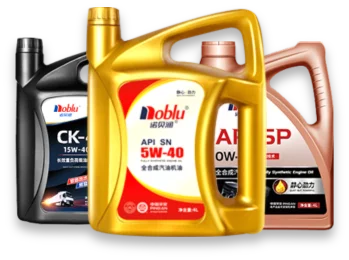


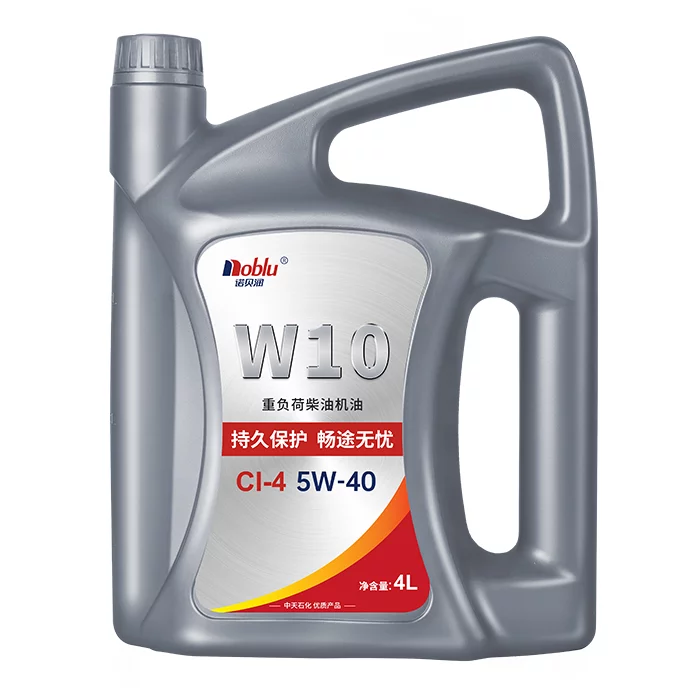
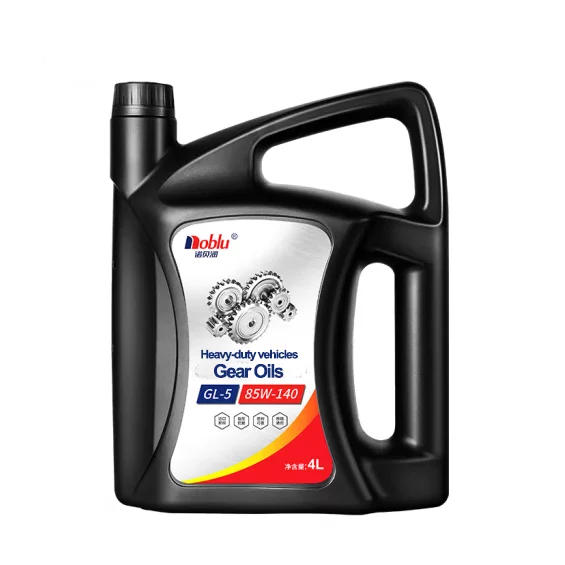
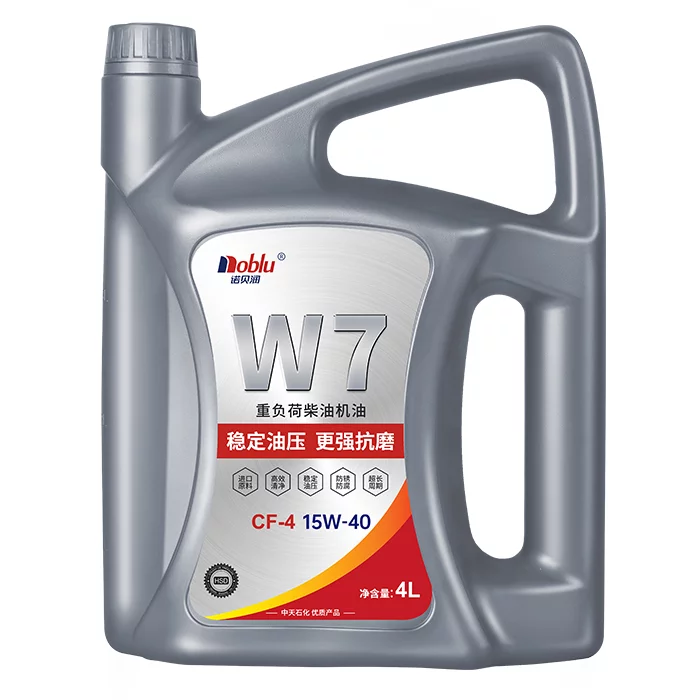
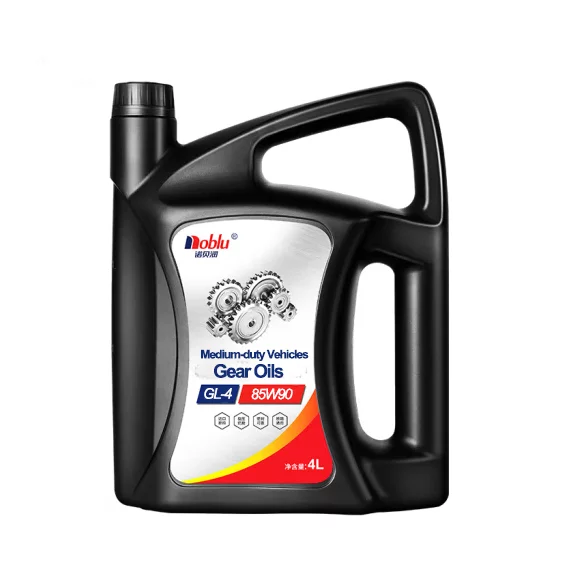




A Colombian auto parts retailer has placed its third repeat order of NOBLU motor oil, shipped as a full 40 ft high-cube container of 1 L bottles from Anhui Zhongtian Petrochemical. The load was 1,700 cartons of twelve 1 L bottles, 20,400 litres in total, across three SKUs only: an API SJ 20W-50 gasoline engine oil and two API GL-5 gear oils, 85W-140 and 80W-90. The account started as a trial, grew through a referral from another customer, and is now on a repeat cycle. This page records what shipped, why the shelf starts with three products rather than a full range, and what a buyer should verify before putting an unfamiliar oil brand on their own shelves.

What a third order proves, and what it does not
A first order tells you a supplier can produce and ship. It says nothing about whether the product sells through, whether the second batch matches the first, or whether the supplier still answers the phone once the novelty of a new account has worn off.
A third order is a different signal, because by then the buyer has been through the full cycle twice: landed cost, customs, shelf placement, sell-through, and whatever complaints came back over the counter. Reordering means the first two rounds cleared that loop. For a retailer evaluating a supplier, that is the useful part. Not the size of the order, but the fact that it repeated after the buyer had real information.
What a repeat order does not prove is fitness for your market. Consistency is only observable over time and against a fixed reference. The reference is the technical data sheet and the batch certificate of analysis; a reorder without those documents on file is a habit, not evidence. Nor does it transfer across product lines: repeat performance on a 20W-50 gasoline oil says nothing about a hydraulic fluid or a grease from the same plant.
What shipped: one container, three SKUs
The container carried finished retail packs rather than bulk drums: 1 L plastic bottles in cartons made to the order’s artwork specification. That difference matters more than it sounds. Retail packs are a consumer-facing product: the label, the bottle, the carton and the shelf presentation are part of what the buyer is purchasing, and they have to survive ocean freight without scuffing.
| SKU | Specification | Viscosity grade | Pack | Role on the shelf |
|---|---|---|---|---|
| Gasoline engine oil | API SJ service category | SAE 20W-50 | 1 L bottle, cartoned | Older and high-mileage petrol cars in a hot climate |
| Automotive gear oil | API GL-5 | SAE 85W-140 | 1 L bottle, cartoned | Heavier-duty hypoid axles, high ambient temperature |
| Automotive gear oil | API GL-5 | SAE 80W-90 | 1 L bottle, cartoned | General manual transmission and axle service |
The two gear oils are both GL-5 and differ only in viscosity grade. That is deliberate: GL-5 describes the additive performance level for hypoid gearing, while the SAE grade describes flow. Stocking two grades of one performance level covers a wide range of axles without doubling the technical support burden on counter staff. Where a vehicle calls for GL-4 instead, the substitution is not free. The yellow-metal compatibility difference is set out in our comparison of GL-4 and GL-5 gear oil, and the 80W-90 grade has its own product page.

The numbers behind two of these SKUs
A shelf decision is made on the label, but a supplier decision is made on the data sheet. These are the published typical values for two of the three grades in this shipment, with the test method beside each figure, so that a buyer can compare them against another quotation on equal terms.
| Property | GL-5 80W-90 | SJ 20W-50 | Test method |
|---|---|---|---|
| Kinematic viscosity at 40 °C | 140.0 mm²/s | Not published | ASTM D445 |
| Kinematic viscosity at 100 °C | 15.2 mm²/s (limit 13.5–18.5) | 17.93 mm²/s | ASTM D445 |
| Viscosity index | 106 | Not published | ASTM D2270 |
| Flash point, open cup | 228 °C (limit ≥180) | 246 °C | ASTM D92 |
| Pour point | −30 °C | −27 °C | ASTM D97 |
| Density at 15 °C | 0.890 kg/L | Not published | ASTM D4052 |
| Water content | Trace | Not published | — |
Figures are typical values of normal production published on the Zhongtian product data sheets for GL-5 80W-90 heavy-duty gear oil and SJ gasoline engine oil; individual batches vary, which is why the batch certificate of analysis and not the data sheet is the document to check on arrival. Two entries are marked as not published because the SJ data sheet reports a different property set, and no value is asserted here for figures the sheet does not carry. The 85W-140 grade is not tabulated above because its own data sheet should be requested for the specific production grade being quoted.
Why a retail shelf starts with three products, not thirty
An auto parts business adding a motor oil line faces a stocking problem rather than a technical one. Every additional SKU is capital sitting on a shelf, a label the counter staff have to explain, and a slow-moving line that eventually gets discounted.
The three products cover the two highest-frequency counter requests for an older petrol vehicle parc: one thick multigrade engine oil, and two gear oils spanning most axles. A 20W-50 is a wide-span multigrade whose high-temperature grade suits warm ambient conditions and engines with accumulated wear. Whether that describes your counter is a question about your own customers, not about the product. Where the local parc is newer and manufacturers specify thinner grades, a 20W-50 is the wrong opening SKU no matter how well it sells elsewhere.
This customer’s own history supports the narrow start. The business has sold automotive parts for many years and only added motor oil recently, stocking it in its own stores. Adding a lubricant line to an established parts counter is an extension of an existing customer relationship, not a new business, and that is exactly the case where a short, fast-moving SKU list beats a broad catalogue.
What a 40 ft high-cube container actually gives you
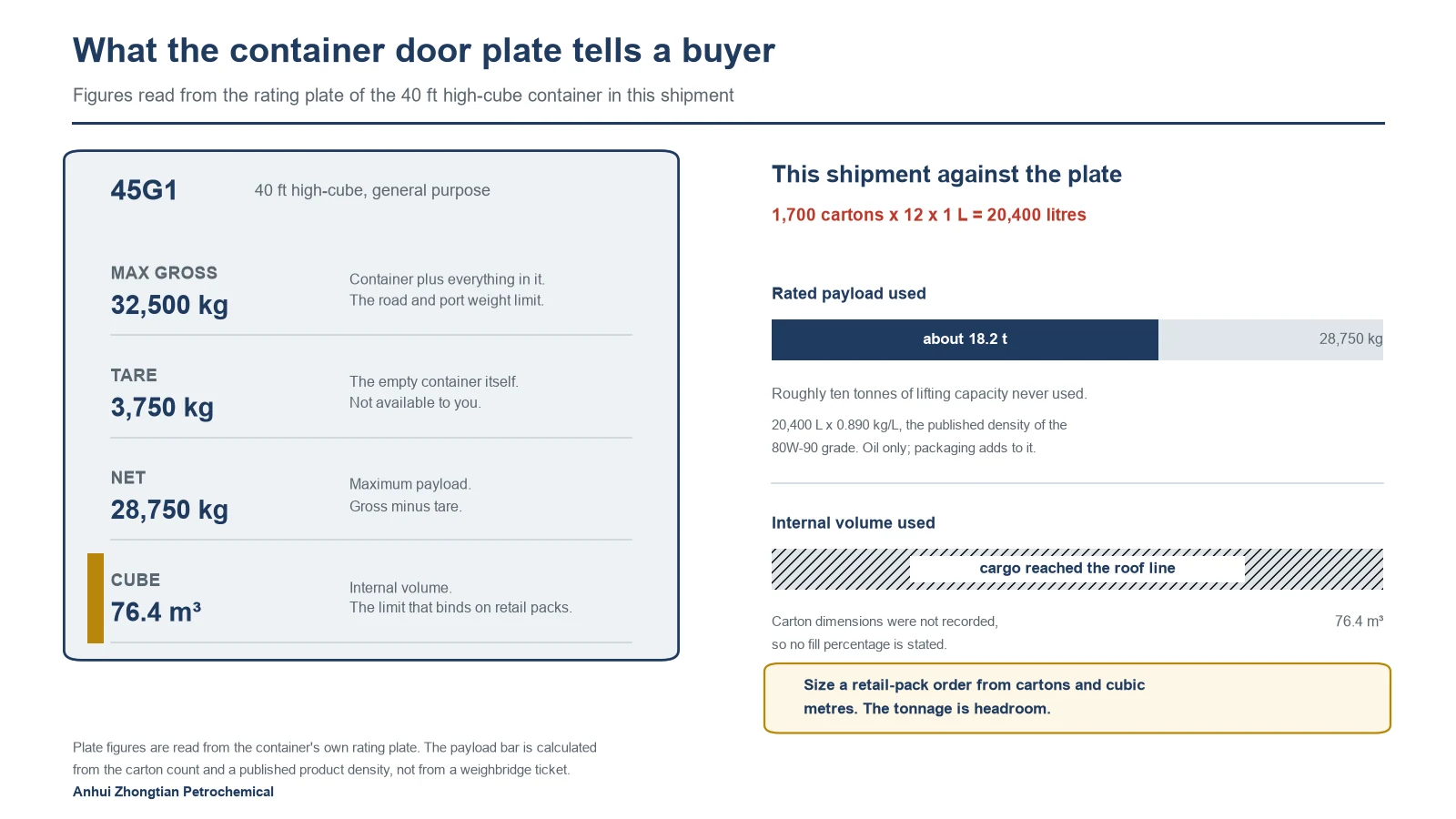
Buyers planning a first container order usually ask how much product fits. The limit is almost never weight when the cargo is 1 L bottles in cartons; it is volume. The rating plate on the container used for this shipment carries the figures that decide it:
| Container rating (from the door plate) | Value |
|---|---|
| Type | 45G1, 40 ft high-cube general purpose |
| Maximum gross mass | 32,500 kg |
| Tare | 3,750 kg |
| Maximum payload | 28,750 kg |
| Internal capacity | 76.4 m³ |
What this container actually carried
This shipment was 1,700 cartons of twelve 1 L bottles: 20,400 litres of finished product. Put that against the plate.
| Measure | This shipment | The container’s limit |
|---|---|---|
| Cartons | 1,700 | Set by volume, not by the plate |
| Bottles | 20,400 x 1 L | As above |
| Product volume | 20,400 L | 76.4 m3 internal capacity |
| Product mass, approximate | about 18.2 t | 28,750 kg rated payload |
The mass figure is the volume multiplied by 0.890 kg/L, the density published for the 80W-90 grade at 15 °C by ASTM D4052, and it counts the oil only. Bottles, cartons and dunnage add to it; the three grades do not share one density, so treat 18.2 t as an order of magnitude rather than a weighbridge reading.
Even so, the gap is the point. Roughly ten tonnes of rated payload went unused while the cargo reached the roof line, which is what the photographs show. A buyer sizing a first retail-pack order should work from cartons and cubic metres and treat the tonnage as headroom.
Those are the container’s rated limits, not the weight of this shipment. The practical consequence is straightforward: cartoned 1 L bottles are a low-density cargo, so a retail-pack load runs out of room before it runs out of permitted weight. A buyer budgeting a first order should plan against cubic metres and carton dimensions, and treat the payload figure as headroom rather than a target. Bulk drums invert the relationship entirely. A drum load reaches the weight limit with the container still visibly empty, as in the 40HQ trial shipment sent to a Colombian construction fleet, where the same container type carried 200 L and 20 L packs.
The account grew by referral, not advertising
This account did not come from a search result or a trade show. It came from a referral by an existing customer, and it has since expanded on the same basis.
That is worth stating plainly because it is the part of supplier selection that no website can demonstrate on its own. A referral transfers something a specification sheet cannot: the referring buyer has already absorbed the risk of a first order and has a reputation of their own attached to the recommendation. For a supplier, referral-driven growth in a single market is also a harder test than winning unrelated one-off orders, because the referrer hears about it when something goes wrong.
For a buyer, the practical use of this is narrow but real. If you are evaluating an unfamiliar brand, ask the supplier for a reference in your own region and product category, and ask the referring business how many orders they have placed, not whether they are satisfied.
What to verify before you stock a new motor oil brand
Treat a new lubricant line the way you would treat any other supplier qualification. The items below are the ones that decide whether a brand can sit on a retail shelf without becoming a liability.
| What to check | What to ask for | Why it matters at retail |
|---|---|---|
| Manufacturer or trader | Business licence, plant address, plant photographs or a visit | A trader cannot control formulation or batch consistency between your orders |
| Product identity | Technical data sheet for the exact grade, with revision date | The TDS is the fixed reference every later batch is compared against |
| Batch consistency | Certificate of analysis for the batch you receive | Without it, “same as last time” is an assumption |
| Performance level | The API service category and SAE grade in writing | Service category and viscosity grade answer different questions |
| Viscosity behaviour | Kinematic viscosity at 40 °C and 100 °C, and viscosity index | Viscosity index is calculated by ASTM D2270 and is not visible from the SAE grade |
| Quality system | An ISO 9001 certificate with a verifiable registration number | A number you can check beats a logo on a brochure |
| Packaging | Bottle, closure, label and carton specification and artwork proof | Retail packs are judged on the shelf before they are judged in the engine |
| Supply continuity | Lead times for in-stock versus produced-to-order | A shelf gap costs more than a small price difference |
| Shelf life and storage | The stated shelf life for each grade and the storage conditions it assumes | Retail stock turns slower than fleet stock, so the oldest carton on the shelf sets the risk |
| Destination conformity | Written confirmation of which label, language and marking rules the artwork was built to | Label rules are set by the importing country, and reprinting artwork after arrival is expensive |
| Brand rights | Who owns the brand in your market and what you are permitted to do with it | Selling under a brand you have no written right to use is a commercial risk that no data sheet covers |
Zhongtian’s quality, environmental and occupational health systems are certified to ISO 9001:2015, ISO 14001:2015 and ISO 45001:2018 under registration numbers 62825Q9372R0S, 62825E9373R0S and 62825S9374R0S, valid to April 2028 and verifiable through the issuing body. The wider version of this checklist, written for industrial rather than retail buyers, is in our guide to vetting lubricant suppliers. Retailers building a distribution business from a parts counter will find the commercial side covered in how to become a lubricant distributor.

Frequently asked questions
Is a 20W-50 the right first engine oil SKU for a retail shelf?
It depends on the vehicle parc your counter serves. A 20W-50 suits older and higher-mileage petrol engines in warm climates. Where the local parc is newer and manufacturers specify thinner grades, a 20W-50 is the wrong opening SKU regardless of how well it sells elsewhere.
What is the difference between GL-5 85W-140 and GL-5 80W-90?
The API service category is the same, so the additive performance level for hypoid gearing is the same. The SAE grades differ: 85W-140 is the heavier oil, suited to higher operating temperatures and heavier axle loading, while 80W-90 covers general manual transmission and axle service. Always match the grade to the vehicle manufacturer’s requirement.
How much motor oil fits in a 40HQ container?
This one carried 1,700 cartons of twelve 1 L bottles, which is 20,400 litres. At the density published for the 80W-90 grade, 0.890 kg/L at 15 °C, that is roughly 18.2 tonnes of product against a rated payload of 28,750 kg, so about ten tonnes of lifting capacity was never used while the cargo still reached the roof line. For cartoned retail bottles the binding constraint is volume. Plan a first order from carton dimensions rather than from tonnage.
Does a repeat order mean the product is right for my market?
No. It means it worked for that buyer’s market and vehicle parc. Ask which country, which vehicle types, and which SKUs repeated, then compare that against your own counter demand before assuming the result transfers.
Can I order fewer than a full container to start?
Yes. The stated minimum order quantity is 20 packaging units, and trial quantities are negotiable. Lead time is 3 to 7 days for items in stock and 10 to 20 days where production is required, depending on quantity.
How do I confirm the supplier is the manufacturer?
Ask for the plant address, the business licence and the ISO certificate registration numbers, then verify the numbers with the issuing body rather than accepting a certificate image. A factory visit or a live video walkthrough of the production line answers the same question faster.
Talk to us about the shelf, not the product list
If you are adding a lubricant line to a parts counter, the useful first conversation is about your vehicle parc and your shelf space, not about our catalogue. Send the vehicle types your counter serves most often, the grades customers already ask for by name, and the number of SKUs you can realistically stock in year one. We will come back with the shortest SKU list that covers it, the TDS for each grade, and the packaging and artwork options, including whether a three-SKU start makes sense for your market or whether it needs a different opening set. Contact Zhongtian Petrochemical.
Reviewed by the technical department of Anhui Zhongtian Petrochemical against the company’s shipment and product records. Date of last review: 2026-09-14.