






Base oil prices in 2026 have not followed one trend. They have split by group. Since late February, Group III prices in Asia have more than tripled, while Group II rose sharply in the spring and has been easing since June. For buyers in Latin America and Southeast Asia, two regions that import most of their base oil, that split decides which lubricants get more expensive and by how much.
This page sets out the price path with dated assessments, explains why Group III is the constraint, and covers what shapes the landed cost of base oil and finished lubricants in the two regions: who supplies them, which import rules apply, and how long shipments take from China. Prices quoted are third-party market assessments, not our quotes. This page is published by Zhongtian, a Chinese lubricant and grease manufacturer. Last updated: October 2026.
Base oil price trend in 2026
The table tracks weekly assessments published by Lubes’n’Greases for Asia, in US dollars per metric ton.
| Assessment date | Group III 4 cSt, FOB Asia | Group II 150N, FOB Asia | Group I SN150, ex-tank Singapore |
|---|---|---|---|
| 9 Feb 2026 | $1,090–1,130 | $720–760 | $790–830 |
| 13 Apr 2026 | $1,890–1,930 | $1,570–1,610 | $1,640–1,680 |
| 16 Jun 2026 | $2,850–2,890 | $1,780–1,820 | $1,660–1,700 |
| 19 Oct 2026 | $3,650–3,690 | $1,520–1,560 | $1,500–1,540 |
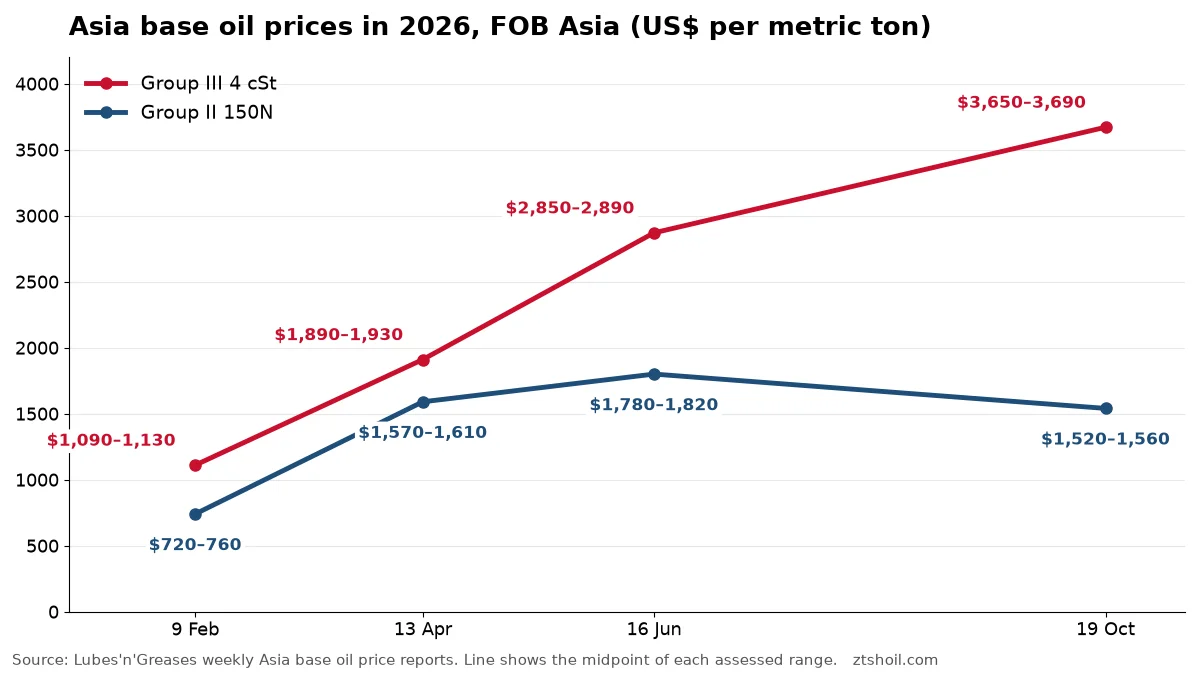
Two things stand out. Group III 4 cSt is now about 3.3 times its February level and was still edging up in October. Group II 150N roughly doubled, peaked around June and has come off since. Argus reported the first dip in Asian Group II prices in late May, after Asian refineries secured alternative crude and regional output rose, and noted that demand in the region was shrinking because prices were seen as too high.
Why Group III is the constraint
The trigger was the US-Iran war that began in late February 2026 and the de facto closure of the Strait of Hormuz. According to Argus, the Mideast Gulf accounts for about 20% of global Group III output, and in 2025 it supplied 47% of US and 72% of European Group III imports. Shell’s Pearl GTL plant in Qatar sustained missile damage to one of its two trains, which Argus said would take a year to repair.
As of mid-October, Lubes’n’Greases reported that very few vessels could cross Hormuz and that base oil plants in Abu Dhabi, Bahrain and Qatar were heard to be shut down or running at reduced rates. A Repsol/SK Enmove 4 cSt unit in Spain was also down. In Europe, Argus described the same split seen in Asia: Group I and Group II prices declining on weak demand, Group III at record highs as buyers compete for available material.
In the US, posted prices for Group II+ and Group III rose again in October. Motiva raised its Group III 4 cSt posting by 75 cents per gallon from 1 October (source), and ExxonMobil announced a 71 cents per gallon increase on its Group II+ EHC45 grade effective 15 October (source), while US Group I and Group II spot prices were little changed.
One claim that circulates in supplier messages is that South Korea has capped base oil exports. The March 2026 Korean export cap covered gasoline, diesel and kerosene, not base oil. What Lubes’n’Greases did report in October is that one key Korean exporter curtailed heavy-viscosity base oil exports that month.
South America base oil market: an import market
Most of Latin America buys its base oil abroad. A 2023 Lubes’n’Greases review of the region put it plainly: most Latin American markets are completely reliant on imports. The few local plants are Group I units, such as YPF’s La Plata refinery in Argentina and Ecopetrol’s Barrancabermeja plant in Colombia.
Brazil
Brazil is the largest market and a net importer. In 2025 it imported 931,000 tons of base oil and produced 532,000 tons domestically, importing more than half of what it consumes, mostly API Group II from the United States. Argus put the US share of Brazil’s base oil and lubricant imports at 76% in 2024. Petrobras plans a Group II plant at Itaboraí to replace Group I output, but sources disagree on timing: Argus reported a 2029 target, while Lubes’n’Greases said in February 2026 that the long-delayed project is not scheduled to open by 2029.
Domestic supply tightened in the third quarter of 2026 during a Petrobras turnaround, and local Group I light grade prices rose in October after increases by the local producer (source). Lubes’n’Greases also noted that US export prices into Latin America were under pressure from competing Asian supplies (source).
Mexico and the west coast
Mexico’s own base oil output had fallen to around 200 barrels a day by 2022, buyers reported that Pemex had not sold base oil since 2020, and the US held more than 95% of Mexico’s base oil imports that year (Lubes’n’Greases, 2023). More recently, US base oil exports to Mexico in April 2026 were 44% lower than a year earlier, and exports to Chile, Ecuador and Peru were down 20% (Argus, EIA data). In October, US export prices into Mexico dropped as suppliers faced growing inventories (source).
Asia-Pacific and Southeast Asia base oil supply
Southeast Asia is closer to supply than Latin America, but it is not self-sufficient, and part of what it imports is Gulf Group III.
- Singapore: ExxonMobil started up a 20,000 barrels per day Group II expansion in 2025, including up to 6,000 b/d of its EHC 340 MAX grade.
- Malaysia and Indonesia: Petronas runs Group II and Group III units at Melaka, Pertamina runs a Group I plant at Cilacap, and Pertamina and SK operate a Group III joint venture at Dumai (Argus).
- Thailand: produces Group I and imports the rest. In April 2024, South Korea and Qatar made up 54% of its imports (Argus), so it is directly exposed to the Gulf disruption.
- Vietnam: does not produce any base oil and is fully reliant on imports (Argus, February 2026).
What goes into landed cost
The FOB price is only the starting point. For a buyer in Latin America or Southeast Asia, landed cost also depends on freight and transit time, import duty and taxes, registration or certification before the product can be sold, and currency. Duty rates change and depend on origin and trade agreements, so confirm the current rate for your HS code with your customs broker rather than relying on a published figure.
Registration and certification rules to plan for
- Brazil: under ANP Resolution 804/2019, the import and production of finished lubricants require ANP authorization, and listed products must be registered with ANP before they can be sold or imported. Build the registration time into any new supply plan.
- Indonesia: Ministry of Industry Regulation 8/2025 makes SNI certification mandatory for motor vehicle lubricants, whether made locally or imported, covering gasoline and diesel engine oils, two-stroke oils, manual gear oils and ATF. It took effect six months after it was promulgated in January 2025.
- Mexico: a 2023 decree added an energy ministry (SENER) import application requirement for petroleum products, as reported at the time. Check with your broker whether it applies to your product and how it is currently enforced.
Transit times from Chinese ports
Scheduled port-to-port times on Maersk services, as published on its route pages in October 2026 (the Santos figure is from a March 2025 service announcement). Door-to-door time is longer once customs and inland transport are added.
| Route | Scheduled transit |
|---|---|
| Shanghai to Manzanillo, Mexico | 21 days |
| Ningbo to Manzanillo, Mexico (via Lázaro Cárdenas) | 34 days |
| Shanghai to Callao, Peru | about 37 days |
| Shanghai to Santos, Brazil | 37 days |
| Ningbo to Jakarta | 8 days |
| Shanghai to Ho Chi Minh City | 5 to 7 days |
| Ningbo to Manila | 6 days |
A five-week voyage to Brazil means a cargo priced today arrives into a different market. With Group III still moving week to week, agree in the contract which date the price is fixed on and how long a quotation stays valid.
What this means if you buy finished lubricants
Most buyers in these regions purchase blended lubricants and greases, not base oil. A few practical points follow from the price split:
- Know which base oil group your product depends on. Low-viscosity engine oils and other formulations that rely on Group III are the most exposed this year. Products built mainly on Group I or Group II, which covers many industrial oils and greases, have seen smaller and now easing cost pressure.
- Ask for the base oil group on the technical data sheet and check that it does not change between batches without notice. A substitution made to protect margin can change viscosity index and low-temperature behaviour.
- Fix the price basis. Agree the quotation validity period and, for longer contracts, a review clause tied to a named published assessment rather than open-ended surcharges.
- Do not over-buy at the peak. Group II prices have already turned down in Asia and Europe. Stock decisions should follow your own consumption, not headlines.
Zhongtian blends lubricants and greases in Anhui, China, and exports to more than 100 countries and regions. Our base oil suppliers include Shell, S-OIL, GS Caltex, SK, Sinopec, PetroChina, CNOOC and Formosa Plastics. If you are comparing offers for hydraulic oils, engine oils or greases for delivery to Latin America or Southeast Asia, send us your specification and destination port.
Frequently asked questions
Why are Group III base oil prices so much higher than Group II in 2026?
The Mideast Gulf supplies about a fifth of the world’s Group III and a large share of US and European imports. With Hormuz largely closed and several Gulf plants shut or running at reduced rates, Group III supply has stayed tight, while Group I and Group II supply recovered as Asian refineries found other crude.
Is South America a base oil importer?
Yes. Brazil imports more than half the base oil it uses, mostly Group II from the United States, and most other Latin American markets rely entirely on imports.
Has South Korea restricted base oil exports?
No general cap has been reported. The March 2026 export cap covered gasoline, diesel and kerosene. In October one Korean exporter was reported to have cut heavy-viscosity base oil exports.
Sources
- Lubes’n’Greases, Weekly Asia Base Oil Price Report, 9 February 2026
- Lubes’n’Greases, Weekly Asia Base Oil Price Report, 13 April 2026
- Lubes’n’Greases, Weekly Asia Base Oil Price Report, 16 June 2026
- Lubes’n’Greases, Weekly Asia Base Oil Price Report, 19 October 2026
- Argus, Base oil prices remain elevated since ceasefire, 10 April 2026
- Argus, Asian Group II prices slip on growing supplies, 26 May 2026
- Argus, European base oils: Group III price pressure, October 2026
- Lubes’n’Greases, Weekly Americas Base Oil Price Report, 30 September 2026
- Lubes’n’Greases, Weekly Americas Base Oil Price Report, 14 October 2026
- Argus, South Korea caps fuel exports to safeguard supply, 17 March 2026
- Lubes’n’Greases, Brazil base oil production dropped in 2025, 25 February 2026
- Argus, Petrobras eyes 2029 for Group II base oils production, 15 July 2025
- Argus, US April base oil exports up by 5.8pc: EIA, 30 June 2026
- Lubes’n’Greases, Latin America base oil market still lagging, 1 March 2023
- ExxonMobil, Singapore Group II expansion start-up, 23 September 2025
- Argus, Malaysia’s Petronas, Pertamina sign base oil plant deal
- Argus, Thailand’s base oil imports fall in April, 11 June 2024
- Argus, Vietsea to distribute ExxonMobil’s base oils in Vietnam, 23 February 2026
- Brazil ANP Resolution 804/2019 (text)
- Indonesia Ministry of Industry Regulation 8/2025 (text)
- Portal Lubes, Mexico restricts base oil imports, 3 November 2023
- Maersk route timetables (AC1, AC2, AC3, IA1, IA12, PH3), accessed October 2026; Maersk service announcement, 4 March 2025