




Drone motor bearing grease is packed into the motor’s ball bearings at assembly and usually has to last the life of the bearing.
- Speed: T-Motor lists its heavy-lift MN1315 motor at 3,799 rpm at full throttle; small high-KV motors spin far faster
- Field oiling: NSK says sealed and shielded bearings are greased for life and should not be relubricated
- Spray drones: operators most often blame dust, washing water and chemical residue for early bearing wear
- Data sheet: check speed factor, low-temperature torque, rust rating and evaporation loss, not the dropping point
- Our grease: Zhongtian publishes a −40 to 150 °C range for its drone motor bearing grease
What grease is inside a drone motor bearing?
Most drone motors run small shielded or sealed ball bearings that are filled with grease once, at the factory, and never relubricated. T-Motor’s product pages list imported 6904ZZ bearings in its MN1315 heavy-lift motor and 6901ZZ bearings in the MN8014; the ZZ suffix means a shield on both sides. Whatever grease the bearing maker or motor maker puts in at assembly is the grease the motor flies on for its whole life.
That grease has to cope with speed, heat and the outdoors at once. Schaeffler’s technical guide TPI 176 notes that greases for high speeds typically have a low base-oil viscosity and an ester base oil, and that they also suit low temperatures. SKF’s grease selection chart lists its LGLT 2, a PAO-based grease for extremely high speeds, from −50 to +110 °C. High-speed motor greases use different thickeners: Klüber’s Klüberspeed BF 72-22 uses polyurea, and ExxonMobil’s Mobilith SHC 100, which ExxonMobil recommends for electric motors and other higher-speed applications, uses a lithium complex soap. What they share is a synthetic base oil chosen for speed and cold starts.
For general guidance on greases for industrial motors, see our page on electric motor bearing grease, and for the thickener most used in sealed motor bearings, our guide to polyurea grease. A drone motor adds two things an industrial motor rarely sees: weather and, on spray drones, chemicals.
Should you oil or grease drone motor bearings in the field?
Usually not: shielded and sealed bearings are greased for life, and oil added from outside tends to fling out and collect dirt. NSK’s technical note on lubrication states that sealed and shielded bearings are greased for the life of the bearing and should not be replenished with lubricant.
Pilots who have tried it report the same. In a thread on r/Multicopter, the top reply to an owner planning to use a bicycle lubricant was that anything put in the bearings gets flung out into the stator and attracts dirt (thread). A moderator on the Mavic Pilots forum answered a Mavic 3 Pro owner’s question about adding a drop of oil with a flat “no”, and another member pointed out that anything applied will spin off (thread).
Not everyone agrees. A Swellpro service centre in New Zealand posted a worn motor bearing from a spray drone that had been stored without being washed or lubricated, and recommended rinsing with a water mist and then applying a light oil (video). DJI’s Agras T40 preseason maintenance guide takes a third line: if a motor feels rough when turned by hand, the likely causes are coil corrosion or a broken bearing, and the owner should contact the dealer. It gives no lubrication step.
Because field oiling is disputed and the drone makers do not call for it, the factory grease has to resist washing water and chemical residue on its own. Specify that at the motor design stage rather than leaving it to operators.
How fast do drone motor bearings actually spin?
Heavy-lift and spray drone motors turn at about 3,500 to 4,000 rpm at full throttle; small high-KV motors turn many times faster. T-Motor publishes full-throttle test data for its large UAV motors, and the figures are lower than many buyers expect.
The usual way to judge whether a bearing speed is high for grease is the speed factor n·dm: the speed in rpm multiplied by the bearing’s mean diameter, dm = 0.5 × (bore + outside diameter), in millimetres, as SKF defines it. The table works it out for two T-Motor motors from the bearing sizes and speeds on their product pages.
| Motor (T-Motor) | Bearing | Full-throttle speed (T-Motor test) | n·dm, calculated |
|---|---|---|---|
| MN8014 KV100, 12S | 6901ZZ (12 × 24 mm) | 3,947 rpm | about 71,000 |
| MN1315 KV100, 14S | 6904ZZ (20 × 37 mm) | 3,799 rpm | about 108,000 |
| U10 II KV100, 12S | not stated | 3,517 rpm | — |
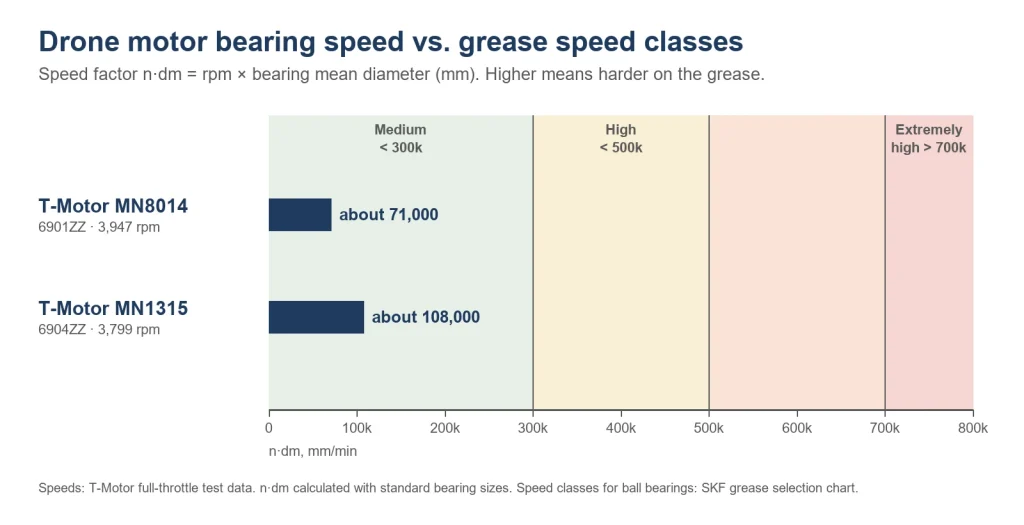
SKF’s grease selection chart classes ball-bearing speeds below 300,000 as medium, below 500,000 as high, and above 700,000 as extremely high. By that measure, the bearings in large agricultural drone motors run at a medium speed for grease. Small motors are a different case: a 1,950 KV racing motor on a 6S pack (25.2 V) has a theoretical no-load speed of about 49,000 rpm, which is a calculation from KV and voltage, not a measured figure. If you build small high-KV motors, speed is the first thing to check on the grease data sheet. If you build heavy-lift motors, it rarely is.
Why do spray drone motor bearings wear out early?
Spray drone operators most often blame dust, washing water and chemical residue, on top of long hours at heavy load. In a Facebook group for XAG spray drone operators in the USA, one member said they frequently replace motor bearings because of the local dust; another said that switching to sealed bearings made them last much longer (group post).
Some operators replace these bearings themselves. An XAG P100 Pro owner on r/drones described a clicking motor under full load and a bearing change; the owner put a new motor at about 2,700 and its bearings at about 14 per motor, without stating the currency (thread). Another operator on r/drones described servicing the A60 motors of an XAG P150 in batches: three screws and a snap ring, then press the motor apart (thread). A spray drone dealer, Agri Spray Drones, states in its knowledge base that DJI recommends replacing Agras T50 motors every 700 flight hours (dealer page); that is the dealer’s account, not a DJI document.
Heat adds to the wear. T-Motor’s test table for the MN1315 shows a motor temperature of 97 °C at 40 % throttle in a 25 °C room. SKF and NSK both state that above 70 °C, the grease relubrication interval halves for every 15 °C rise, and Schaeffler gives the same 15 K rule for grease life. Water matters too: SKF advises that where water or condensation is present, the grease’s corrosion-inhibiting properties are very important, and it uses the Emcor test, described in ASTM D6138, to rate it.
For an agricultural drone motor, rust protection and water resistance therefore matter more than the speed rating. See our high temperature grease guide for how temperature shortens grease life in hot bearings.
What should you check on a grease data sheet for drone motors?
Check the speed factor, low-temperature torque, rust rating and evaporation loss; the dropping point is not an operating temperature. When you compare high speed bearing grease data sheets for brushless motor bearings, the table below maps each drone duty to the line that matters.
| Drone duty | What the grease must do | Line to check on the data sheet |
|---|---|---|
| Small high-KV motors | Run at a high n·dm without churning | Speed factor n·dm (mm/min); base oil viscosity at 40 °C |
| Long runs at speed | Stay in the bearing instead of softening and leaking | Roll stability (ASTM D1831); prolonged worked penetration (ASTM D217) |
| Heavy-lift motors with large propellers | Protect against wear under load | Four-ball wear scar (ASTM D2266, 40 kgf, 1,200 rpm, 75 °C, 1 h) |
| Winter and high-altitude starts | Low starting torque in the cold | Low-temperature torque (ASTM D1478); base oil type (PAO or ester) |
| Long hover, summer heat | Long life at temperature | Upper operating temperature; evaporation loss (ASTM D972 or D2595) |
| Spraying, washing, coastal air | Prevent rust with water present | Emcor rating (ASTM D6138) with distilled and salt water; ASTM D1743 |
Test methods as described by ASTM and SKF. ASTM notes that results of several of these tests, including the four-ball wear test and evaporation loss, have not been correlated with field service; use them to compare greases, not to predict life.
To narrow the choice by temperature, load and water, try our grease selector.
How much grease should a high-speed motor bearing hold?
At high speed, fill roughly one-third of the bearing’s free space; more grease means more churning and more heat. NSK’s lubrication note gives one-third to one-half of the free space when the bearing runs above 50 % of its limiting speed, and one-half to two-thirds below that. NTN’s catalogue gives 30 to 40 %, and says a reduced amount should be used where speeds are high and temperature rise must be kept low, because excessive grease causes temperature rises. Timken’s miniature bearing catalogue gives one-third as the standard fill.
Expect a short temperature peak at first start-up while the grease distributes itself; SKF notes this for grease-lubricated bearings. If you specify grease for a motor line, write the fill quantity on the drawing in grams or as a share of free space, together with the consistency grade; our guide to NLGI grease grades explains what the grade number does and does not tell you.
What does Zhongtian’s drone motor bearing grease offer?
Zhongtian’s drone motor bearing grease is a synthetic-oil grease with a special soap thickener, published for −40 to 150 °C. Zhongtian Petrochemical developed it for the brushless motor bearings of industrial drones used for logistics, power-line inspection, crop spraying, mapping and emergency response, covering deep-groove and angular-contact ball bearings.
Zhongtian Drone Motor Bearing Grease
- Thickener: special soap
- Base oil: synthetic hydrocarbon
- Operating temperature: −40 to 150 °C, short peaks to 180 °C
- Dropping point: ≥ 250 °C (not an operating temperature)
- Four-ball wear scar: ≤ 0.50 mm (test conditions not published)
Figures as published by Zhongtian Petrochemical in July 2026. They are product information, not batch results or a technical data sheet.
Zhongtian designed the grease to stay in the bearing at high speed, to start easily in the cold, and to resist water, salt air and agricultural chemicals, with low evaporation for long running at temperature. The company states that its oil film stays intact at 30,000 rpm, a speed that applies to small high-speed motors rather than the heavy-lift motors in the table above. Zhongtian has not published rust or water-resistance test results for this grease, so for spray drone motors, tell us how the drones are sprayed, washed and stored when you ask about it.
FAQ
Is the dropping point the maximum operating temperature of a grease?
No. ASTM D2265 states that above 200 °C, the dropping point has no correlation with the maximum upper operating temperature. Use the operating temperature range on the data sheet, and bear in mind that grease life shortens as temperature rises.
Does a salt spray test prove that a bearing grease resists corrosion?
No. ASTM B117 is a test for metals and coated metals. For a bearing grease, rust protection is tested in a running bearing with water or salt water, as in the Emcor test (ASTM D6138), or in a stored wet bearing, as in ASTM D1743.
Can WD-40 lubricate drone motor bearings?
It is not a bearing grease. Drone forums are split: in an r/dji thread about rust on a Mavic Mini flown near the sea, the most-voted reply suggested spraying WD-40 on the motors, while other replies objected (thread). Bearing makers say shielded and sealed bearings are greased for life; a rough bearing should be replaced.
How often should agricultural drone motors be replaced?
Follow the drone maker’s maintenance schedule. For the DJI Agras T50, the dealer Agri Spray Drones states that DJI recommends motor replacement every 700 flight hours. Inspect motors before each season by turning them by hand and listening for roughness, as DJI’s T40 guide describes.
Sources and notes
- NSK, technical insight on lubrication and on limiting speed (sealed and shielded bearings greased for life; fill quantity). nsk.com
- SKF, grease life and relubrication (n·dm; 15 °C rule) and grease selection chart 13238 EN (speed classes; LGLT 2). skf.com
- Schaeffler, TPI 176, Lubrication of rolling bearings (high-speed greases; 15 K rule). schaeffler.com
- NTN, Ball and Roller Bearings catalogue 2203/E (grease fill and temperature rise). ntnglobal.com
- Timken, Miniature and Thin-Section Bearing Catalog (standard fill). timken.com
- ASTM D2265, D2266, D1478, D6138, D1743 and B117 scope statements. astm.org
- T-Motor product pages for MN1315, MN8014 and U10 II (bearings, full-throttle speeds, motor temperature). n·dm values are our calculation from those speeds and standard bearing dimensions.
- Klüber Lubrication (Klüberspeed BF 72-22) and ExxonMobil (Mobilith SHC 100) product information, cited for thickener type only.
- Owner and service-centre reports from Reddit (r/drones, r/Multicopter, r/dji), the Mavic Pilots forum and Facebook groups, linked where cited; they describe individual drones and are not tests.
- Zhongtian product figures are as published by the company in July 2026, not batch results.