




Zhongtian Petrochemical technical sales. Published 8 October 2026. Product figures as read on our product pages on 1 October 2026.
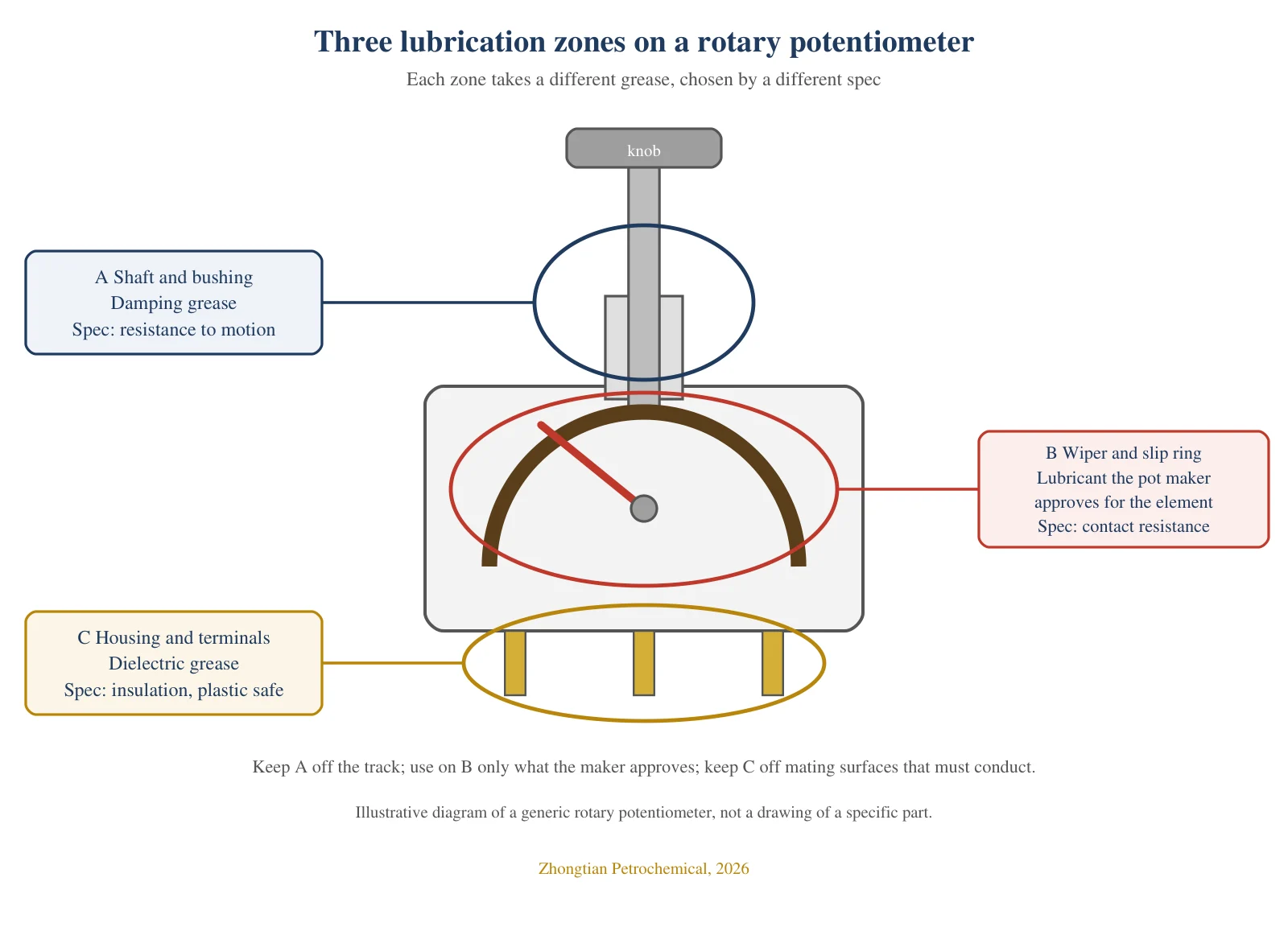
Potentiometer grease is not one product. A damping grease goes on the shaft and bushing to set the feel and stop the knob drifting; an electrical contact grease goes on switch contacts and connectors, where the film must not raise contact resistance; a dielectric grease goes on housings and terminals to keep water out while insulating. The spec that decides each is different, and the wrong one in the wrong place makes a pot noisy, shorted or stiff.
Three greases, three jobs
| Grease | Where it goes on a potentiometer or switch | The one number that decides | Our product |
|---|---|---|---|
| Damping grease | Shaft, bushing, detent: the parts you feel | Resistance to motion: apparent viscosity or damping torque at the working temperature | Potentiometer damping grease, insulating, minus 20 to 130 °C |
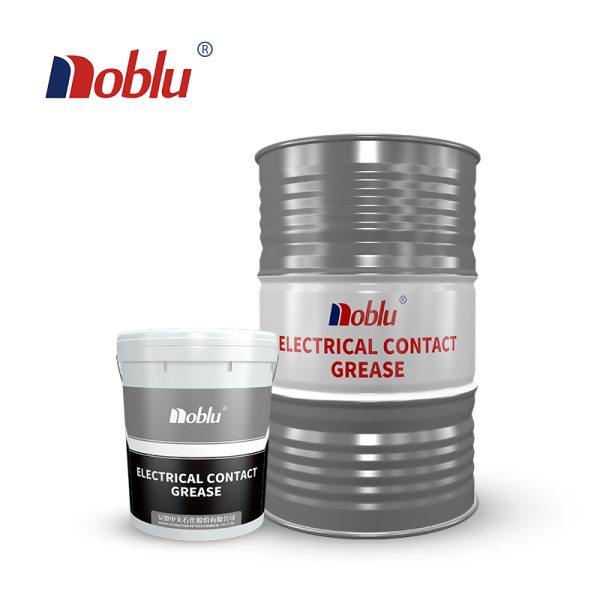
| Electrical contact grease | Switch contacts and plug-in contacts in low-current circuits; slip rings only where the potentiometer maker allows a contact grease | Contact resistance through the film, by a named method | Electrical contact grease, volume resistivity figure of at most 120 ohm-cm by our in-house method |
| Dielectric grease | Terminal blocks, connector housings, boots and seals around a contact, not across it | Insulation and sealing; plastic and rubber compatibility | Not a product we list |
The names overlap in catalogues and in search results, which is why a buyer who writes “potentiometer grease” on a purchase order usually gets a question back. Our own sales training files damping grease and conductive grease under special-purpose greases, alongside sealing grease, and gives damping grease the cassette compartment of a tape recorder as its example. Two enquiries from the last eighteen months show the two directions the question comes from: an importer asked us for the specification of a damping grease, and another buyer asked for 150 kg of electrical contact grease. They were not asking for the same product.
Our two sheets side by side
| Row on the product page | Potentiometer damping grease | Electrical contact grease |
|---|---|---|
| What it is for | Damping and quietening of adjustment and slow-opening mechanisms | Protection and lubrication of low-current contacts, switch contacts and plug-in connectors |
| Electrical behaviour | Insulating | Volume resistivity figure of at most 120 ohm-cm, in-house method; filler not stated |
| Appearance | White smooth ointment | White smooth even ointment |
| Worked penetration, 0.1 mm | 275 typical (NLGI grade 2) | 265 to 295 (grade 2) |
| Dropping point | 255 °C typical | at least 160 °C |
| Copper-strip corrosion | pass, 100 °C, 30 h | pass, 100 °C, 3 h as printed |
| Evaporation | 5.0, unit and conditions not printed | at most 1.0 percent, 99 °C, 24 h |
| Apparent viscosity | 1,800, unit, temperature and shear rate not printed | not listed |
| Service range | minus 20 to 130 °C | minus 35 to 120 °C |
| Thickener and oil | organic thickener, semi-synthetic oil, antioxidant and rust inhibitor | not stated |
Both sheets are the typical values as read on the product pages on 1 October 2026, not batch results. The rows marked “not printed” or “not stated” are the ones to ask about before a production release.
Damping grease: the spec is resistance to motion, not load
A damping grease is formulated for shear resistance first; load-carrying is not what sets the grade. Nye Lubricants, a US maker of damping greases, describes the difference on its damping page and in the design guide linked from it: these greases use viscous, high-molecular-weight synthetic oils so that they resist being sheared, they are tackier than a standard grease, and a lighter grade gives less resistance than a heavier one; selection is objective on material compatibility and temperature range, and subjective on the feel the designer wants. The same page reports dynamic viscosity at a shear rate of 50 per second, in pascal-seconds, alongside an NLGI grade and a tack scale, and advises testing several viscosities on the actual mechanism.
Our potentiometer damping grease is a semi-synthetic oil thickened with an organic thickener, with antioxidant and rust inhibitor added, and it is electrically insulating. The product page lists the mechanisms it is sold for: potentiometer adjustment mechanisms; the slow-opening mechanisms of optical drives and recorders; slow-opening mechanisms on washing machines and other automatic sanitary fittings; focusing mechanisms on telescope heads and camera lenses; and the reset mechanisms of car combination switches and instrument pointers. The page describes the product as a low-temperature grease, so do not read its apparent-viscosity figure of 1,800 against a room-temperature dynamic viscosity in pascal-seconds; the unit, test temperature and shear rate are not printed, and we will give them on request. The page also says the grade range covers “a wide range of damping moments” without listing the grades. If you are specifying a feel rather than a penetration number, send us the torque your mechanism needs at its working temperature, in gram-centimetres or newton-millimetres as your potentiometer datasheet states it, and we reply with the grade.
One practical point follows from the chemistry. A damping grease is chosen for the force it takes to move through it, so it must stay where it is put. On a potentiometer that means the shaft and bushing, and never the resistive track, where a thick film under the wiper becomes contact noise.
Electrical contact grease: the spec is what happens to contact resistance
A contact grease has the opposite job: it lubricates and protects a metal contact without raising the resistance across it. Whether a given grease does that depends on how the film behaves under the contact force, and the figure that describes it only means something with the method attached. ASTM D257, the standard for DC resistance of insulating materials, notes that surface resistance changes rapidly with humidity while volume resistance changes slowly, that the result depends on electrode geometry, film thickness, voltage, electrification time and temperature, and that a resistance figure is most useful when the specimen and electrodes match the real geometry. The same standard says it is not suitable for moderately conductive materials, which it refers to ASTM D4496; a figure as low as 120 ohm-cm sits outside D257’s scope, one more reason to ask for the method behind any such number, ours included.
Our electrical contact grease is sold for the maintenance of contacts in low-current equipment and for static contacts such as plug-in connectors, with arc suppression and protection of switch contacts as its stated jobs. Its volume resistivity figure (the page calls it volume resistance) of at most 120 ohm-cm is by our in-house method, not by a published standard, so a buyer comparing it with another supplier’s sheet should ask both suppliers for the electrode geometry, film thickness and voltage before treating the two numbers as comparable. Ask us, too, whether the product carries a conductive filler; the page describes it as a white, smooth ointment and does not say.
That question decides one risk. A grease that conducts through its bulk because it carries a conductive filler will conduct between two adjacent pins if it is spread across them, so a filled grease belongs on single contacts, slip rings and wide-pitch connectors, never across the face of a fine-pitch multi-pin connector. A grease without a filler does not bridge, and relies on the contact force displacing the film at the touch point.
Dielectric grease: insulation that protects the housing, not the track
A dielectric grease insulates. It is applied around a connection to keep water, salt and dust off the metal and to let plastic and rubber parts mate without tearing; where two contacts are pressed together, the metal displaces the film and current flows at the contact point. On a potentiometer that makes it a housing, terminal and boot product. A lightly loaded wiper may not push through it. We do not list a dielectric grease.
Choose by the mechanism
| Mechanism | Grease type | What to check before you specify it |
|---|---|---|
| Rotary potentiometer shaft and bushing | Damping grease | Feel at the lowest and highest operating temperature; the bushing material |
| Slider or fader rail | Usually a light lubricant, not a damping grease; the products searchers call “fader lube” are cleaner-lubricants, a different class | Travel force the user expects; migration onto the track |
| Wiper on a carbon or cermet track | Only the lubricant the potentiometer maker approves for the element, normally a non-filled contact lubricant the wiper displaces; a bulk-conductive grease along the track adds a parallel resistance path and shifts the reading | Maker’s instruction first; ask us whether our contact grease has been used on resistive elements, since its page lists switch contacts and plug-in connectors, not tracks |
| Detent or click mechanism | Damping grease, usually a lighter grade than the shaft | The snap must survive the film; test two grades on the real detent spring |
| Rotary switch contacts, low current | Electrical contact grease | The resistance method behind the sheet; the current the contact is rated for |
| Camera lens focus ring, telescope head | Damping grease | Temperature range of the location; no migration onto optics |
| Washing-machine and appliance slow-opening mechanisms | Damping grease | Plastic compatibility of the hinge or rack; the opening speed wanted |
| Automotive combination switch, instrument pointer reset | Damping grease | Full cabin range; minus 40 °C, the usual automotive lower limit, is below our grade’s minus 20 °C rating |
| Plug-in connector housings, terminal blocks, battery terminals | Dielectric grease | Keep it off the mating surfaces that must conduct through light pressure |
Two of those rows limit our own product. The automotive row exceeds the minus 20 °C lower rating of our damping grease; a cold-market combination switch needs a grade rated lower, which we would have to quote separately. And the wiper row depends on the potentiometer maker: some makers specify no lubricant on the track at all, and that instruction outranks any grease sheet.
Searchers arrive at this question with two product names from other makers: the Nyogel 767A that searchers look for, which its maker sells as a damping grease, and the DeoxIT fader products, which are cleaner-lubricants. The first is a damping grease and belongs in the shaft row; the second is a cleaner, not a grease, and belongs in the cleaning section below; neither is an electrical contact grease. If you already use one, send us its data sheet and we match the row.
The four ways the wrong grease fails
| Wrong choice | What happens | Why |
|---|---|---|
| Damping grease on the resistive track | Crackle, dead spots, drift in the setting | A thick, tacky film under a lightly loaded wiper breaks contact |
| Filled conductive grease spread across a multi-pin connector | Leakage between pins, a soft short | The film conducts through its bulk from one pin to the next |
| Dielectric grease under a lightly loaded wiper or contact | Open circuit or intermittent reading | The contact force is too low to displace the film |
| Contact cleaner with no re-lubrication | Scratchy feel, faster wear of wiper and shaft | The solvent removed the lubricant the part was built with |
Check the plastic before you order
Potentiometer and switch bodies, bushings and sliders are often plastic, and a grease that is right for the mechanism can still crack the housing. Newgate Simms, a UK distributor of specialty greases, explains that swelling, cracking and discolouration take hours to weeks to appear, that the additives in a grease can attack a plastic even when the base oil is considered safe, that perfluoropolyether and silicone oils are compatible with most plastics, and that ester oils should be used with extreme caution on polycarbonate, polystyrene, PVC and several rubbers. Our damping grease page says “semi-synthetic” without naming the base-oil family; ask for it before you test, and test anyway, because we have not published an immersion result for this grease on any plastic.
The test they describe is simple enough to run before a production release: immerse a sample of the housing plastic in the grease, keep a control sample dry, hold both at an elevated temperature that does not itself damage the plastic, weigh and measure before and after, and run two durations, such as 24 or 48 hours and one week. A small change in weight is normal. A crack or a soft surface is a reason to change the grease; a colour change is a question for whoever will see the part.
When a pot gets noisy: clean first, then put the lubricant back
Contact noise on an old potentiometer comes from contaminants between wiper and track and from oxidised metal on the wiper and slip ring. The clearest diagnosis is electrical: drive the pot with a few volts and watch the wiper voltage on an oscilloscope while turning it; a clean part gives a smooth line, a noisy one shows spikes where the wiper loses contact. Inventors Emporium’s case study shows both traces and makes the point that matters for grease: cleaning with solvent removes whatever lubricant the part had, and the feel and the wear change until lubrication is restored to the shaft and, where the maker allows it, the track.
The products searchers ask about in this context are contact treatments, not greases. CAIG’s DeoxIT D-Series, by the maker’s description, dissolves oxides and sulphides on metal surfaces, leaves a thin protective film, has about 20 percent deoxidising action, and is stated by CAIG not to damage carbon potentiometers; for gold and other plated surfaces CAIG points to its separate G-Series. A treatment like that cleans the contact. It does not set the feel of the shaft and it does not seal the housing.
A buyer wrote to us about greenish residue and rust on the inverter terminals of a crane, asking whether electrical contact grease would fix it. The order of work is the same as for a noisy pot: remove the corrosion and re-make the joint first, then protect the cleaned metal. Our contact grease is specified for low-current contacts; bolted power terminals need a product rated for that current and spacing, and we said so. Grease applied over corrosion keeps the corrosion in.
Frequently asked questions
Is dielectric grease just petroleum jelly?
No. Dielectric grease is sold with a stated temperature range and plastic compatibility, and most products are silicone-based. Petroleum jelly is a mineral hydrocarbon sold with neither, with a melting point near 40 to 60 °C, and with the risk that mineral-oil products carry of swelling some rubbers and plastics. Both insulate; only one is specified for the job.
What is the best cleaner for a potentiometer?
There is no single best cleaner; the maker’s instruction for the track material comes first. A contact treatment such as CAIG’s DeoxIT D-Series is described by its maker as removing oxides and protecting the metal, and as safe on carbon potentiometers. Whatever cleaner is used, it also removes the lubricant, so the shaft needs damping grease afterwards.
What is a good spray for cleaning potentiometers?
A spray made for contacts, applied in the smallest amount that reaches the track, with the part worked through its travel afterwards. Avoid general solvents that attack the housing plastic, and do not expect a cleaning spray to restore the feel of the shaft; that takes a damping grease on the shaft and bushing only.
Is it safe to use Deoxit on potentiometers?
CAIG, the maker, states that DeoxIT D5 does not destroy carbon potentiometers and recommends its G-Series for plated surfaces. Follow the maker’s instruction for the specific part, keep the amount small, and re-lubricate the shaft after cleaning.
Tell us the mechanism, not the grease name
Send three things: what the part is (shaft, slider, wiper, detent, connector), what the housing and bushing are made of, and the lowest and highest temperature it will see. We reply with which of our two greases fits, the grade, and its data sheet, or with a plain statement that neither does. A sample under 1 kg is free with freight paid by the buyer, stock items have a lead time of 3 to 7 days, and both greases are packed from 320 g to 180 kg, as the product pages state.