




For procurement engineers, maintenance managers, OEM specifiers & industrial distributors. Last updated: March 2025 · Reading time: ~22 minutes
| �� Quick Navigation1. Market Overview & Why Grease Matters | 2. What Is Grease & How It Works | 3. The 7 Types Explained 4. NLGI Grade Selector | 5. 6-Factor Selection Framework | 6. Applications by Industry 7. Grease vs. Oil Decision Guide | 8. The #1 Hidden Danger: Over- & Under-Greasing 9. Compatibility Matrix & Changeover Guide | 10. Grease Failure Modes & Diagnosis 11. Grease Analysis in the Field | 12. Storage & Handling | 13. FAQ | 14. ZTSH Oil Product Range |
1. Why Industrial Grease Matters — Market Context
Industrial lubricating grease underpins virtually every rotating, sliding, or oscillating machine in manufacturing, mining, construction, and power generation. Far from a commodity purchase, grease specification is a precision engineering decision with direct impact on equipment reliability, maintenance budgets, and production uptime.
| �� IMAGE PLACEHOLDERGlobal Industrial Grease Market 2025–2030 Growth ChartAlt text: “Bar chart showing global grease market growth from USD 6.0B in 2024 to USD 7.68B by 2030 at 4.1% CAGR”Source suggestion: Custom chart using data from Grand View Research / Mordor Intelligence — create in-house |
| $6.8BGlobal grease market size, 2025 | 36%of premature bearing failures caused by poor lubrication (SKF, 2025) | 49%Asia-Pacific’s share of global grease demand — led by China, India, SE Asia |
The fastest-growing grease segment globally is calcium sulfonate complex, expanding at 9.1% CAGR — twice the overall market average — driven by mining, marine, and offshore demand for its exceptional water resistance. High-temperature greases hold 35% of 2024 market volume and are projected to grow at 6.5% CAGR through 2030.
| �� China’s Position in Global Grease SupplyChina’s lubricant exports grew 18.43% year-on-year in 2025. Belt & Road markets — Panama, Southeast Asia, the Middle East — have become core growth destinations for Chinese-manufactured industrial greases. Domestic brands now hold 35%+ of the Chinese market, with quality standards rapidly converging with Western incumbents at significantly lower cost points. |
2. What Is Industrial Lubricating Grease?
| �� IMAGE PLACEHOLDERCross-section diagram: grease composition (base oil + thickener + additives)Alt text: “Cutaway illustration showing grease thickener matrix holding base oil, with additive molecules, for industrial grease guide”Source suggestion: Commission original infographic — or use Canva/similar with grease anatomy diagram style |
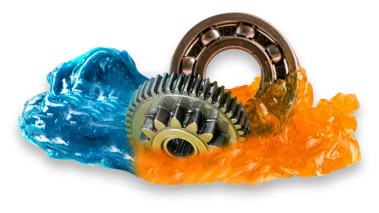
Industrial lubricating grease is a semi-solid lubricant combining three components: a base oil (60–75%), a thickener (5–25%), and a performance additive package (5–20%). Unlike oil, grease stays in place under centrifugal force, gravity, and pressure — making it the lubricant of choice for sealed bearings, hard-to-reach points, and equipment that cannot tolerate leakage.
2.1 How Grease Actually Lubricates — The Thixotropic Mechanism
When a bearing surface moves, shear forces cause the thickener matrix to release base oil, forming a thin hydrodynamic film between metal surfaces. When motion stops, the thickener re-absorbs the oil. This reversible behavior — called thixotropy — is why grease provides lubrication even after extended idle periods, making it ideal for stop-start machines.
Critical insight often missed by B2B buyers: the base oil — not the thickener — does the actual lubricating. The thickener is purely a structural carrier. This is why two NLGI 2 greases from different thickener families can have radically different performance in the same bearing.
2.2 The Three Components — What B2B Buyers Must Verify
- Base Oil (the lubricant): carries out the actual lubrication and must be matched to operating speed and temperature using ISO VG viscosity classification.
- Thickener (the structural sponge): defines temperature range, water resistance, and compatibility. This is the #1 factor differentiating grease types.
- Additives (the performance enhancers): provide EP/AW protection, rust inhibition, oxidation resistance, and tackiness. EP additives are NOT universal — they can damage lightly loaded high-speed bearings.
3. The 7 Types of Industrial Grease — Full Comparison
Thickener chemistry is the primary differentiator between grease families. Selecting the wrong thickener — even with correct base oil viscosity — is a common and costly error. The table below compares all seven families relevant to B2B industrial procurement.
| Grease Type | Temp Range | Water Resist. | Speed Suit. | Mixing Risk | Best Applications |
| Lithium Complex (Li-X) ★ | −30°C to 180°C | Good | Low–High | Low (with Li) | Bearings, chassis, OEM general-purpose |
| Polyurea (PU) | −30°C to 180°C | Very Good | High (ideal for motors) | HIGH — never mix | Electric motors, sealed-for-life bearings |
| Calcium Sulfonate Complex | −20°C to 180°C | Outstanding | Low–Medium | Moderate | Mining, offshore, marine, wet environments |
| Bentone / Clay | No drop point (>230°C base oil limit) | Moderate | Low–Medium | Compatible with most | Furnace, kiln, continuous casters |
| Simple Lithium (Li) | −30°C to 130°C | Moderate | Low–High | Low | Budget/general purpose, chassis grease |
| Calcium (Ca) | −20°C to 80°C | Superior | Low–Medium | Moderate | Classic marine, wet/outdoor, steel works |
| PTFE / Synthetic | −50°C to 260°C | Good | High | Low | Food-grade, clean-room, extreme temp |
| �� IMAGE PLACEHOLDERPhoto: Side-by-side samples of Li-X, Polyurea, Ca-Sulfonate, Bentone greases in cartridges — different colorsAlt text: “Side-by-side industrial grease type samples showing lithium complex, polyurea, calcium sulfonate, and bentone greases”Source suggestion: Product photography — ZTSH Oil in-house photo shoot of your actual product lineup |
3.1 Lithium Complex — The B2B Workhorse
Lithium complex (Li-X) greases are the most specified grease type in general industrial applications. The complexing agent raises the dropping point above 260°C and delivers superior EP performance compared to simple lithium. For OEM and MRO buyers wanting a single approved grease for 70–80% of application points, a Lithium Complex NLGI 2 EP with ISO VG 100–220 base oil is the industry benchmark.
| �� ZTSH Oil RecommendationZTSH Oil’s Lithium Complex EP Grease NLGI 2 is formulated with high-quality API Group II base oil, providing a dropping point >260°C, 4-ball weld load >400 kgf (ASTM D2596), and a 2-year shelf life. Available in 15 kg pails to 180 kg drums. → www.ztshoil.com/lithium-complex-ep-grease/ |
→ Lithium Grease Full Product Range & Datasheets (https://www.ztshoil.com/lithium-grease/)
→ Article: Lithium vs. Lithium Complex — Which Do You Actually Need? (https://www.ztshoil.com/blog/lithium-vs-lithium-complex/)
3.2 Polyurea — The Premium Choice for Electric Motors
Polyurea (diurea/tetraurea) greases lack metallic soap thickeners, delivering outstanding oxidation stability, high dropping points (>260°C), and compatibility with sealed high-speed bearings. Their clean-burning chemistry generates minimal residue, extending bearing service life dramatically. ASTM D1741 testing shows premium polyurea NLGI 2 greases delivering 10,000+ hours of bearing life at 125°C.
| �� Critical Compatibility WarningPolyurea greases are incompatible with the majority of soap-based greases — including lithium, lithium complex, and calcium. Mixing polyurea with lithium grease in a bearing housing can cause catastrophic softening within hours of startup. NEVER switch to polyurea without a complete bearing purge procedure. |
| ⚡ ZTSH Oil RecommendationZTSH Oil Polyurea Grease NLGI 2 is manufactured for electric motor bearings (standard & VFD-driven), with anti-static additives available for variable-frequency drive applications. Meets DIN 51825 KP2K specifications. → www.ztshoil.com/polyurea-grease/ |
→ Polyurea Grease Hub — Full Range, Motor Specs & Sealed Bearing Guide (https://www.ztshoil.com/polyurea-grease/)
3.3 High-Temperature Greases — Bentone, Ca-Sulfonate & Synthetic
Applications exceeding 150°C continuous operating temperature demand specific formulations:
- Bentone (Clay): inorganic clay with no dropping point — survives any temperature. Base oil oxidizes above ~230°C, setting the true upper limit. Best for kiln cars, furnace chains, and glass processing.
- Calcium Sulfonate Complex: the fastest-growing premium grease category globally (+9.1% CAGR). Outstanding water resistance, excellent EP performance, stable to 180°C. Dominant in mining, offshore, and heavy construction.
- Synthetic Grease (PAO / PFPE / Silicone): for continuous −50°C to +260°C applications, NSF H1 food-grade requirements, or clean-room environments where hydrocarbon contamination is prohibited.
| ��️ ZTSH Oil RecommendationZTSH Oil High-Temperature Bearing Grease (Bentone base, ISO VG 460) operates continuously at 250°C+ in kiln and steel mill environments. Available with or without moly additive (MoS₂). → www.ztshoil.com/high-temperature-grease/ |
→ High-Temperature Grease Hub — Kiln, Furnace & Steel Mill Applications (https://www.ztshoil.com/high-temperature-grease/)
4. NLGI Consistency Grades — The Complete Selector
The NLGI consistency grade — measured by ASTM D217 worked penetration at 25°C — classifies grease stiffness from 000 (semi-fluid) to 6 (block). It is the most universally referenced grease parameter, but also the most misunderstood.
| NLGI Grade | Consistency | Texture Analogy | Typical Use | Why Choose It |
| 000–00 | Semi-fluid / flowable | Very soft paste | Centralized auto-lube systems, enclosed gears | Maximum pumpability, no reservoir needed |
| 0–1 | Soft | Soft butter / shortening | Cold-climate bearings, low-temp chains | Good pump delivery at sub-zero temps |
| 2 ★ | Medium (industry standard) | Peanut butter | General industrial: bearings, motors, chassis | Balances pumpability & retention — 70%+ of all grease sold |
| 3 | Firm | Hard butter / cheddar | High-speed, precision, electric motor bearings | Better channeling, less churning at speed |
| 4–6 | Hard / block | Wax or harder | Open gears, extreme vibration, kiln bearings | Stays put under shock loads and gravity |
| ⚠️ NLGI Grade ≠ Base Oil Viscosity — A Costly ConfusionThis is the single most common grease specification error. NLGI grade measures thickener stiffness, NOT the lubricating oil inside the grease. An NLGI 2 grease can contain base oil ranging from ISO VG 46 (thin, for high-speed motors) to ISO VG 460 (thick, for slow heavy-loaded bearings). Always verify base oil viscosity in the Technical Data Sheet — NLGI grade alone is insufficient for engineering specification. |
4.1 DN Speed Factor & NLGI Grade
DN = RPM × bore diameter (mm). Higher DN requires stiffer greases (higher NLGI grade) to promote channeling and prevent churning:
- DN < 75,000: NLGI 1–2 generally appropriate
- DN 75,000–300,000: NLGI 2–3, channeling behavior preferred
- DN > 300,000: NLGI 3–4, or consult bearing OEM specification
4.2 Temperature Correction for Relubrication Intervals
Industry rule: bearing grease service life halves for every 10°C (18°F) increase in operating temperature above 70°C.
If your calculated relubrication interval is 1,000 hours at 70°C: → 500 hours at 80°C → 250 hours at 90°C → 125 hours at 100°C. This exponential degradation is why selecting a grease with genuine thermal stability (not just a high dropping point on the TDS) is critical for hot applications.
| �� IMAGE PLACEHOLDERChart: Bearing grease service life vs. operating temperature (exponential decay curve)Alt text: “Graph showing grease relubrication interval halving every 10°C above 70°C operating temperature in industrial bearings”Source suggestion: Create original data visualization — based on SKF/Noria published methodology |
5. How to Choose the Right Industrial Grease — 6-Factor Framework
Grease selection by brand familiarity or inertia (‘the last grease that worked’) costs industry hundreds of millions of dollars annually in premature bearing failures. The following systematic framework prevents the most common selection errors.
Quick Reference: Application-to-Grease Selector Matrix
| Application | Typical Temp | NLGI Grade | Recommended Grease | Critical Note |
| Electric motor bearings | −30 to 180°C | NLGI 2–3 | Polyurea | No EP additives for ball bearings |
| Mining / crushing equip. | −10 to 150°C | NLGI 1–2 | Ca-Sulfonate Complex | High water washout resistance critical |
| Steel mill rolling mills | 50 to 200°C | NLGI 2 | Li-X or Ca-Sulfonate | ISO VG 220–460 base oil |
| Wind turbine main shaft | −30 to 80°C | NLGI 1–2 | Li-X Synthetic (PAO) | 5-year interval; fretting resistance |
| Food processing | −10 to 120°C | NLGI 1–2 | PTFE / Al-Complex NSF H1 | Must carry NSF H1 registration |
| Construction pin joints | −20 to 60°C | NLGI 1–2 EP | Li-X with tackifier | Oscillating motion — use anti-fretting grade |
| Centralized auto-lube systems | −20 to 60°C | NLGI 00–1 | Li-X or Ca-Sulfonate | Pumpability at minimum ambient temp critical |
| Kiln / furnace bearings | 150–300°C+ | NLGI 1–2 | Bentone / PTFE Synthetic | Base oil oxidizes above ~230°C — note limits |
Factor 1: Operating Temperature Range
Map the full temperature envelope: minimum ambient start-up temperature AND maximum continuous operating temperature. The grease’s dropping point must exceed max operating temperature by ≥50°C safety margin. For wide seasonal swings (e.g., outdoor equipment from −20°C to +80°C), synthetic base oil greases provide better low-temperature pumpability without sacrificing high-temperature film strength.
Factor 2: Speed (DN or NDm)
Higher bearing speeds require lower base oil viscosity (reduce fluid friction) but higher NLGI grade (promote channeling). The NDm factor — using pitch circle diameter rather than bore — is more accurate for large bearings. Reference ExxonMobil, SKF, or NSK viscosity selection charts for precise ISO VG determination.
→ ZTSH Oil Base Oil Viscosity Selection Guide for Bearings (https://www.ztshoil.com/resources/viscosity-selection-guide/)
Factor 3: Load and Shock Loading
High loads and shock loading require EP additives (sulfur-phosphorus or MoS₂). However: lightly loaded, high-speed ball bearings do NOT benefit from EP additives and can suffer increased wear from chemical activity at operating temperature. Match EP level to actual contact stress — not just application type.
Factor 4: Water and Contamination Exposure
Prioritize water washout resistance (ASTM D1264) and rust inhibition (ASTM D1743) for equipment exposed to water spray, steam, condensation, or immersion. Calcium sulfonate complex and calcium-based greases lead here. In dusty environments (mining, cement, quarrying), higher base oil viscosity and tackifying additives help resist abrasive wear.
Factor 5: Lubrication Method & Fill Volume
Centralized lubrication systems require NLGI 0–1 for pumpability. Manual or single-point application can use NLGI 2–3. For electric motor bearings, fill volume matters as much as grease type: overfilling is the leading cause of motor bearing failure by churning-induced temperature rise.
Factor 6: Compatibility With Existing Grease
The most overlooked factor. When switching grease types, mixing incompatible greases causes catastrophic softening, hardening, or loss of EP performance — and bearing failure within hours. Consult the compatibility matrix in Section 9 before every grease changeover.
6. Industrial Grease Applications by Sector
| �� IMAGE PLACEHOLDERIndustry map: icons for Mining, Steel, Wind, Food Processing, Construction, Electric Motors with grease type calloutsAlt text: “Industrial grease application sectors infographic: mining, steel, wind energy, food processing, construction equipment”Source suggestion: Commission custom infographic — 6 industry icons with grease type recommendation callouts |
6.1 Mining & Quarrying — The Most Demanding Environment
Mining presents the extreme edge of grease performance requirements: continuous vibration, full water ingress, abrasive contamination, and 250–500+ hour relubrication intervals on remote equipment. A single shovel or crusher bearing failure costs $50,000–$200,000+ in repair, lost production, and logistics.
- Calcium Sulfonate Complex NLGI 1–2 with EP and tackifier — the current best-practice specification
- ASTM D1264 water washout <1%, Timken OK Load >60 lbs, 4-ball weld >400 kgf
- Central auto-lube: NLGI 00–1 pumpable at full operating temperature range
| ⛏️ ZTSH Oil for MiningZTSH Oil Calcium Sulfonate Complex Grease is our flagship mining-grade product: >180°C operating temp, <0.5% water washout (ASTM D1264), 4-ball weld load 500+ kgf. Used by mine operators across 12 countries. Request TDS and third-party test certificates: www.ztshoil.com/mining-grease/ |
→ Mining Lubrication Solutions — Shovel, Crusher, Conveyor & Drill Specifications (https://www.ztshoil.com/industry/mining/)
6.2 Steel & Metal Processing
Steel mill rolling mill bearings operate at 120°C+ under very high radial loads at low speeds. Continuous casters require greases that survive steam, scale, and cooling water. Central auto-lube systems on rolling mill lines commonly operate with NLGI 0–1 Lithium Complex greases at ISO VG 220–460.
- Rolling mill bearings: Li-X or Ca-Sulfonate, NLGI 1–2, ISO VG 220–460
- Open gear/continuous caster: adhesive synthetic open gear grease, ISO VG 680–1500
- High-temp zones (reheat furnace zones): Bentone NLGI 1–2 or Ca-Sulfonate
→ Steel & Metal Processing Lubrication Guide (https://www.ztshoil.com/industry/steel/)
6.3 Electric Motor Bearings — The Highest-Volume Application
Electric motor bearings represent the largest grease application point count in any industrial plant. The specification has shifted toward polyurea over the past decade due to superior sealed-bearing compatibility and extended service intervals at 160–180°C.
VFD-driven motors require special attention: variable-frequency drives introduce electrical discharge through bearings (EDM bearing damage), visible as gray or black frosted raceways. Specify greases with anti-static or conductive additives for VFD applications.
| ⚡ ZTSH Oil for Electric MotorsZTSH Oil Polyurea Motor Bearing Grease NLGI 2: dropping point >260°C, ASTM D3336 life >1,200 hrs at 150°C. Anti-static formulation for VFD motors available. → www.ztshoil.com/polyurea-grease/ |
6.4 Wind Energy — The 5-Year Interval Challenge
Wind turbine pitch and yaw bearings undergo oscillating motion — not continuous rotation — a demanding condition where many standard greases exhibit fretting wear (micro-scale adhesive damage under oscillation without full hydrodynamic film formation). Main shaft bearings require very high base oil viscosity (ISO VG 460–1500) with extended relubrication intervals.
- Pitch & yaw bearings: oscillation-specific grade with ASTM D4170 fretting wear test compliance
- Main shaft: Li-X PAO synthetic, NLGI 1–2, ISO VG 460–1500, >5-year service life
- Gearbox bearings: synthetic PAO-based, full synthetic for extended drain intervals
6.5 Food & Beverage Processing — NSF H1 Mandatory
Any lubrication point with incidental food contact requires NSF H1 registered lubricants. This is non-negotiable — using non-registered lubricants in food plants constitutes a regulatory violation in virtually every jurisdiction. Aluminum complex and PTFE-thickened greases with white mineral oil or PAO base are the standard.
- Required: NSF H1 registration (not just ‘food-grade labeling’ — verify the NSF H1 registration number)
- Avoid: Any grease containing molybdenum disulfide, graphite, or heavy metals
- Additional: Kosher/Halal certification required for some customers in Middle East and Jewish markets
| ��️ ZTSH Oil for Food GradeZTSH Oil NSF H1 Food-Grade Grease: white mineral base oil, aluminum complex thickener, NSF H1 registration number [####]. NLGI 1–2. Suitable for meat processing, dairy, and packaged food lines. → www.ztshoil.com/food-grade-grease/ |
6.6 Construction Equipment
Construction greasing covers pin joints, bucket bushings, track chain, swing bearings, and centralized auto-lube systems on excavators, loaders, and cranes. Primary challenges: water contamination, dirt ingress, high static loads on pin-and-bushing joints, and wide temperature swings from predawn startup to midday operating temperature.
- Pin joints and open surfaces: adhesive Li-X or Ca-Sulfonate NLGI 1–2 EP with tackifier
- Central auto-lube: NLGI 00–1 pumpable at −20°C minimum
- Track chain: moly-fortified NLGI 1–2 for boundary lubrication under high shock load
7. Grease vs. Lubricating Oil — The Decision Framework
| Factor | Grease ✓ | Oil |
| Stays in place | ✓ Yes — no reservoir needed | ✗ Requires sealed or circulating system |
| Contamination barrier | ✓ Self-sealing function | ✗ Needs external seals |
| Heat removal | ✗ Limited cooling capacity | ✓ Excellent via circulation |
| High-speed suitability | ✓ Good up to ~DN 300k | ✓ Better above DN 300k+ |
| Re-application frequency | Low — long intervals | High — continuous or regular |
| System cost | Lower (simpler housings) | Higher (seals, pumps, reservoirs) |
| Vertical shafts | ✓ Preferred | ✗ Drains away without reservoir |
| Best for | Mobile equip, sealed bearings, hard-to-reach points | High-speed machinery, turbines, gearboxes needing cooling |
Decision rule: If the bearing is sealed, hard to reach, subject to contamination, runs intermittently, or sits on a vertical shaft — specify grease. If the bearing needs cooling, runs above DN 300,000, or is part of an existing circulating system — specify oil. When in doubt for critical applications, run both a grease-lubricated and oil-lubricated pilot for 3–6 months and compare bearing temperature, vibration, and wear.
8. The #1 Hidden Danger: Over-Greasing and Under-Greasing
Surveys consistently show over-greasing causes as many bearing failures as under-greasing — yet it remains the most overlooked lubrication risk in plant maintenance programs. This section covers what the Mobil, SKF, and Noria guides do not adequately explain to B2B maintenance buyers.
| �� IMAGE PLACEHOLDERDiagram: Over-greasing failure sequence — excess grease → seal blow-out → churning → heat rise → bearing failureAlt text: “Industrial bearing failure diagram showing over-greasing failure sequence: excess grease pressure, seal damage, churning, overheating”Source suggestion: Commission original process diagram — 4-step failure sequence illustration |
8.1 The Physics of Over-Greasing Failure
When excess grease is injected into a bearing housing, internal pressure rises. At speed, rolling elements must push grease out of the way — causing churning. Churning generates heat. Heat causes the thickener to release base oil faster than it can be re-absorbed. The remaining structure is a stiff, oil-depleted soap cake with minimal lubricating capacity. The final result is bearing failure despite the bearing being ‘full of grease.’
| ⚠️ Temperature Signal to WatchA bearing temperature rise of >10°C immediately after greasing is a classic over-greasing signature. Reduce fill volume and monitor. If temperature rises again 24–48 hours after greasing, the interval is too short or the fill volume is too high. |
8.2 Under-Greasing — The Silent Killer
Under-greasing is less visible but equally destructive. By the time a bearing is ‘loud’ or obviously failing, metal-to-metal contact has already caused raceway damage. Adding grease at this stage quiets the bearing temporarily but does not reverse the damage — failure is simply postponed.
Best practice: Implement ultrasound-based greasing. Ultrasonic instruments detect the friction signature of lubrication starvation in the 20,000 Hz+ frequency range — long before audible noise or temperature rise. Grease until the ultrasound signal returns to baseline, then stop. This approach eliminates both over- and under-greasing.
8.3 Correct Fill Volume Formula
For electric motor bearings (SKF methodology):
| Grease quantity (grams) = 0.005 × D × BWhere D = bearing outside diameter (mm) | B = bearing width (mm) Example: 6310 bearing (D=110mm, B=27mm): 0.005 × 110 × 27 = 14.85 grams per relubrication |
Critical: For sealed-for-life bearings (2RS design), do NOT add grease. The factory fill is sufficient for the bearing’s design life. Adding grease to a sealed bearing will blow the seals and contaminate the rolling elements.
9. Grease Compatibility Matrix & Changeover Protocol
Grease incompatibility is cited by SKF and NLGI as one of the most consequential — and most preventable — causes of bearing failure during maintenance events. Note: some polyurea thickeners ARE compatible with lithium complex, while others are not — the chart below shows typical compatibility; always request compatibility test data from your supplier for critical applications.
Grease Thickener Compatibility Matrix (Typical Values — Verify with Supplier)
✓ Compatible ✗ Typically Incompatible ~ Borderline — test required — Same type
| Li | Li-X | Ca | Ca-S | PU | Bentone | Al-C | PTFE | |
| Li | — | ✓ | ✗ | ✗ | ✗ | ✓ | ✗ | ✗ |
| Li-X | ✓ | — | ✗ | ✗ | ✗ | ✓ | ✗ | ✗ |
| Ca | ✗ | ✗ | — | ~ | ✗ | ✓ | ✗ | ✗ |
| Ca-S | ✗ | ✗ | ~ | — | ✗ | ✓ | ✗ | ✗ |
| PU | ✗ | ✗ | ✗ | ✗ | — | ✓ | ✗ | ✗ |
| Bentone | ✓ | ✓ | ✓ | ✓ | ✓ | — | ✓ | ✓ |
| Al-C | ✗ | ✗ | ✗ | ✗ | ✗ | ✓ | — | ✗ |
| PTFE | ✗ | ✗ | ✗ | ✗ | ✗ | ✓ | ✗ | — |
9.1 Step-by-Step Grease Changeover Protocol
- Document the current grease type, thickener chemistry, and fill volume for the bearing being changed.
- Check the compatibility matrix. If new and old greases are incompatible, plan a full purge.
- Run the bearing at normal speed while applying new grease slowly until fresh grease appears at the relief valve — purging ≥90% of the old charge.
- If purge is insufficient or greases are definitively incompatible, disassemble, clean bearing with solvent, re-pack from scratch with new grease type at correct fill volume.
- Tag the bearing housing with the new grease type, date, and fill volume. Update your lubrication management system (LMS).
- Use color-coded Zerk fittings or caps (red=polyurea, blue=Li-X, yellow=Ca-Sulfonate, etc.) to prevent future cross-contamination.
10. Industrial Grease Failure Modes — Diagnosis & Remediation
Most grease-related bearing failures are predictable and preventable. The following framework covers the six most common failure modes encountered in industrial plant maintenance — with prevention and remediation steps not found in most supplier technical literature.
| Failure Mode | Consequence | Prevention | Pro Tip |
| Wrong grease type | Bearings seize or wear rapidly | Match thickener+base oil viscosity to OEM spec | Polyurea for motors, Li-X EP for mining |
| Over-greasing | Seal blow-out, heat rise, churning | Add grease in small increments; monitor temperature | Stop when fresh grease purges at relief valve |
| Under-greasing | Surface fatigue, metal-to-metal contact | Set calendar + condition-based relubrication schedule | Use ultrasound to detect lubrication starvation early |
| Incompatible grease mix | Softening/hardening, loss of EP film, failure within hours | Full purge before switching thickener types | Use color-coded fittings per grease type |
| Contaminated grease | Abrasive wear, accelerated oxidation | Clean Zerk fittings before every greasing event | Cap drums; use dedicated grease guns |
| Incorrect storage | Oxidation, phase separation, shelf-life failure | FIFO rotation; horizontal drum storage; 5–40°C | Tag drums with date of receipt |
| �� IMAGE PLACEHOLDERPhoto collage: 4 grease failure modes — over-greased bearing seal failure, discolored/oxidized grease, contaminated grease, mixed incompatible greasesAlt text: “Industrial bearing grease failure modes: over-greasing seal damage, oxidized grease darkening, water contamination milky grease, incompatible grease mixing”Source suggestion: Source from maintenance documentation or commission photo shoot at a facility |
| �� False Brinelling — The Failure Nobody Expects in StorageBearings in stored or stationary equipment are vulnerable to false brinelling: oscillating micro-vibrations (from nearby machinery, transport, or building vibration) cause rolling elements to indent raceways without rotation — creating grooves that cause premature failure once the equipment starts. Prevention: rotate stored equipment monthly by hand, use anti-fretting compound or corrosion-inhibiting grease for long-term storage, and fully grease motors before placing them in storage. |
11. Grease Analysis in the Field — Condition Monitoring for B2B Plants
Grease analysis is the field equivalent of oil analysis — yet it remains underutilized in most industrial plants. Approximately 90% of all bearings are grease-lubricated, but fewer than 10% of plants perform routine grease condition monitoring. This section covers what most grease supplier guides omit entirely.
11.1 Visual Inspection — The First Line of Defense
| Observable Sign | Likely Cause | Immediate Action | Notes |
| Color change (darkening) | Oxidation, contamination, overheating | Grease analysis; check temp sensors | Normal: slight darkening. Alarm: black/burnt smell |
| Oil separation (bleed) | Aged thickener, incorrect storage, thermal degradation | Stir if minor (<6mm); discard if severe | Minor bleed in fresh drums is normal |
| Hardening (increased NLGI) | Oil loss via evaporation or oxidation | Increase relubrication frequency | Common in high-temp applications |
| Softening (decreased NLGI) | Mechanical degradation, incompatible grease mix | Identify and purge contaminating grease | Can lead to leakage and starvation |
| Milky / white color | Water contamination | Find and eliminate water source; upgrade to Ca-S | Calcium sulfonate resists this best |
| Metallic particles visible | Active wear — bearing damage in progress | Immediate inspection; send sample to lab | Ferrography can identify wear mode |
11.2 Laboratory Grease Analysis — When to Specify It
For critical bearings (>$10,000 replacement cost, high consequence of failure, or where relubrication intervals are being extended), laboratory grease analysis provides quantitative condition data:
- FTIR spectroscopy — identifies thickener type, oxidation state, and contaminants
- Penetration test (ASTM D217) — measures consistency change vs. new grease baseline
- ICP spectrometry — detects wear metals (iron, chromium, copper) indicating active bearing damage
- RULER test — measures remaining antioxidant life (predicts remaining service interval)
- Analytical ferrography — characterizes wear particle size, morphology, and failure mode
| �� Grease Sampling Best PracticeStandard grease guns do not capture representative samples. Use a dedicated grease sampler (such as the ‘Grease Thief’ device) to extract a sample from the active lubrication zone near the bearing raceways, not from the grease reservoir or housing periphery. Peripheral samples are non-representative and give false-negative readings for bearing wear. |
→ ZTSH Oil Technical Support: Grease Condition Monitoring & Relubrication Interval Optimization (https://www.ztshoil.com/technical-support/grease-analysis/)
12. Grease Storage, Handling & Relubrication Best Practices
12.1 Storage Requirements
- Store drums horizontally to prevent moisture ingress through drum vents; vertical storage draws in condensation as drums cool
- Maintain storage temperature 5–40°C; avoid temperature cycling (thermal pumping accelerates oil separation)
- FIFO rotation: always use oldest stock first; typical shelf life is 2–5 years from manufacture date
- Keep containers sealed until point of use; never return partially used grease to original container
- Separate grease types with clear labeling and physical separation to prevent accidental cross-contamination
12.2 Application Best Practices
- Use dedicated, color-coded grease guns per grease type — cross-contamination most commonly occurs via shared equipment
- Clean Zerk fittings before every greasing event — the first pump stroke drives surface contamination directly into the bearing
- Apply grease slowly and evenly — high-pressure fast injection can force grease past rolling elements rather than through them
- For sealed-for-life bearings (2RS): DO NOT grease — factory fill is sufficient for design life; additional greasing destroys seals
12.3 Relubrication Interval Calculator
For bearing relubrication intervals, use the SKF relubrication formula:
| t (hours) = K × [14,000,000 / (n × √d) − 4d]Where: K = 1.0 (lithium soap) or 1.5 (polyurea) | n = shaft RPM | d = bearing bore (mm)Example: 3,000 RPM motor, 50mm bore, polyurea grease:t = 1.5 × [14,000,000 / (3000 × √50) − 4×50] = 1.5 × [14,000,000 / 21,213 − 200] = 1.5 × [460] ≈ 690 hours |
Reduce interval by 50% if operating temperature exceeds 70°C; by 50% again above 100°C. Reduce by 30–50% for contaminated (dusty/wet) environments.
13. Frequently Asked Questions (FAQ)
This FAQ section is structured to capture Google People Also Ask (PAA) featured snippets.
Q1: What is the difference between lithium grease and lithium complex grease?
Lithium complex (Li-X) uses a complexing agent during saponification, raising the dropping point from ~185°C (simple Li) to >260°C, and improving EP performance and oxidation stability. The cost premium is 15–30%. For industrial applications above 120°C or under high load, lithium complex is the minimum recommended specification.
Q2: Can I mix different brands of the same grease type?
Thickener type compatibility is the primary concern — two lithium complex greases from different manufacturers are generally compatible with each other (though always test first). However, additive package interactions between brands can cause issues even with the same thickener type. Mixing is lowest-risk with the same thickener, similar base oil viscosity, and same additive system. When switching brands, treat it as a grease changeover event.
Q3: How do I know if my grease is failing in service?
Key indicators: unusual bearing noise or vibration, bearing temperature >15°C above baseline, discolored grease (darkening = oxidation; milky = water contamination; metallic particles = active wear), or grease hardening / softening vs. the original consistency. Laboratory grease analysis (FTIR, ICP spectrometry, penetration test) provides quantitative confirmation.
Q4: What does NLGI 2 mean — is it always the right choice?
NLGI 2 is the most commonly specified grade (accounting for ~70% of global grease consumption) because it balances pumpability and retention across a wide range of standard applications. However, high-speed bearings (DN >200,000) often perform better with NLGI 3; centralized auto-lube systems typically require NLGI 0–1; and shock-loaded open gears may need NLGI 4–6 block grease. NLGI 2 is the right default — but verify it against the specific speed, load, and delivery method.
Q5: What causes electric motor bearings to fail after regreasing?
The four most common causes: (1) Over-greasing — injecting too much grease raises temperature by forcing rolling elements to push through excess grease; (2) Grease incompatibility — the new grease is incompatible with residual old grease, causing softening or hardening; (3) Wrong grease type — using an EP-additive grease in a lightly loaded ball bearing; (4) Contamination during greasing — not cleaning the Zerk fitting before applying grease. Over-greasing accounts for an estimated 40–60% of regreasing-induced motor failures.
Q6: What is the advantage of sourcing industrial grease from Chinese manufacturers vs. Western brands?
Modern Chinese lubricant manufacturers operating under ISO 9001:2015 with third-party ASTM test documentation provide equivalent technical performance to Western brands for the majority of industrial applications. The cost advantage is 20–45% for equivalent specifications. The due-diligence checklist: ISO 9001:2015 certification, verifiable ASTM test reports (D217, D2596, D2509, D1264, D3336, D6185), SDS/TDS for every grade, and traceable base oil quality documentation (API Group certification). Request a paid sample before committing to supply contracts.
→ ZTSH Oil provides full documentation packages: ISO certificate, third-party test reports, SDS/TDS, and COA for every production batch. Contact: www.ztshoil.com/quality/
Q7: How should over-greased bearings be recovered?
Stop the equipment if possible. Open the relief fitting or drain plug and allow excess grease to purge at low speed (500–800 RPM) for 15–30 minutes. Monitor bearing temperature — it should decline within the first 30 minutes if over-greasing was the cause. If temperature remains elevated after purging, inspect for seal damage and bearing condition before returning to full operation.
Q8: What is false brinelling and how do I prevent it?
False brinelling is raceway damage caused by oscillating micro-vibrations in stationary bearings — from nearby machinery, transport, or building vibration. It creates wear grooves (brinell marks) without bearing rotation, causing premature failure at startup. Prevention: rotate stored equipment by hand monthly, apply anti-fretting compound or corrosion-inhibiting grease for storage, use vibration-isolation pads under stored motors and gearboxes.
14. ZTSH Oil — Industrial Grease Manufacturer & Supplier
| �� IMAGE PLACEHOLDERZTSH Oil manufacturing facility and product lineup — lithium, polyurea, calcium sulfonate, high-temp greaseAlt text: “ZTSH Oil industrial grease manufacturing facility in Zibo, China — product lineup showing lithium complex, polyurea, calcium sulfonate complex, and high-temperature greases”Source suggestion: Professional facility photography — ZTSH Oil production plant, lab, and product range |
ZTSH Oil (Zibo Tianshi Huasheng Petroleum Technology Co., Ltd.) manufactures industrial lubricating grease for B2B customers across 30+ countries. Our product range covers every major thickener chemistry and application sector — with full documentation, flexible packaging, and custom formulation capability.
| Product | Thickener | NLGI Grade | Temp Range | Key Application | URL |
| Li-X EP Grease | Lithium Complex | 0 / 1 / 2 / 3 | −30°C to 180°C | General industrial, mining, chassis | /lithium-complex-ep-grease/ |
| Polyurea Motor Grease | Polyurea | 2 / 3 | −30°C to 180°C | Electric motors, sealed bearings | /polyurea-grease/ |
| Ca-Sulfonate Complex | Calcium Sulfonate | 0 / 1 / 2 | −20°C to 180°C | Mining, marine, wet environments | /calcium-sulfonate-grease/ |
| High-Temp Bearing Grease | Bentone | 1 / 2 | Up to 250°C+ | Kiln, furnace, steel mill | /high-temperature-grease/ |
| PTFE Synthetic Grease | PTFE / Synthetic | 1 / 2 | −50°C to 260°C | Food-grade, extreme temp, clean-room | /ptfe-synthetic-grease/ |
| Open Gear Grease | Lithium Complex | 5 / 6 Block | −10°C to 160°C | Open gears, racks, large pivots | /open-gear-grease/ |
| NSF H1 Food-Grade Grease | Al-Complex / PTFE | 1 / 2 | −20°C to 140°C | Food & beverage processing | /food-grade-grease/ |
| Ready to Specify, Sample, or Source?Contact ZTSH Oil’s technical sales team to receive:✓ Sample kit (up to 3 grades) ✓ Full TDS & test certificate package ✓ Competitive B2B pricing & MOQ schedule✓ Custom formulation consultation ✓ OEM / private label options ✓ ISO 9001:2015 documentation�� www.ztshoil.com | Response within 24 hours on business days |
Related Technical Resources
→ Lithium Grease Hub — Products, Datasheets, Application Guides (https://www.ztshoil.com/lithium-grease/)
→ Polyurea Grease Hub — Electric Motor Bearing Specification & Selection (https://www.ztshoil.com/polyurea-grease/)
→ High-Temperature Grease Hub — Bentone, Calcium Sulfonate, Synthetic (https://www.ztshoil.com/high-temperature-grease/)
→ Industry: Mining Lubrication Solutions (https://www.ztshoil.com/industry/mining/)
→ Industry: Steel & Metal Processing Lubrication (https://www.ztshoil.com/industry/steel/)
→ Industry: Food-Grade Lubricants (NSF H1 Certified Range) (https://www.ztshoil.com/food-grade-grease/)
→ Blog: 7 Types of Industrial Grease — Detailed Chemistry & Performance (https://www.ztshoil.com/blog/7-types-of-grease/)
→ Blog: Grease Compatibility — Why It Matters & How to Manage Changeovers (https://www.ztshoil.com/blog/grease-compatibility/)
→ Blog: How to Read a Grease Technical Data Sheet (https://www.ztshoil.com/blog/how-to-read-grease-tds/)
→ Resources: Viscosity Selection Guide for Bearings (https://www.ztshoil.com/resources/viscosity-selection-guide/)
→ Quality: ISO 9001:2015 Certificate & Test Documentation (https://www.ztshoil.com/quality/)
© 2025 ZTSH Oil (Zibo Tianshi Huasheng Petroleum Technology Co., Ltd.) · www.ztshoil.com · All specifications subject to change without notice. Always consult current Technical Data Sheets for engineering specification.