




This guide covers every major grease type, how each one is built, where it works, and where it fails. If you need to make a selection decision, start at the application matrix in Section 6. If you’re troubleshooting a lubrication failure, go to Section 7. If you’re switching grease types on existing equipment, read Section 5 before you do anything.
What Is Grease? (Definition, Composition & How It Differs from Oil)
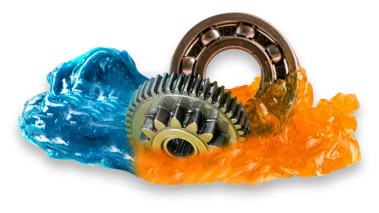
Grease is a semi-solid lubricant consisting of three components: a base oil that provides lubrication, a thickener that holds the oil in a stable structure, and additives that extend performance beyond what base oil and thickener alone can deliver.
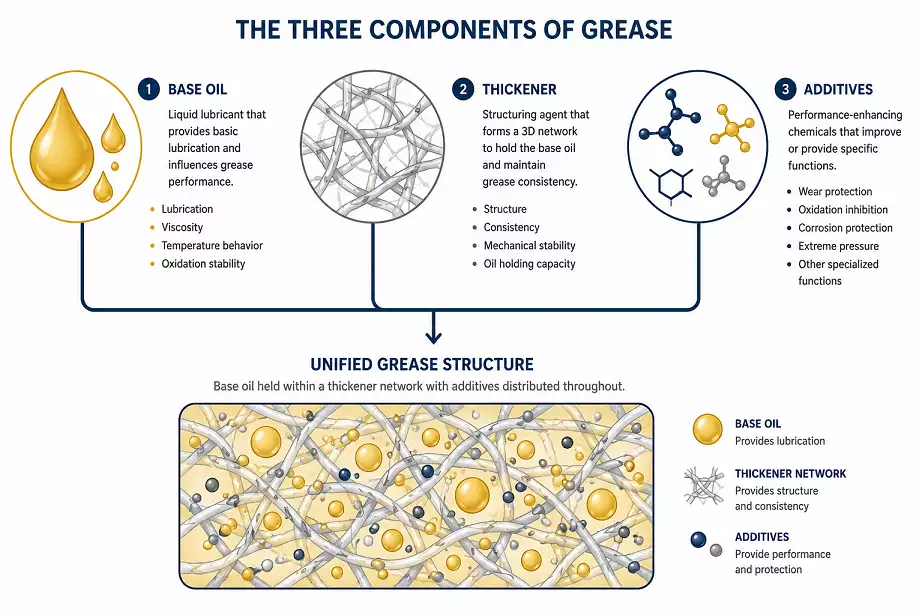
The thickener forms a matrix — think of it as a sponge — that holds the base oil in place. Under mechanical stress (shear), the matrix releases oil to lubricate the contact surface. When stress reduces, the structure reforms and retains the oil again. This behavior is what makes grease suitable for bearings, joints, and open surfaces where oil would simply drain away.
Grease vs. Lubricating Oil
| Property | Grease | Lubricating Oil |
|---|---|---|
| Physical state | Semi-solid | Liquid |
| Stays on the component | Yes — minimal migration | No — requires sealing or continuous recirculation |
| Cooling capacity | Low | High |
| Sealing against contamination | Moderate (acts as its own seal) | Requires external sealing |
| Typical components | Bearings, hinges, slides, open gears, joints | Engines, gearboxes, hydraulic systems, circulating systems |
| Relubrication interval | Generally longer | Generally shorter |
| Best environment | Exposed, intermittent, hard-to-seal, high-load | Enclosed, continuous, high-speed circulation |
Grease is not simply “thickened oil.” The thickener type fundamentally changes how the product behaves at temperature extremes, in water, and under load — which is why switching from one grease type to another requires verification, not assumption.
🔗 [内链 → /types-of-lubricating-oil → “complete lubricating oil types guide”] — If your application uses liquid lubricants rather than grease, see our complete lubricating oil types guide for engine oil, gear oil, hydraulic oil, and industrial oil selection.
The Three Components of Grease
Base oil makes up 70–95% of grease by weight and does the actual lubricating. Mineral base oils (Group I–III) are standard for most industrial applications. Synthetic base oils — PAO (Group IV), esters, silicone — extend the usable temperature range and oxidation resistance, and cost more. The base oil viscosity drives lubrication film thickness at operating temperature; get this wrong and even a correctly selected grease type will fail.
Thickener is the structural element. Metallic soap thickeners — lithium, calcium, sodium, aluminum — are made by saponifying fatty acids with metal hydroxides. Non-soap thickeners — polyurea, bentonite clay, PTFE — form by different chemical routes. The thickener type controls temperature ceiling, water resistance, and compatibility with other greases far more than the base oil type does.
Additives are blended in at 0–10% by weight. Extreme-pressure (EP) agents (typically sulfur-phosphorus compounds or borates) protect metal surfaces under heavy load. Antioxidants slow oil degradation at elevated temperatures. Rust and corrosion inhibitors protect against moisture. Tackifiers improve adhesion to vertical surfaces and open gear flanks.
How Many Types of Grease Are There?
There are more than 12 main types of industrial and automotive grease, classified by thickener system. The table below lists all major types in production use.
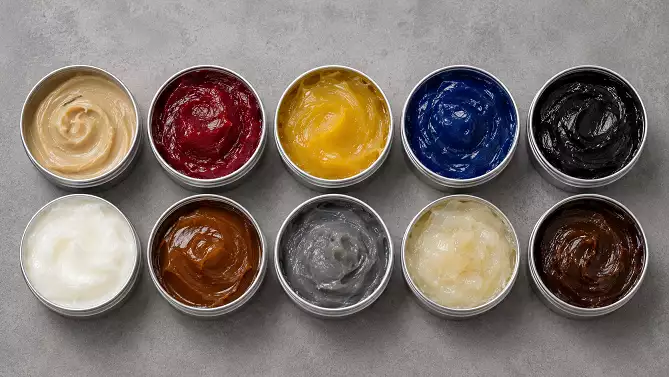
Grease Types: Complete Reference Table
| Grease Type | Thickener | Typical Color | Temp Range | Water Resistance | Common NLGI | Typical Use |
|---|---|---|---|---|---|---|
| Lithium Grease | Lithium soap | Beige / off-white | −20°C to 130°C | Moderate | 1, 2 | General-purpose bearings, automotive chassis |
| Lithium Complex Grease | Lithium complex soap | Beige / tan | −30°C to 220°C | Moderate–high | 2, 3 | High-temp bearings, heavy-load industrial |
| Polyurea Grease | Polyurea (non-soap) | Light yellow / beige | −20°C to 220°C | High | 2 | Electric motor bearings, sealed-for-life bearings |
| Calcium Sulfonate Complex | Calcium sulfonate complex | Brown / red-brown | −20°C to 200°C+ | Extremely high | 1, 2 | Marine, heavy industry, saltwater environments |
| Bentonite Grease | Bentonite clay (non-soap) | Brown / black | −30°C to 250°C | Low–moderate | 1, 2 | High-heat industrial: kilns, steel mills, furnaces |
| Ultra-High Temperature Grease | Inorganic thickener (non-soap) | Black | Up to 600°C | Moderate | 2–3 | Kiln car bearings, furnace door chains, ceramics |
| Calcium Grease | Calcium soap | Light yellow / cream | −20°C to 85°C | High | 2 | Water pumps, agricultural equipment, marine |
| Sodium Grease | Sodium soap | Amber / yellow | −20°C to 120°C | Very low | 2 | Legacy high-temp bearings — largely replaced |
| Aluminum Complex Grease | Aluminum complex soap | Translucent / off-white | −20°C to 160°C | Extremely high | 0, 1, 2 | Food-adjacent equipment, wet environments, steel mills |
| Barium Grease | Barium soap | Off-white / yellow | −30°C to 150°C | High | 2, 3 | Military, specialty equipment (use restricted due to toxicity) |
| Silicone Grease | Silicone gel | White / translucent | −60°C to 220°C | High | 1, 2 | Electronics, plastics, medical devices, rubber seals |
| PTFE / Teflon Grease | PTFE (non-soap) | White | −70°C to 250°C | Extremely high | 0, 1 | Precision instruments, valve stems, threaded fasteners |
Understanding NLGI Grades
NLGI grade indicates grease consistency — how soft or firm it is. The National Lubricating Grease Institute defines nine grades, from 000 (semi-fluid) to 6 (near-solid), based on cone penetration testing per ASTM D217 / GB/T269.
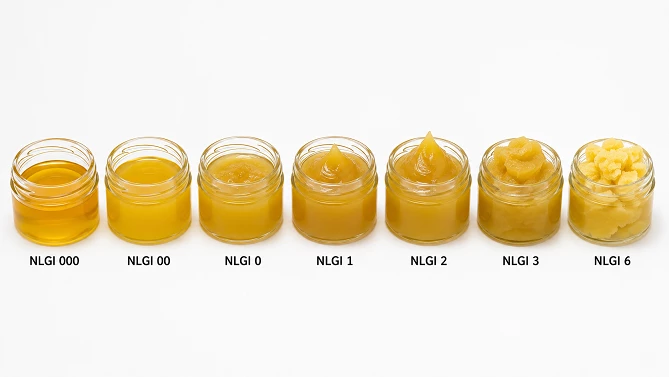
NLGI Grade Reference Table
| NLGI | Consistency | Texture Analogy | Penetration (dmm) | Typical Applications |
|---|---|---|---|---|
| 000 | Semi-fluid | Cooking oil | 445–475 | Centralized lubrication systems, enclosed gearboxes |
| 00 | Very fluid | Applesauce | 400–430 | Centralized systems, low-temperature bearings |
| 0 | Very soft | Vegetable shortening | 355–385 | Open gears, cold-weather applications |
| 1 | Soft | Tomato paste | 310–340 | Slow-speed heavy-load bearings, centralized systems |
| 2 | Medium — the most widely used | Peanut butter | 265–295 | General-purpose bearings, automotive chassis |
| 3 | Firm | Cold butter | 220–250 | Open bearings, vertical-shaft applications |
| 4 | Hard | Cream cheese | 175–205 | High-temperature, loss-prevention applications |
| 5 | Very hard | Hard cheese | 130–160 | Specialized sealing applications |
| 6 | Near-solid | Wax block | 85–115 | Rare specialty applications |
Selecting the Right NLGI Grade
Three rules cover the majority of decisions:
High bearing speed → lower NLGI. Fast-spinning bearings generate their own heat from churning resistance. NLGI 0 or 1 reduces that friction penalty in high-speed applications.
High operating temperature or vertical shaft → higher NLGI. Softer greases slump and leak under heat or gravity. NLGI 3 or 4 holds its position.
Heavy shock load or slow speed → higher NLGI. Under impact, a firmer grease maintains the lubricating film where a soft grease would be displaced.
NLGI 2 is the correct starting point for most general-purpose industrial and automotive bearing applications when no specific grade is given.
🔗 [内链 → /nlgi-grease-grades-guide → “NLGI grease grades selection guide”] — For bearing speed factor (ndm) calculations, temperature correction, and grade selection by equipment type, see our NLGI grease grades selection guide.
Grease Thickener Types Explained
The thickener system — not the base oil — determines most of what makes one grease type different from another: its temperature ceiling, water resistance, compatibility with other greases, and mechanical stability under shear.
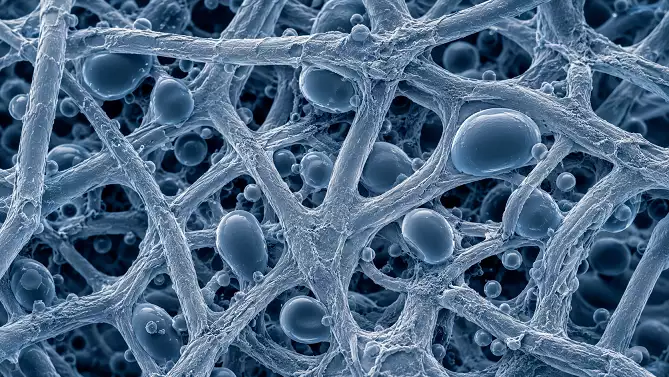
Lithium & Lithium Complex Grease
Lithium soap grease is made by reacting lithium hydroxide with fatty acids — typically 12-hydroxystearic acid — to produce a fibrous matrix. Lithium complex grease adds a dicarboxylic acid complexing agent, which cross-links the soap fibers and raises the dropping point from around 145–180°C (straight lithium) to 270°C and above (lithium complex).
Lithium-based greases account for more than half of global grease consumption. That dominance exists for good reasons: wide usable temperature range, good mechanical stability, reasonable water resistance, and cost-effectiveness that no other thickener system matches at scale.
Where it works: Rolling element bearings, wheel bearings, chassis, electric motors (open type), general industrial equipment.
Where it falls short: Incompatible with polyurea — mixing the two causes structural breakdown and rapid oil bleed. Straight lithium grades aren’t suitable above 130°C. Neither type holds up in continuous saltwater immersion.
🔗 [内链 → /lithium-grease-applications → “lithium grease applications guide”]
Polyurea Grease
Polyurea thickener forms through a reaction between isocyanates and amines — a non-soap, non-metallic matrix that gives the grease its defining properties: exceptional oxidation stability and a dropping point of 260°C and above.
The practical result is a grease that doesn’t oxidize and harden over long service periods the way lithium soap greases can. This is why polyurea grease is the industry standard for sealed-for-life electric motor bearings, where you can’t regrease after installation.
Where it works: Sealed electric motor bearings, extended-life industrial bearings, applications where the equipment design prevents relubrication access.
Where it falls short: Polyurea and lithium grease are incompatible — this is the most common expensive mistake in maintenance departments. Polyurea also costs more than lithium grades. Once the bearing is sealed, there’s no recovery if the wrong grease was used during assembly.
🔗 [内链 → /polyurea-vs-lithium-grease → “polyurea vs lithium grease: full comparison”]
Calcium Sulfonate Complex Grease
Calcium sulfonate complex uses overbased calcium sulfonate as both the thickener and a built-in corrosion inhibitor. That dual function is the key advantage: calcium sulfonate complex grease doesn’t need large additive packages to achieve extreme-pressure and rust-prevention performance — the thickener provides both.
Dropping point is typically above 280°C; high-performance formulations reach 300°C and above. Water resistance is exceptional — including resistance to salt spray and direct seawater contact that would strip most other grease types from metal surfaces within hours.
Where it works: Marine equipment, offshore machinery, steel mill applications with water spray and steam, mining equipment in wet conditions, heavy-duty wheel hub bearings operating in mud and water.
Where it falls short: Higher unit cost than lithium complex. Denser consistency can increase churning losses in high-speed applications. Compatibility with other grease types requires testing before changeover.
🔗 [内链 → /calcium-sulfonate-complex-grease → “calcium sulfonate complex grease guide”]
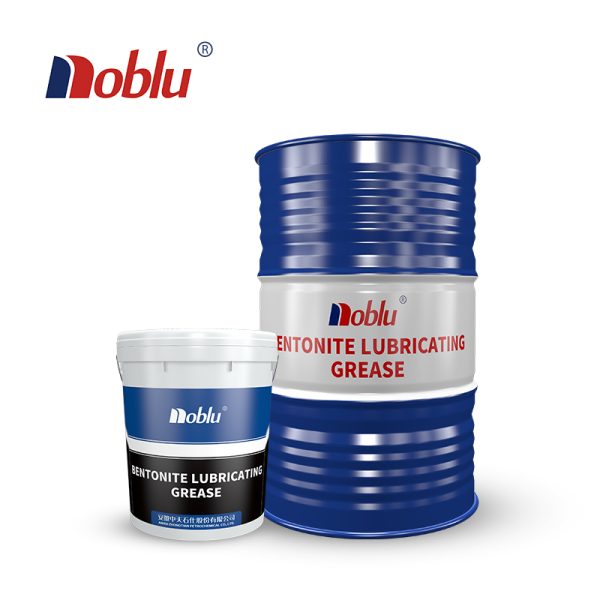
Bentonite Grease
Bentonite grease uses treated montmorillonite clay (bentonite) as the thickener — an inorganic, non-soap system. The key difference: bentonite grease does not melt. Soap-based greases have a dropping point — a temperature at which the thickener releases all its oil and the structure collapses. Bentonite clay doesn’t have a dropping point in this sense. Instead, it carbonizes at extreme temperatures while retaining its structural skeleton longer than any soap-based alternative.
Standard bentonite grease operates continuously up to 250°C. Where even that isn’t enough — kiln car bearings, furnace door hinges, glass industry equipment — specialty formulations using inorganic thickeners extend service to 600°C.
Where it works: High-heat industrial applications where operating temperatures exceed the dropping point of any soap-based grease. Steel mills, cement kilns, glass furnace equipment, aluminum smelting, continuous casting machines.
Where it falls short: Poor water resistance — not suitable for wet or outdoor environments without additional protection. Once base oil bleeds out at extreme temperature, the thickener structure can’t reabsorb it; relubrication intervals at very high temperatures are shorter than the packaging might suggest. Incompatible with most soap-based greases.
🔗 [内链 → /bentonite-grease-guide → “bentonite grease: properties and industrial applications”]
Calcium Grease
Calcium soap (lime-based) grease was among the first commercially manufactured greases and still serves specific niches where its natural water resistance matters more than its low temperature ceiling (around 85°C maximum). Agriculture, traditional marine fittings, and water pump packings account for most of its remaining use. In new equipment designs, it’s largely been replaced by calcium sulfonate complex or lithium complex grades that offer both water resistance and useful temperature range.
Aluminum Complex Grease
Aluminum complex thickener produces a smooth, often translucent grease with two standout properties: extremely high water washout resistance and strong metal adhesion. Drop point reaches 235–240°C depending on consistency grade, and the thickener maintains good mechanical stability under repeated shear cycling.
Where it works: Direct water-spray environments in steel mills, food-adjacent equipment (where aluminum complex compounds with appropriate food-safe base oil and additives meet regulatory requirements), any application requiring grease to stay on a wet metal surface.
Where it falls short: Higher cost than lithium complex. Less widely available than lithium grades, which limits sourcing options for large-volume industrial users.
🔗 [内链 → /aluminum-complex-grease → “aluminum complex grease: water resistance and applications”]
Sodium Grease
Sodium soap grease was used extensively for high-temperature bearing applications before lithium complex and polyurea became available. Its dropping point sits in the 120–150°C range — higher than calcium, but lower than lithium complex. The problem is water resistance: sodium grease dissolves in water. Any moisture exposure causes the thickener structure to wash out completely. New equipment designs have moved away from sodium grease almost entirely.
Silicone, PTFE & Specialty Non-Soap Greases
Silicone grease uses a silicone polymer gel as both thickener and lubricant carrier. Chemically inert, compatible with plastics and rubber, operating range from −60°C to 220°C. The standard choice for plastic-on-plastic contacts, rubber seals, medical devices, and electrical insulation applications where hydrocarbon-based greases would degrade the substrate.
PTFE grease is compounded with fine polytetrafluoroethylene particles that act as a dry-film lubricant. Widest temperature capability of any common grease type: −70°C to 250°C. Used in precision instruments, threaded fasteners requiring specific torque control, valve stems, and any application where chemical resistance takes priority over load-carrying capacity.
For dielectric, electrical contact, and potentiometer-specific grease selection, see our electrical grease guide below.
🔗 [内链 → /electrical-grease-guide → “electrical and electronic grease guide”]
Grease Compatibility & Changeover Rules
Mixing incompatible greases is one of the most common — and most preventable — causes of bearing failure in industrial maintenance. The failure mechanism isn’t slow: in severe cases, a mixed incompatible grease will collapse within the first few hours of operation, releasing all its base oil and leaving the bearing running dry.
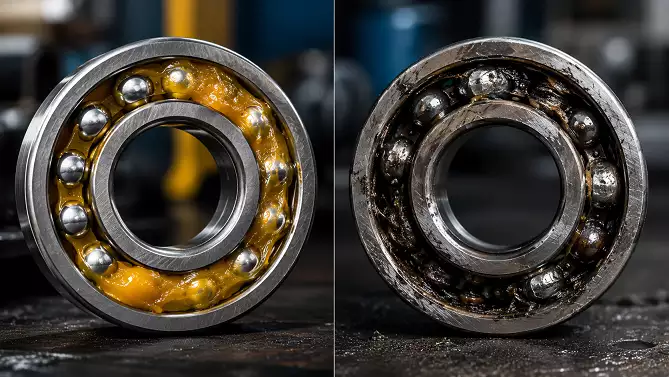
Common Grease Compatibility Quick Reference
| Combination | Compatibility | Risk Level |
|---|---|---|
| Lithium + Lithium Complex | ✓ Compatible | Low |
| Lithium + Calcium | ✓ Generally compatible | Low–Medium |
| Lithium + Calcium Sulfonate Complex | △ Borderline — test before changeover | Medium |
| Lithium + Polyurea | ✗ Incompatible | High |
| Lithium + Bentonite | ✗ Incompatible | High |
| Lithium Complex + Polyurea | ✗ Incompatible | High |
| Polyurea + Calcium Sulfonate Complex | △ Borderline — test required | Medium |
| Bentonite + Any soap-based grease | ✗ Incompatible | High |
| Silicone + Any soap-based grease | ✗ Incompatible | High |
| Aluminum Complex + Lithium Complex | △ Borderline | Medium |
This table covers the most frequent combinations. The full 12×12 matrix, along with field testing methods and laboratory test protocols, is in our dedicated compatibility guide.
🔗 [内链 → /grease-compatibility-chart → “full grease compatibility chart and changeover guide”]
Safe Grease Changeover: 5-Step Procedure
Before you start: if the new and old greases are incompatible, a partial purge will not prevent failure — it delays it. Complete purge is required.
Step 1 — Verify compatibility. Check the matrix before purchasing new grease. If the combination shows borderline or incompatible, plan the changeover procedure before the new grease arrives, not after.
Step 2 — Remove old grease mechanically. Disassemble the bearing housing where practical. Use a compatible flush grease or a small amount of the new grease to mechanically displace residual old grease. Wipe contact surfaces.
Step 3 — Apply a small charge of new grease and run. Operate at normal speed for 20–30 minutes. This distributes the new grease through the bearing cavity and forces the remaining mixed material toward the relief fitting.
Step 4 — Purge the transition mix. Open the relief fitting and run until discharged grease shows uniform color and consistency matching the new product. Don’t rush this step.
Step 5 — Final charge and documentation. Recharge to specified quantity. Record grease type, batch number, quantity, date, and equipment ID. The relubrication interval clock starts from zero.
Grease by Application (Selection Matrix)
The right grease depends on operating temperature, bearing speed, load type, exposure to water and contaminants, and whether the application gets periodic relubrication or is sealed for life.
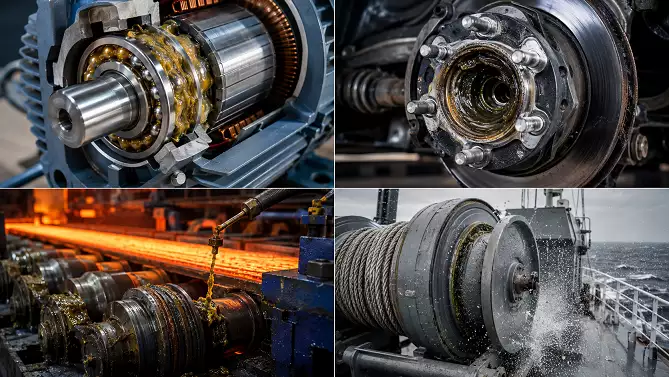
Application Selection Matrix
| Application | Grease Type | Key Requirement | NLGI | Temp Range |
|---|---|---|---|---|
| General industrial bearings | Lithium / Lithium Complex | Cost-effective, wide availability | 2 | −20°C to 130°C / 220°C |
| Sealed electric motor bearings | Polyurea | Long service life, oxidation stability | 2 | −20°C to 220°C |
| High-temp furnace / kiln bearings (>200°C) | Bentonite / Ultra-High Temp | No drop point under sustained heat | 2–3 | −30°C to 600°C |
| Wheel hub bearings | Lithium Complex / Ca. Sulfonate Complex | Water resistance, heat | 2 | −20°C to 220°C |
| Brake calipers | Lithium / Ceramic paste | High heat, anti-squeal, rubber compatibility | 2 | −20°C to 220°C |
| CV joints (inner & outer) | MoS₂ lithium / dedicated CV grease | EP performance, flexibility at angle | 2 | −40°C to 120°C |
| Electrical contact points | Conductive contact grease | Conductivity maintenance, corrosion prevention | 3 | −35°C to 120°C |
| Electronic components / seals (dielectric) | Silicone / dielectric grease | Electrical insulation, chemical inertness | 0–1 | −60°C to 220°C |
| Potentiometer damping | Potentiometer damping grease | Consistent torque feel, non-conductive | 0 | −20°C to 120°C |
| Open gears / slew rings | High-viscosity open gear compound | Adhesion, film thickness under load | 0–1 | Formulation-dependent |
| Marine / saltwater-exposed | Calcium Sulfonate Complex | Saltwater washout resistance, corrosion protection | 2 | −20°C to 200°C+ |
| Food-contact equipment | Food-grade certified grease (NSF H1 required) | Regulatory compliance, no harmful substances | 1–2 | −40°C to 160°C |
Bearing Lubrication
Bearing grease selection centers on three variables: speed factor, temperature, and load type.
Speed factor is expressed as ndm — bearing bore diameter (mm) multiplied by operating speed (RPM). Low ndm values (slow, heavy) suit NLGI 2–3 greases with high consistency. High ndm values (fast, light) need NLGI 1–2 or even 0 to reduce churning losses. In practice, most industrial antifriction bearings operating below 130°C and at moderate speed start with NLGI 2 lithium complex. Polyurea NLGI 2 is the correct choice for sealed-for-life and electric motor bearings where oxidation over long service intervals is the failure mode, not mechanical wear.
In high-water or high-contamination environments, calcium sulfonate complex provides substantially better protection than lithium complex without requiring additional EP additive packages.
🔗 [内链 → /bearing-grease-selection-guide → “bearing grease selection guide: speed factor, NLGI, and relubrication intervals”]
Automotive Applications
Three different environments require three different approaches:
Wheel hub bearings see sustained heat from braking combined with road spray and contamination. Lithium complex NLGI 2 or calcium sulfonate complex NLGI 2 handles this combination. Straight lithium NLGI 2 is marginal if disc brakes are generating sustained heat above 130°C.
Brake calipers require a grease that tolerates temperatures exceeding 150°C on sliding surfaces without attacking rubber dust boots. Lithium complex or purpose-formulated ceramic-compound pastes are the standard. Never use copper-based anti-seize compounds where rubber contact is possible.
CV joints — inner and outer — need high EP performance and the flexibility to maintain film at the operating angles of the joint (up to 47° on inner joints). A dedicated MoS₂-fortified lithium grease or factory-specified CV grease is appropriate. Standard multi-purpose lithium grease without MoS₂ will work under normal load, but won’t protect adequately when a worn or damaged boot allows joint angles to increase.
🔗 [内链 → /lithium-grease-applications → “lithium-based grease applications: automotive and industrial”]
Electrical & Electronic Applications
Two opposite requirements, and they’re not interchangeable.
Conductive electrical contact grease goes on metal-to-metal contact points — battery terminals, switch contacts, bus bars, connector pins — where the goal is to maintain electrical conductivity while preventing oxidation corrosion. Using a standard lithium grease here will increase contact resistance over time as the soap oxidizes.
Dielectric (insulating) grease goes on insulated surfaces — spark plug boots, weatherproof connector shells, rubber seals — where the goal is to prevent conductivity and exclude moisture. A persistent misconception: dielectric grease does not provide anti-wear protection for load-bearing metal surfaces. It isn’t a substitute for bearing grease.
Potentiometer damping grease is a separate category again — designed for consistent rotational torque feel in precision controls. It must be non-conductive, chemically stable with plastics, and viscosity-stable across a useful temperature range.
🔗 [内链 → /electrical-grease-guide → “electrical and electronic grease guide: contact, dielectric, and potentiometer greases”]
High-Temperature Industrial Applications
Above 150°C, most straight lithium greases are outside their rated range. Between 150°C and 220°C, lithium complex, calcium sulfonate complex, and polyurea all remain viable — the choice depends on load and water exposure rather than temperature alone.
Above 220°C, the field narrows. Calcium sulfonate complex and bentonite grease are the primary candidates. Above 250°C sustained, standard bentonite (dropping point ≥270°C, operating to 250°C) remains serviceable. At higher peaks — kiln car bearings, furnace chain links operating in direct flame proximity — inorganic-thickened grease capable of withstanding up to 600°C is required, and relubrication intervals must be shortened to compensate for accelerated base oil evaporation.
Grease Failure Modes & Troubleshooting
Most grease failures in the field trace back to five root causes: wrong quantity, wrong grease type, contamination, sustained overtemperature, or missed relubrication interval. Identifying which one you’re dealing with determines the fix.
🖼️ [配图 → H2-7 标题下方,右浮动或全宽 | AI 提示词: “Close-up photograph of a failed industrial roller bearing showing darkened, hardened, degraded grease residue around the bearing races, metal surface shows early pitting and discoloration, dramatic technical lighting revealing texture detail, no text, industrial failure analysis photography style”]
Grease Failure Diagnosis Table
| Symptom | Likely Cause | Corrective Action |
|---|---|---|
| Bearing running hotter than baseline | Over-greasing (churning) or NLGI grade too low | Reduce quantity; increase to NLGI 2 or 3 |
| Bearing noise — rumbling or intermittent squeal | Insufficient lubrication or grease past service life | Regrease per schedule; purge old grease; inspect bearing condition |
| Grease leaking from housing | NLGI grade too low; operating temperature exceeds grease rating | Switch to higher NLGI; select grease with higher dropping point |
| Bearing seizure | Complete film failure — grease exhausted or incompatible mix caused collapse | Full strip-down; inspect for damage; start with correct grease type |
| Grease turns dark brown or black prematurely | Overtemperature oxidation; metal wear particle contamination | Check temperature source; measure clearances; change grease type if needed |
| Grease softens progressively over time | Mechanical shear breakdown; water ingress; wrong type under load conditions | Switch to more mechanically stable type (polyurea or lithium complex); inspect seals |
| Rust or corrosion on lubricated surfaces | Water resistance inadequate for the environment | Upgrade to calcium sulfonate complex or aluminum complex |
| Hardened or crumbled grease residue on relubrication | Old grease past shelf life used; prolonged oxidation in service | Purge completely; verify storage conditions; check relubrication schedule |
Storage, Handling & Shelf Life
Grease applied from an improperly stored container may already be partially degraded. Contamination during storage — a single open drum left near grinding operations — introduces abrasives that will accelerate bearing wear from the first hour of operation. This is underestimated as a failure source.
🖼️ [配图 → H2-8 标题下方,左浮动 | AI 提示词: “Organized industrial lubricant storage room with rows of sealed grease drums and labeled pail containers stacked on clean shelving, temperature-controlled environment, clear labels visible on containers, professional and orderly industrial warehouse photography, soft even lighting, no text on walls”]
Grease Storage & Handling Requirements
| Parameter | Requirement |
|---|---|
| Storage temperature | 5°C to 35°C — avoid repeated freeze-thaw cycling |
| Humidity | Low-humidity indoor storage; no direct water contact on containers |
| Container position | Drums stored upright; pails and cartridges sealed after every use |
| UV / sun exposure | Avoid prolonged direct exposure — may affect certain additive packages over time |
| Opening and dispensing | Use dedicated grease pumps; never leave containers open in dusty or contaminated environments |
| Stock rotation | First-in, first-out by production or expiry date — no exceptions |
| Shelf life — mineral base oil grease | 24–36 months in original sealed container |
| Shelf life — synthetic base oil grease | 24–48 months in original sealed container |
| Grease approaching or past expiry | Conduct visual inspection for separation, color change, or hardening; test cone penetration per GB/T269 / ASTM D217 before use |
One rule that gets ignored more than any other: each container gets dedicated to one grease type. Reusing a drum pump that carried lithium grease to dispense polyurea grease introduces enough cross-contamination to cause compatibility failures in precision bearings.
Our Grease Products & Manufacturing Capabilities
Zhongtian Petrochemical Group has manufactured industrial lubricants and greases since 1998. With 28 years of production history, a grease production capacity of 500,000 tons annually, and active export relationships across more than 100 countries and regions — including Japan, South Korea, Europe, and Southeast Asia — we supply both standard catalogue products and custom-formulated greases to OEM and industrial customers.
Our group testing facility holds CMA and CNAS dual certification, operating as a state-authorized third-party testing institution. All grease products are tested against GB standards (GB/T269, GB/T3498, GB/T7326, SH/T0109, SH/T0325, and SH/T0202 at minimum) before dispatch.
🖼️ [配图 → 公司介绍段落下方,全宽 | 使用产品手册实拍图,不需要AI生成。推荐使用: 产品手册第5页的研发中心全景图或工厂航拍图,展示生产规模和实验室能力]
Grease Product Range
The following products represent the core of our grease catalogue. Technical data sheets, safety data sheets, and test reports are available on request for all products.
🖼️ [配图 → 产品卡片区域,每个产品卡片左侧或上方使用产品手册对应实拍图(福满天品牌桶装/袋装照片)]
Extreme Pressure Lithium Complex Grease — Fumantian Brand, Model: 2#, 3#
High-performance lithium complex grease for medium and heavy-load rolling bearings, ball bearings, sliding bearings, baking equipment chain, and motorcycle transmission parts. Formulated for humid and harsh environments requiring long-term or lifetime lubrication. Performs where standard lithium grades cannot.
| Parameter | NLGI 2# | NLGI 3# |
|---|---|---|
| Appearance | Yellow smooth uniform ointment | → |
| Working penetration (0.1mm) | 265–295 | 220–250 |
| Drop point, °C ≥ | 270 | 280 |
| EP four-ball (PD), N ≥ | 3,089 | 3,089 |
| Water washout (38°C, 1h) % ≤ | 10 | 10 |
| Operating temperature range | −30°C to 220°C | → |
Packaging: 320g / 400g / 500g / 1kg / 2kg / 5kg / 12kg / 15kg / 170kg / 180kg
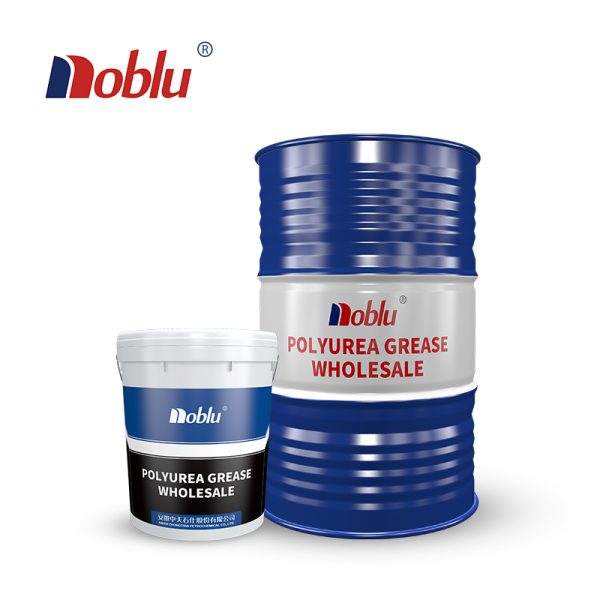
Polyurea Grease — Fumantian Brand, Model: 2#
Non-soap polyurea grease for sealed-for-life bearings, medium and heavy-load sliding bearings, baking equipment gears, and transmission parts requiring oxidation stability over extended service intervals. The standard choice for electric motor bearing applications where relubrication is not possible after sealing.
| Parameter | NLGI 2# |
|---|---|
| Appearance | Smooth even yellow ointment |
| Working penetration (0.1mm) | 265–295 |
| Drop point, °C ≥ | 260 |
| Corrosion (T2 Copper, 100°C, 30h) | No green or black change |
| Extended penetration (100,000 cycles, change) ≤ 0.1mm | 20 |
| Operating temperature range | −20°C to 220°C |
Packaging: 320g / 400g / 500g / 1kg / 2kg / 5kg / 12kg / 15kg / 170kg / 180kg
Ultra-High Temperature Grease — Fumantian Brand, Model: 3#
Synthetic grease with inorganic thickener for kiln car bearings, furnace door chains and bearings, baking equipment gears, and other high-temperature-load applications in ceramics, glass, textile, and metallurgical industries. No dropping point — the inorganic thickener retains structural integrity where soap-based greases would have already melted and run.
| Parameter | NLGI 3# |
|---|---|
| Appearance | Black smooth uniform ointment |
| Working penetration (0.1mm) | 265–295 |
| Drop point | None |
| Steel mesh oil separation (100°C, 24h) % ≤ | 1 |
| Corrosion resistance (52°C, 48h) | Qualified |
| Maximum operating temperature | 600°C |
Packaging: 320g / 400g / 500g / 1kg / 2kg / 5kg / 12kg / 15kg / 170kg / 180kg
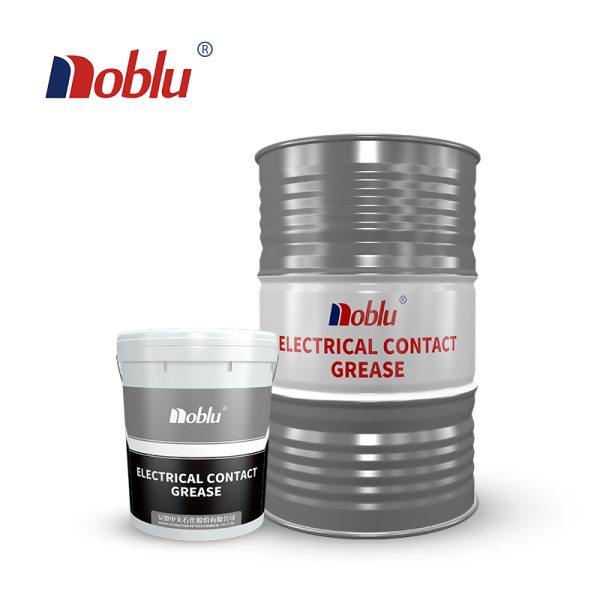
Electrical Contact Grease — Fumantian Brand, Model: 3#
Long-life electrical contact grease for weak-current electrical contact maintenance, static contacts, insert connectors, smooth adjustments, and arc-extinguishing applications. White coloring allows visual inspection of application coverage on contact surfaces.
| Parameter | NLGI 3# |
|---|---|
| Appearance | White smooth even ointment |
| Working penetration (0.1mm) | 265–295 |
| Drop point, °C | 160 |
| Volume resistance, Ω·cm ≤ | 120 |
| Evaporation (99°C, 24h) % (m/m) ≤ | 1.0 |
| Operating temperature range | −35°C to 120°C |
Packaging: 320g / 400g / 500g / 1kg / 2kg / 5kg / 12kg / 15kg / 170kg / 180kg
Manufacturing Credentials
🖼️ [配图 → 资质模块,使用产品手册第5页的证书实拍图,并排排列:国家绿色工厂 / 高新技术企业 / 知识产权示范企业 / 守合同重信用单位 等实物证书图片]
| Credential | Details |
|---|---|
| Founded | 1998 |
| Industry experience | 28 years |
| Annual grease production capacity | 500,000 tons |
| Product range | 2,000+ products across 2 major categories |
| Export markets | 100+ countries and regions — Europe, Americas, Japan, South Korea, Southeast Asia |
| Application sectors | Industrial & agricultural machinery / Transportation / Civil facilities / National defense equipment |
| R&D infrastructure | Anhui Provincial Key Laboratory; Academician Workstation; Post-Doctoral Research Center |
| Honorary designations | National Green Factory; National IP Advantage Enterprise; Specialized & Sophisticated Enterprise; High-Tech Enterprise; China Well-Known Trademark (Fumantian) |
| Testing certifications | CMA + CNAS dual-certified testing facility (state-authorized third-party status) |
| Key customers | Conch Group, JAC Group, Dongfeng Motor, Heli Forklift, E-P Equipment, Shaanxi Coal Group, Zenith Steel, Rockcheck Steel; KOBELCO Japan, HITACHI |
Procurement & Ordering
| Item | Details |
|---|---|
| Standard packaging | 320g – 180kg (grease); 18L – 200L (specialty products) |
| MOQ | Contact our sales team — varies by product and format |
| Lead time — standard products | Contact us for current availability |
| Lead time — custom formulations | Contact our R&D team for timeline |
| Technical data sheet | Available for all catalogue products |
| Safety data sheet | Available — GHS-compliant format |
| Sample policy | Contact our technical team |
| Custom formulation | Available — from viscosity adjustment to full custom development |
| Private label / OEM supply | Available |
[Request a Technical Data Sheet] [Get a Bulk Quotation]
Frequently Asked Questions
How many types of grease are there?
More than 12 main types are in common industrial and automotive use, classified by thickener system. The most widely used are lithium, lithium complex, polyurea, calcium sulfonate complex, and bentonite grease. Silicone, PTFE, aluminum complex, calcium, and several specialty types fill specific application niches.
What is the most common type of industrial grease?
Lithium-based grease — including both straight lithium and lithium complex — accounts for more than half of global grease consumption. Its combination of wide temperature range, good mechanical stability, reasonable water resistance, and cost-effectiveness makes it the default for general-purpose bearing applications across virtually every industry.
Can you mix different types of grease?
Some combinations are compatible; many are not. Lithium and polyurea grease, for example, are incompatible — mixing them causes the thickener matrix to collapse, resulting in oil bleed and bearing failure. Lithium and calcium are generally compatible. Before switching grease types on any piece of equipment, check a full compatibility chart and follow a proper changeover procedure. Borderline combinations require laboratory testing to confirm.
What does grease color tell you?
Nothing reliable about grease type. Color is added by manufacturers as a batch-tracking or marketing choice, independent of the thickener system. The same grease type can appear in multiple colors from different suppliers. Two greases with the same color can be completely incompatible. Confirm type from the technical data sheet, not the container color.
What is NLGI 2 grease?
NLGI 2 is the most widely used consistency grade, with a firm, peanut-butter-like texture (cone penetration 265–295 dmm per GB/T269 / ASTM D217). It suits the majority of rolling element bearing applications operating at moderate temperatures, loads, and speeds. When equipment documentation calls for “general-purpose bearing grease” without specifying a grade, NLGI 2 is the correct starting point.
How often should industrial grease be replaced?
Relubrication intervals depend on bearing size, speed, temperature, load, and grease type. Sealed electric motor bearings lubricated with polyurea grease are often designed for lifetime service with no relubrication. General-purpose lithium complex grease in open bearings requires periodic relubrication — intervals range from several hundred to several thousand hours depending on operating conditions. Equipment manufacturer specifications take precedence over general guidelines. When in doubt, err toward more frequent relubrication with smaller quantities rather than large infrequent charges.
Zhongtian Petrochemical Group — Founded 1998. 28 years of lubricant production. Technical inquiries: [Contact]