




A grease cross reference chart should match greases on thickener, base oil viscosity, NLGI grade, temperature range and extreme-pressure level, each measured by the same test method. Brand interchange guides group products by application, so one grease can sit in more than one column: the 2010 Timken Grease Interchange Guide lists SKF LGEP 2 under both its Premium All Purpose Industrial LC-2 grease and its Multi-Use Lithium grease, while SKF’s current data sheet gives the thickener as lithium. Use a chart to shortlist a replacement, then settle whether two greases can share a bearing with a compatibility test or a purge.
Published data for 12 common greases
Values are as printed on the data sheet or product page linked in each row, as opened in September 2026; “not printed” means the sheet does not state it. The last column shows where the 2010 Timken guide places the grease, where it lists it.
| Grease | Thickener | Base oil, mm²/s at 40 °C | NLGI | Dropping point (method) | Operating range | DIN code | Timken guide group |
|---|---|---|---|---|---|---|---|
| Mobilux EP 2 | Lithium | 160 (type not printed) | 2 | 190 °C (D2265) | −20 to 130 °C | KP 2 K-20 | Multi-Use Lithium |
| Mobilith SHC 220 | Lithium complex | Synthetic, 220 | 2 | 265 °C (D2265) | −40 to 150 °C | KP HC 2 N-30 | not listed |
| Mobilgrease XHP 222 | Lithium complex | 220 (type not printed) | 2 | 290 °C (D2265) | not printed | KP 2 N-20 | Premium All Purpose Industrial LC-2 |
| Mobil Polyrex EM | Polyurea | 115 (type not printed) | 2 | 260 °C (D2265) | not printed | K 2 P-20 | Ball Bearing Pillow Block |
| Shell Gadus S2 V220 2 | Lithium | Mineral, 220 | 2 | 180 °C (IP 396) | −20 to 130 °C | not printed | not listed |
| Shell Gadus S3 V220C 2 | Lithium complex | Mineral, 220 | 2 | 260 °C (IP 396) | −20 to 140 °C | not printed | not listed |
| SKF LGMT 2 | Lithium | Mineral, 110 | 2 | above 180 °C (ISO method) | −30 to 120 °C | K2K-30 | Multi-Use Lithium |
| SKF LGEP 2 | Lithium | Mineral, 200 | 2 | above 180 °C (ISO method) | −20 to 110 °C | KP2G-20 | Multi-Use Lithium, and LC-2 |
| SKF LGHP 2 | Di-urea (polyurea) | Mineral, 96 | 2 to 3 | above 240 °C (ISO method) | −40 to 150 °C | K2N-40 | Ball Bearing Pillow Block |
| SKF LGWA 2 | Lithium complex | Mineral, 250 | 2 | above 250 °C (ISO method) | −30 to 140 °C | KP2N-30 | Premium All Purpose Industrial LC-2 |
| Castrol Spheerol EPL 2 | Lithium | Mineral, 150 to 200 | 2 | 200 °C (ISO method and D566) | not printed | KP2K-20 | Multi-Use Lithium (listed as Castrol Spheerol EPL) |
| Chevron Delo Grease EP 2 | Lithium complex | Mineral, 220 | 2 | 262 °C (IP 396) | −30 to 140 °C | KP2N-30 | Premium All Purpose Industrial LC-2 (listed as Chevron Delo EP 2) |
Even this short list uses three dropping-point methods and prints the base oil type for only some greases. Those gaps have to be closed before any two rows can be called equivalent.
The columns a cross-reference needs
| Column | What to record | Test method to note | When two greases match |
|---|---|---|---|
| Thickener | Lithium, lithium complex, calcium sulfonate complex, polyurea, and so on | Maker’s data sheet | Same family, as printed by the maker |
| Base oil | Mineral or synthetic, and viscosity at 40 °C | Maker’s data sheet | Same type; viscosity in the same ISO 3448 grade band (how the bands work) |
| Consistency | NLGI grade and worked penetration | ASTM D217 | Same NLGI grade |
| Dropping point | °C, with the method | ASTM D2265 | Replacement at least as high, on the same method |
| Operating temperature | Lowest and highest, as the maker states | Maker’s data sheet | Replacement covers both ends |
| Load carrying | Four-ball weld load, with unit | ASTM D2596 | At least as high if the original is an EP grease |
| Water resistance | Washout %, and the test temperature | ASTM D1264 | Same temperature, no higher loss |
| Oil separation | %, with method, time and temperature | ASTM D1742 or ASTM D6184 | Same method only |
| Classification code | ISO 6743-9 and DIN 51502 codes if printed | See the next section | No letter rated lower |
Three notes on the method column. ASTM D566, the older dropping-point method, was withdrawn in 2023 and replaced by D2265, and ASTM notes that above 200 °C the dropping point has no correlation with the upper operating temperature of a grease. The four-ball wear test, ASTM D2266, cannot tell an EP grease from a non-EP grease, so it does not belong in the load-carrying column. The two oil-separation tests measure different things: D1742 runs 24 hours at 25 °C as printed on Mobil data sheets, D6184 30 hours at 100 °C.
Two codes that already encode half the chart
The international code for greases is set by ISO 6743-9. It reads ISO-L-X, then four letters and the NLGI grade:
| Position | Meaning | Letters |
|---|---|---|
| 1 | Lowest operating temperature | A 0 °C, B −20 °C, C −30 °C, D −40 °C, E below −40 °C |
| 2 | Highest operating temperature | A 60 °C, B 90 °C, C 120 °C, D 140 °C, E 160 °C, F 180 °C, G above 180 °C |
| 3 | Water and rust protection | A to I, from dry conditions without rust protection to water washout with salt-water protection |
| 4 | Extreme pressure | A non-EP, B EP |
| Last | Consistency | NLGI grade |
The German code from DIN 51502, common on European data sheets, packs similar information differently, as set out on the FUCHS DIN 51502 page: K for rolling and plain bearing greases, P for EP or anti-wear additives, the NLGI grade, a letter for the upper temperature (K is 120 °C, N 140 °C, P 160 °C) and a number for the lower one.
One published sheet shows both codes side by side. The Castrol Spheerol EPL 2 data sheet prints DIN KP2K-20 and ISO L-XBCEB 2. Decoded, they agree: upper temperature 120 °C (K and C), lower temperature −20 °C (−20 and B), EP (P and B), NLGI 2. Two greases with the same code make a strong shortlist; a candidate rated lower on any letter is not an equivalent.
Five mismatches inside a single manual
Test conditions drift within one maker’s catalogue, too. Our own 2026 steel-industry product manual lists nine greases, and its specification tables use five sets of conditions that cannot be compared directly:
| Property | One product states | Another product states | Why the numbers do not compare |
|---|---|---|---|
| Steel-mesh oil separation | 100 °C for 24 hours (EP lithium grease) | 100 °C for 30 hours (molybdenum disulfide lithium grease) | Different test durations; ASTM D6184 defaults to 30 hours |
| Shear stability after 100,000 strokes | Change of no more than 20% (EP lithium complex grease) | Difference of no more than 40 units of 0.1 mm (calcium sulfonate complex grease) | A percentage against an absolute change |
| Dropping point | Ordinary method (lithium greases) | Wide-range method (complex greases) | Two methods, the D566 and D2265 types |
| Water washout | At 38 °C (EP lithium complex grease) | At 79 °C (sinter-machine grease) | ASTM D1264 runs at both temperatures; the results do not compare |
| Oxidation stability, pressure drop | 0.070 MPa at 100 °C (lithium greases) | 50 kPa at 99 °C (sinter-machine, roll-bearing and continuous-caster greases) | Different units and conditions; 0.070 MPa is 70 kPa |
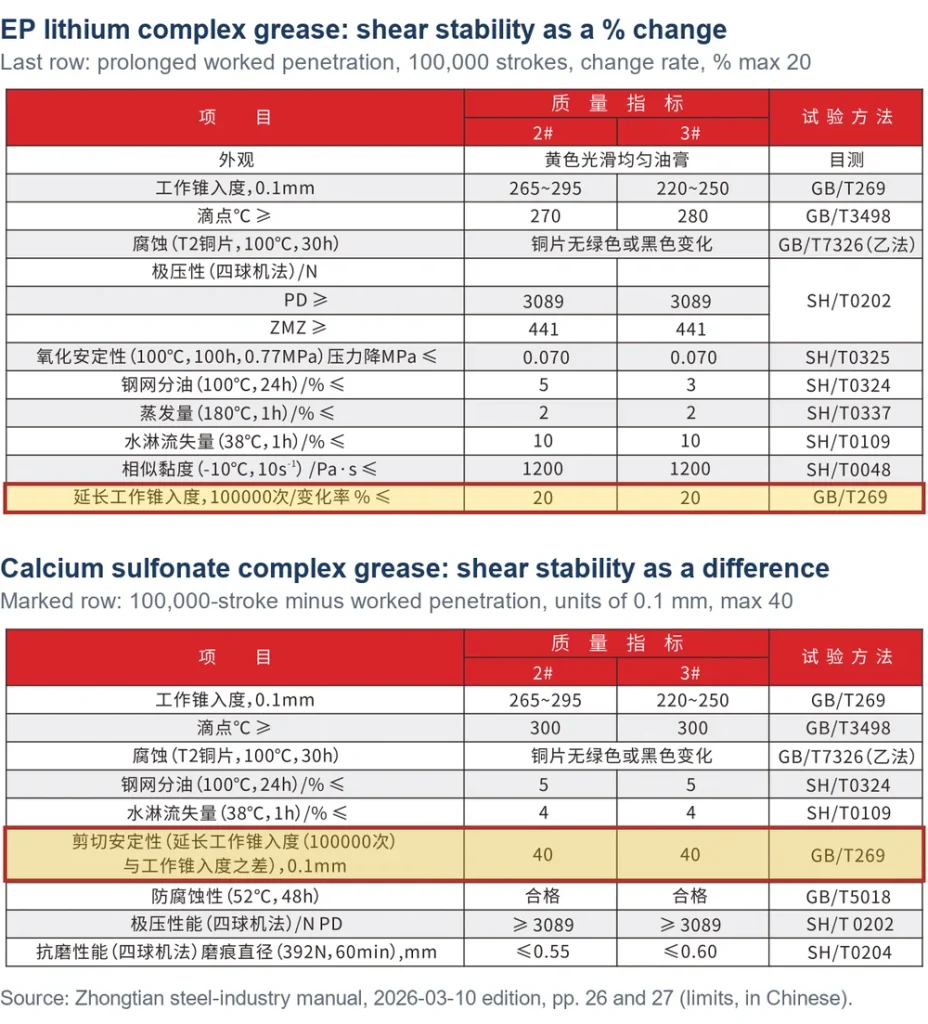
Write the method, time, temperature and unit next to every number in the chart. Where they differ between two greases, ask for a retest on one basis rather than converting. Why the percentage and absolute shear figures cannot be ranked against each other is explained in why grease hardens, softens or bleeds, and how dropping point relates to service temperature in high-temperature grease.
A worked cross-reference: four families, including ours
This chart compares published data only. It does not claim that any Zhongtian grease is approved to replace a named product; where an equipment maker specifies a grease, that approval decides. Zhongtian values for the EP lithium and EP lithium complex greases are limits from our 2026 steel-industry manual; the multi-purpose lithium values are typical values from its product page, and the polyurea range is from our catalogue.
| Family | Published examples | Zhongtian grease in the same family | Tier on paper |
|---|---|---|---|
| Lithium EP | Mobilux EP 2 (160 mm²/s, 190 °C, −20 to 130 °C); SKF LGEP 2 (200 mm²/s, above 180 °C, −20 to 110 °C) | EP lithium grease 2#: NLGI 2, dropping point at least 175 °C (ordinary method), −20 to 120 °C, four-ball PB at least 588 N | Tier 2: base oil viscosity not published; dropping point lower and on a different method; top temperature 120 against 130 °C for Mobilux EP 2 |
| Lithium complex EP, base oil 220 to 250 mm²/s | Mobilgrease XHP 222 (290 °C); SKF LGWA 2 (above 250 °C, −30 to 140 °C); Chevron Delo Grease EP 2 (262 °C, −30 to 140 °C) | EP lithium complex grease 2#: dropping point at least 270 °C (wide-range method), −30 to 220 °C, four-ball PD at least 3,089 N | Tier 2: base oil viscosity not published; dropping point 20 °C below XHP 222, a gap ASTM says does not predict service temperature above 200 °C |
| General-purpose lithium | SKF LGMT 2 (110 mm²/s, above 180 °C, −30 to 120 °C) | Multi-purpose lithium grease 2#: typical penetration 277, dropping point 175 °C, −20 to 120 °C | Tier 2: lower limit −20 against −30 °C; dropping point 175 against above 180 °C |
| Polyurea | Mobil Polyrex EM (115 mm²/s, 260 °C); SKF LGHP 2 (96 mm²/s, above 240 °C, −40 to 150 °C) | Polyurea grease 2#: −20 to 220 °C in our catalogue | Tier 2: SKF LGHP 2 is rated to −40 °C and NLGI 2 to 3; ours is rated to −20 °C |
No row reaches Tier 1 on published data. Our data sheets do not print base oil viscosity, so ask for it before shortlisting, and note that the load-carrying figures use three different four-ball methods: kgf on ASTM D2596 at Mobil, newtons on a DIN test at SKF, and newtons on the Chinese industry test in our manual. Because we make grease to order, base oil viscosity, NLGI grade and temperature range can be set in the purchase specification and are then stated on the data sheet and the batch certificate. Polyurea greases are common in electric motor bearings; what matters there is covered in grease for electric motors.
Three tiers of equivalence
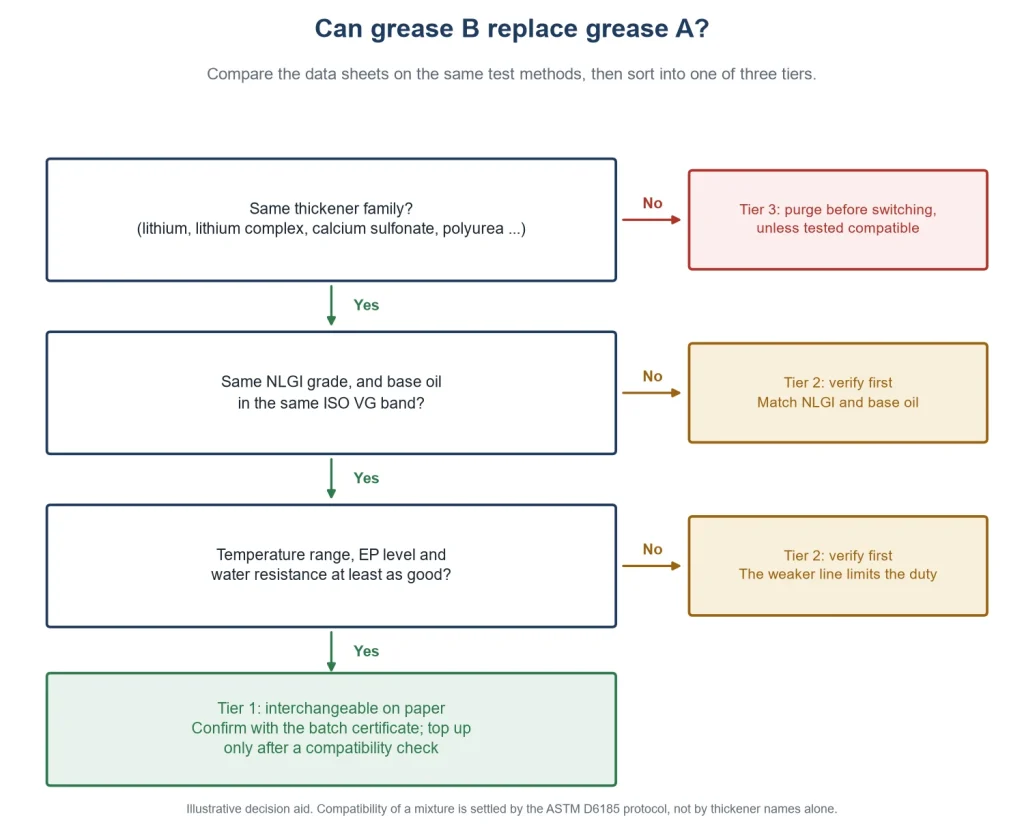
Tier 1 is interchangeable on paper: same thickener family, same NLGI grade, base oil in the same viscosity band, and a temperature range, EP level and water resistance at least as good. Tier 2 is the same family with one or more lines that do not match; the grease may still work, but the weaker line limits the duty. Tier 3 is a different thickener family: purge before switching, unless a published chart and an ASTM D6185 test both rate the pair compatible.
Tier 1 on paper still does not prove two greases can be mixed. The practice for that is ASTM D6185, which checks dropping point, shear stability and storage stability on mixtures: a 50:50 mix stands for topping up without cleaning, 10:90 and 90:10 for a changeover with flushing. ASTM states that compatibility cannot be predicted with certainty from what the greases are made of. Published charts are a first screen only; the Machinery Lubrication compatibility chart rates lithium with lithium complex as compatible and lithium with conventional polyurea as incompatible, while its text notes that some polyurea greases are compatible with lithium. Our thickener matrix and a changeover procedure are in the grease types guide. When in doubt, clean the old grease out; the ASTM practice itself notes that equipment makers recommend completely cleaning out the old grease before a different one goes in.
A cross-reference template to fill in
Copy these columns into a spreadsheet, one row per grease in use. The example row is filled from the tables above.
| Grease in use | Thickener | Base oil, mm²/s at 40 °C | NLGI | Dropping point (method) | Temperature range | Load carrying (method) | Washout (°C) | Oil separation (method, hours) | ISO / DIN code | Candidate | Tier |
|---|---|---|---|---|---|---|---|---|---|---|---|
| Mobilux EP 2 | Lithium | 160 | 2 | 190 °C (D2265) | −20 to 130 °C | 250 kgf weld (D2596) | not printed | not printed | KP 2 K-20 | Zhongtian EP lithium grease 2#, base oil viscosity to be confirmed | Tier 2: base oil not confirmed; dropping point 175 °C (ordinary method) against 190 °C (D2265); upper limit 120 against 130 °C |
Any cell the supplier cannot fill is the question to send them before the trial order.
Frequently asked questions
What does KP2K-20 mean on a grease data sheet?
It is the DIN 51502 code: a rolling and plain bearing grease (K) with EP or anti-wear additives (P), NLGI grade 2, an upper operating temperature of 120 °C (K) and a lower one of −20 °C.
What does L-XBCEB 2 mean?
It is an ISO 6743-9 code: a grease (X) for use from −20 °C (B) to 120 °C (C), water and rust class E (static wet conditions, rust protection against fresh water), extreme-pressure performance (B) and NLGI grade 2.
Can I mix two greases with the same thickener?
Charts usually rate same-family greases as compatible, but base oils and additives differ between brands. ASTM D6185 is the way to confirm; without that result, purge the old grease before changing.
Is a grease interchange guide enough to switch brands?
No. Interchange guides group products by application or product line, not by measured properties. Check thickener, base oil viscosity, NLGI grade, temperature range and EP level on both data sheets, on the same test methods, before switching.
Send us your filled template
Fill in the template for the greases in your plant and send it with their data sheets. We return the Zhongtian column: the closest Zhongtian grease, the lines its data sheet and batch certificate confirm, and the lines that still need a test. Contact Zhongtian Petrochemical.