





AW32, AW46 and AW68 are labels that differ in one published property: viscosity grade. The number is the ISO viscosity grade measured at 40°C: AW32 sits in a window of 28.8–35.2 mm²/s, AW46 in 41.4–50.6 mm²/s, and AW68 in 61.2–74.8 mm²/s, per ISO 3448. Nothing else in the designation changes. The anti-wear additive package, the base oil quality and the oxidation resistance are not encoded in the number at all, and they are not necessarily identical across the three grades even within one supplier’s range.
Pick by two things: what the equipment manufacturer specifies, and the temperature range the machine actually works in. Start with the OEM’s fluid specification and permitted viscosity grades. If more than one grade is allowed, compare the candidate oils at the lowest start-up temperature and at the normal operating oil temperature against the pump’s viscosity limits. Ambient temperature, load or equipment age alone cannot authorize a grade change, and if the manual names a grade, that grade wins over any rule of thumb on this page.
One clarification resolves a common ordering error before it happens: AW is not an ISO category. It is a market designation for anti-wear hydraulic oil, widely used in North America. The international system uses two separate standards: ISO 3448 for the viscosity grade, and ISO 6743-4 for the service family. A supplier may market an HM-classified ISO VG 46 product as AW 46, but the AW label alone does not verify that classification or any OEM approval; ask for the declared performance standard and the supporting product documentation. ISO 46 and AW 46 are not competing specifications, and they are not synonyms either: one names a viscosity, the other names a viscosity plus an additive intent.
What the numbers actually mean
Every ISO viscosity grade is a band, not a single value. ISO 3448 names each grade for the midpoint of its window and allows ±10% either side, measured as kinematic viscosity at 40°C.
| Grade | Midpoint at 40°C | Permitted range | Rough position |
|---|---|---|---|
| AW32 (ISO VG 32) | 32 mm²/s | 28.8 – 35.2 mm²/s | Thinner |
| AW46 (ISO VG 46) | 46 mm²/s | 41.4 – 50.6 mm²/s | The industrial default |
| AW68 (ISO VG 68) | 68 mm²/s | 61.2 – 74.8 mm²/s | Thicker |
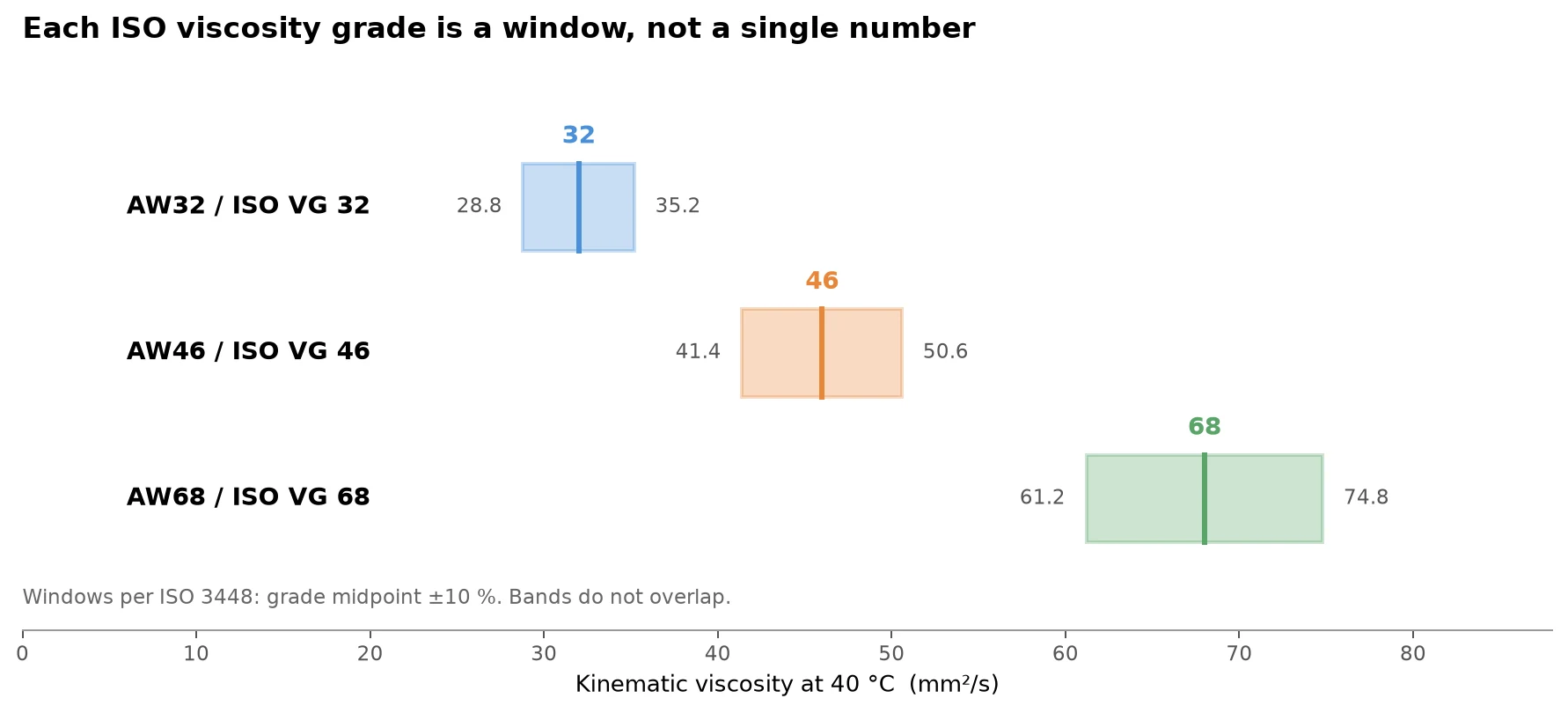
The grades step in roughly 1.5× increments, so each one is meaningfully different from the last without wasteful overlap. Two products in the same grade can still differ by about 20% in measured viscosity and both be correctly labelled.
The 40°C reference point matters more than it first appears. The ISO VG designation uses a 40°C reference measurement. It does not specify the oil’s viscosity at the machine’s cold-start or operating temperature; those values require additional product data. The grade therefore tells you nothing about how the oil behaves on a cold morning or in a reservoir running at 70°C. That gap is where most selection mistakes live, and it is covered further down.
AW, ISO VG and HM: three labels answering three different questions
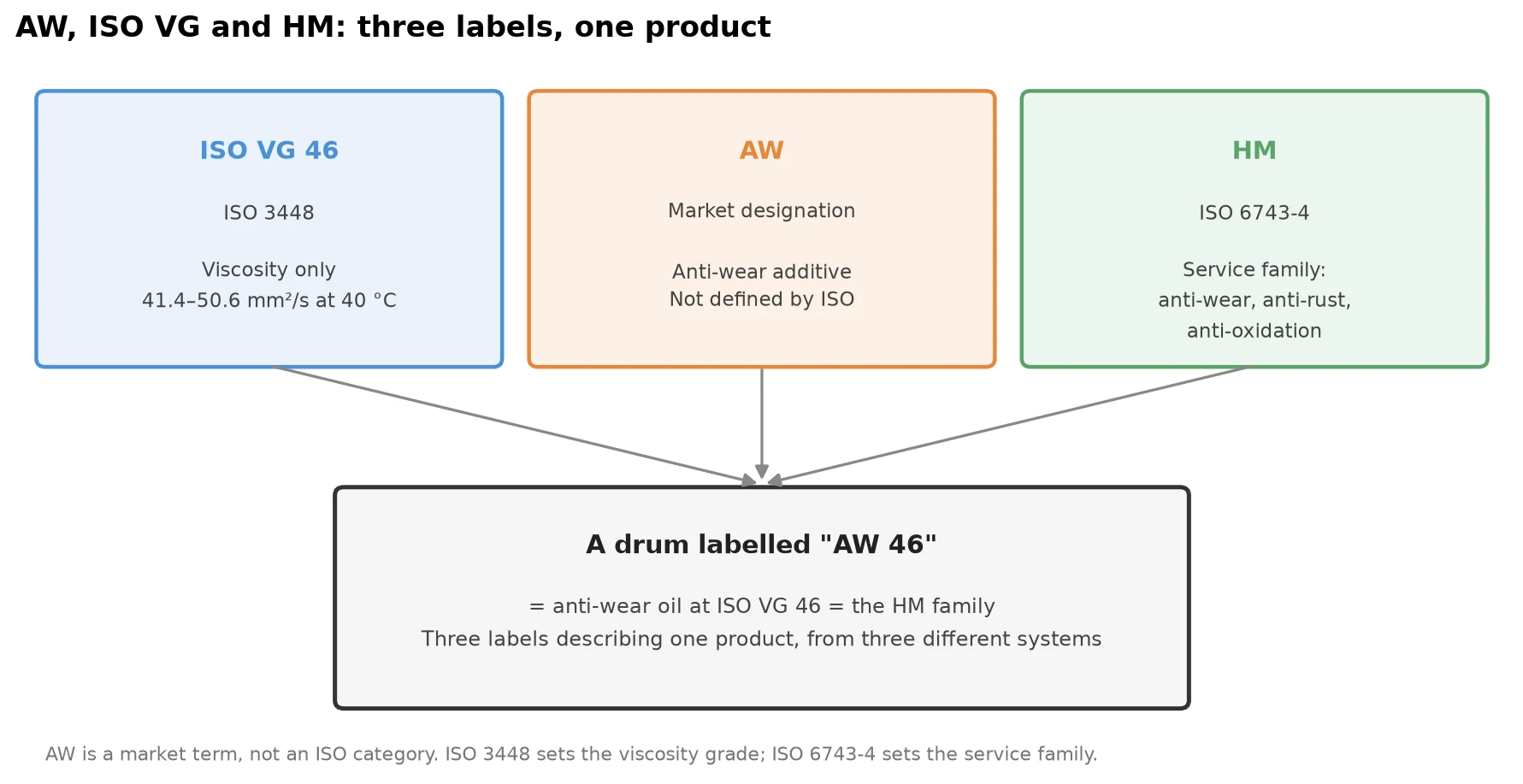
Buyers searching for the difference between ISO 46 and AW 46 are asking a reasonable question, because the market uses both terms without explaining either.
- ISO VG 46 is a viscosity grade from ISO 3448. It describes thickness at 40°C and says nothing about additives.
- AW is a market designation meaning anti-wear. It is not defined by ISO. It signals that the oil carries an anti-wear additive package that protects pump surfaces under load, but not which chemistry. Zinc dialkyldithiophosphate (ZDDP) is the common one; ashless anti-wear packages are sold under the same AW label, and equipment with silver-containing components generally requires the ashless type. The label does not separate them. The data sheet does.
- HM is the service family from ISO 6743-4 covering refined mineral oils with anti-wear, anti-rust and anti-oxidation properties. Chinese manufacturers use the matching L-HM designation, as on our own high-pressure anti-wear hydraulic oil data sheet.
So an oil described as AW 46 in one catalogue and L-HM 46 in another is, at family level, the same kind of product. The equivalence holds as a category, not as a certification: two HM oils can meet the same family definition and still differ in additive quality, filterability and oxidation life. Treat the family name as a starting filter, then read the technical data sheet.
Choosing by temperature and equipment
The manufacturer’s manual is the first authority. Where it gives a range rather than a single grade, or where a machine has moved to a different climate, these are the working rules.
| Situation | Candidate grade | Verify before deciding | Stop and ask the OEM if |
|---|---|---|---|
| The manual permits a range and the machine cold-starts well below its normal operating temperature | The thinner grade in the permitted range | Kinematic viscosity at the actual lowest start-up temperature, against the pump’s maximum start-up viscosity | Start-up viscosity still exceeds the pump limit at the thinnest permitted grade |
| The manual permits a range and oil temperature sits at the top of the normal band under sustained load | The thicker grade in the permitted range | Viscosity at the measured operating oil temperature, against the pump’s minimum viscosity | The grade that satisfies the minimum falls outside the permitted range |
| The machine has been relocated to a different climate | Re-run the check; do not carry the previous grade over | Both start-up and operating viscosity at the new site’s temperature extremes | One grade cannot cover the new site’s full temperature span |
| Oil temperature runs above the manual’s normal band | No grade change yet | Cooler performance, filter condition, relief-valve setting and duty cycle first | Temperature is still out of band after the cooling system checks out |
Every row ends in a measurement rather than a rule of thumb. Viscosity at temperature is the quantity the pump actually responds to; ambient climate and equipment category are only proxies for it, and they are the wrong proxy often enough to matter. Where the running temperature itself is the problem rather than the grade, the diagnostic path is covered in hydraulic system overheating. A system that cold-starts far below freezing may need something the AW range does not offer at all, which is the limitation the next section deals with.
What the grade does not tell you
Here is the failure mode that catches experienced buyers. Two oils can carry the same AW 46 label, sit inside the same ISO 3448 window, and behave nothing alike once the temperature moves away from 40°C.
The following typical values are listed for ISO VG 46 products in Zhongtian Petrochemical’s Engineering Machinery Oil Catalogue dated 10 March 2026 (printed pages 26 and 28). They identify the catalogue products; they are not a guarantee for every batch or an approval for a particular pump. Request the current TDS and a batch-specific CoA before procurement.
| Property at ISO VG 46 | L-HE high-cleanliness anti-wear (HM family) | L-HV low-temperature (HV family) |
|---|---|---|
| Kinematic viscosity at 40°C | 45.12 mm²/s | 45.47 mm²/s |
| Viscosity index | 105 | 144 |
| Pour point | −21°C | −39°C |
| Flash point (open) | 226°C | 205°C |
At 40°C the two are almost indistinguishable, and the grade label treats them as interchangeable. The viscosity index says otherwise: 105 against 144 means the low-temperature oil holds usable viscosity across a far wider band. Their listed pour points differ by 18°C. Pour point alone does not establish safe pump start-up: approval requires the oil’s low-temperature viscosity and the equipment manufacturer’s start-up limit for the actual conditions. The AW 46 designation carries none of this information.
This is why viscosity index and pour point belong on the purchase order alongside the grade. The full comparison of anti-wear against high-viscosity-index formulations is in L-HM vs L-HV hydraulic oil, and the window concept behind the grades is set out in the ISO viscosity grades chart.
What going wrong actually costs
Grade errors rarely announce themselves. They show up as symptoms that get blamed on components.
Too thin for the conditions. The oil film thins under load and pressure, metal-to-metal contact rises, and internal leakage past worn clearances increases. Leakage converts pump energy into heat rather than work, so the system runs hotter, which thins the oil further. Pump wear accelerates and efficiency drops before anything obvious fails.
Too thick for the conditions. Cold-start flow suffers, the pump can cavitate as it struggles to draw oil, and fluid friction generates heat of its own. Response goes sluggish, and cavitation damage to the pump inlet is cumulative and permanent.
Both directions end in the same place: a hotter system and a shorter pump life. That is why the symptom alone cannot tell you which way you erred. The temperature range and the manual can.
Beyond the AW range
The AW family covers most industrial hydraulics, but three situations sit outside it.
Genuine cold climates. Cold start-up requires product-specific low-temperature viscosity data and the pump’s permitted start-up viscosity; a grade number alone cannot establish it. A high-viscosity-index formulation such as L-HV low-temperature hydraulic oil is designed for this, and L-HS extreme-low-temperature oil extends the pour point further.
Fire risk. Near furnaces, die-casting cells or molten metal, mineral oil is a hazard whatever its grade. Fire-resistant and less flammable fluids form a separate family under ISO 12922, with their own trade-offs in seal compatibility and pump limits.
High cleanliness requirements. Servo valves and proportional systems fail on contamination before they fail on viscosity. A high-cleanliness grade such as L-HE is specified by filterability and cleanliness class, not by the AW number.
What to put on the purchase order
The grade alone underspecifies the product. A complete request includes:
- ISO viscosity grade: 32, 46 or 68, taken from the equipment manual.
- Service family: HM for standard anti-wear, HV where the temperature range is wide, or the equipment maker’s own specification if it names one.
- Viscosity-temperature data, including low-temperature viscosity where start-up conditions require it. Compare it with the OEM’s pump limits. Viscosity index and pour point are supporting properties, not independent start-up approval.
- Any OEM approval the system requires: pump makers publish their own fluid requirements, and these override general category rules.
- The current TDS for the exact product and viscosity grade, plus a batch-specific CoA for the supplied lot. Confirm which figures are typical values, which are specification limits and which are actual batch results, with test methods and units. A supplier who cannot produce one for the grade being quoted is a supplier worth a second look. The wider checklist is in our lubricants sourcing guide.
FAQ
Is AW 46 the same as ISO 46? Not quite. ISO VG 46 names the viscosity grade only. AW 46 means an anti-wear oil at that grade. Every AW 46 is an ISO VG 46, but an ISO VG 46 oil is not necessarily an anti-wear formulation.
Can I use AW46 instead of AW32? Only when the OEM permits ISO VG 46 and the proposed product meets the performance and viscosity requirements for the actual conditions. AW46 is thicker, so cold-start flow and fluid friction both change. Check cold-start viscosity as well as normal operating viscosity before substituting.
Can I mix AW32 and AW46? Do not assume compatibility from the AW label or a shared base-oil description. Before mixing, obtain confirmation from the equipment manufacturer and from the suppliers of both specific products. If mixing has already occurred, follow the OEM’s approved assessment and fluid-change procedure; an intermediate viscosity does not prove the mixture is suitable.
What is the difference between AW32 and AW46 in one sentence? Thickness at 40°C, and nothing else in the designation.
Is AW46 a universal default? No. ISO VG 46 may be permitted for a particular machine, and it is widely stocked, but availability or common use cannot replace the OEM’s specification. Select from the grades and performance standards the equipment manufacturer allows.
Does a higher AW number mean better protection? No. The number is a viscosity grade, not a quality or protection rating. Anti-wear performance comes from the additive package and is documented on the data sheet, not encoded in the grade.
Sources
- ISO 3448 — industrial liquid lubricants, ISO viscosity classification. Defines the VG 32, 46 and 68 windows quoted above.
- ISO 6743-4 — classification of hydraulic fluids by service family, including the HM and HV families.
- Viscosity, viscosity index, pour point and flash point figures for the ISO VG 46 comparison: Zhongtian Petrochemical technical data sheets for L-HE and L-HV, current production.
Zhongtian Petrochemical has manufactured hydraulic oils since 1998. Our quality, environmental and occupational health management systems are certified to ISO 9001:2015, ISO 14001:2015 and ISO 45001:2018 under registration numbers 62825Q9372R0S, 62825E9373R0S and 62825S9374R0S, valid to April 2028 and verifiable through the issuing body. Our anti-wear range is produced in ISO VG 32, 46, 68, 100 and 150.
For an AW32/AW46/AW68 assessment, send the pump model, the manual page specifying the fluid, the lowest start-up temperature, the measured operating oil temperature and the current product’s TDS. Ask any supplier to identify the permitted viscosity grade and performance specification, and to flag missing start-up data before quoting a replacement. Contact Zhongtian Petrochemical.