





Most industrial greases carry a shelf life of three to five years in the sealed original container: Mobil and SKF state five years, Chevron three. The date assumes indoor storage at a moderate, steady temperature. A pail past its date, or one stored badly, is not automatically scrap; it needs a consistency and oil-separation check before it goes into a bearing.
How long grease lasts: what the major makers publish
| Maker | Stated shelf life | Conditions and exceptions |
|---|---|---|
| Mobil (ExxonMobil) | 5 years | Mobil-branded greases, stored properly in the original sealed containers |
| SKF | 5 years | Printed on the data sheets of LGMT 2, LGEP 2, LGHP 2 and LGWA 2 |
| Petro-Canada | 5 years; about 3 for soft grades | NLGI 1 and stiffer get 5 years; NLGI 0, 00 and 000 generally 3 |
| Chevron | 3 years | Mineral or synthetic greases; one product, SRI Grease NLGI 2, is rated 2 years |
| Klüber | About 24 months, minimum | One product, Klüberplex AG 11-461: dry, frost-free place, unopened container |
| Shell AeroShell | Up to 6 years | Aviation greases, no retest required within that period |
| ExxonMobil Aviation | 10 years | Two products, Mobilgrease 33 and Mobilgrease 28; it puts the aviation industry average at about 3 years |
The figures are not all the same kind of number. Klüber gives a minimum, Chevron and Shell give maximums, and most of the others give a recommendation. Older guidance was far shorter: a 2001 Machinery Lubrication article lists 12 months for lithium greases and 6 for calcium complex greases, and concludes that the industry has no consensus standard. Petro-Canada gives soft grades less time, and our own training material points the same way: the more thickener a grease holds, the less oil it gives up in storage. Chevron singles out one product, noting that its SRI Grease NLGI 2 may show surface cracks and oil separation from about six months old, which it says does not affect lubrication performance. The figure that applies to your pail is the one its maker prints, counted from the production date on the label.
Three different clocks
| Clock | Starts | What limits it |
|---|---|---|
| Shelf life | Production date on the label, container sealed | The maker’s stated period and your storage conditions |
| Opened container | The day the lid comes off | No stated period: ExxonMobil’s aviation team says the shelf life no longer applies once a container is opened, and Shell’s AeroShell FAQ gives an opened product no specified period. Only a check of the grease can clear it. |
| Life in the bearing | The day the grease goes in | Temperature above all; our training material puts it at roughly half the life for every 10 to 15 °C rise. How that plays out in a motor bearing is covered in grease for electric motors. |
What shortens it: heat, weight and time
Heat is the main accelerator. Storing a lubricant 10 °C warmer doubles its oxidation rate, according to Machinery Lubrication, and Chevron notes that storage above 110 °F (43 °C) can speed up oil separation. For aviation greases, ExxonMobil’s aviation team and Shell’s AeroShell Book both recommend 0 to 40 °C; Mobil’s industrial guidance says only typical ambient temperatures. The rule we train our own sales staff on is tighter: keep the grease store between 10 and 30 °C, never above 35 °C and never below −15 °C, and avoid large day-to-night swings, which weaken the grease structure.
The container’s own weight matters too. In a tall drum, the grease at the bottom carries everything above it, and that load presses oil out over the months. Our training guidance is that the larger the container, the worse this pressure bleed gets, which is why slow-moving grades belong in small packs. The standard storage-bleed test, ASTM D1742, measures this tendency; ASTM states that its results correlate directly with oil separation in 35 lb pails during storage, and that the method is not suitable for greases softer than NLGI 1.
Grease can also stiffen slowly on the shelf, which is called age hardening. A few thickener families have their own habits: Petro-Canada notes that aluminium complex greases may set and harden with age, while lithium, lithium complex and calcium sulfonate complex greases generally stay stable for a long time.
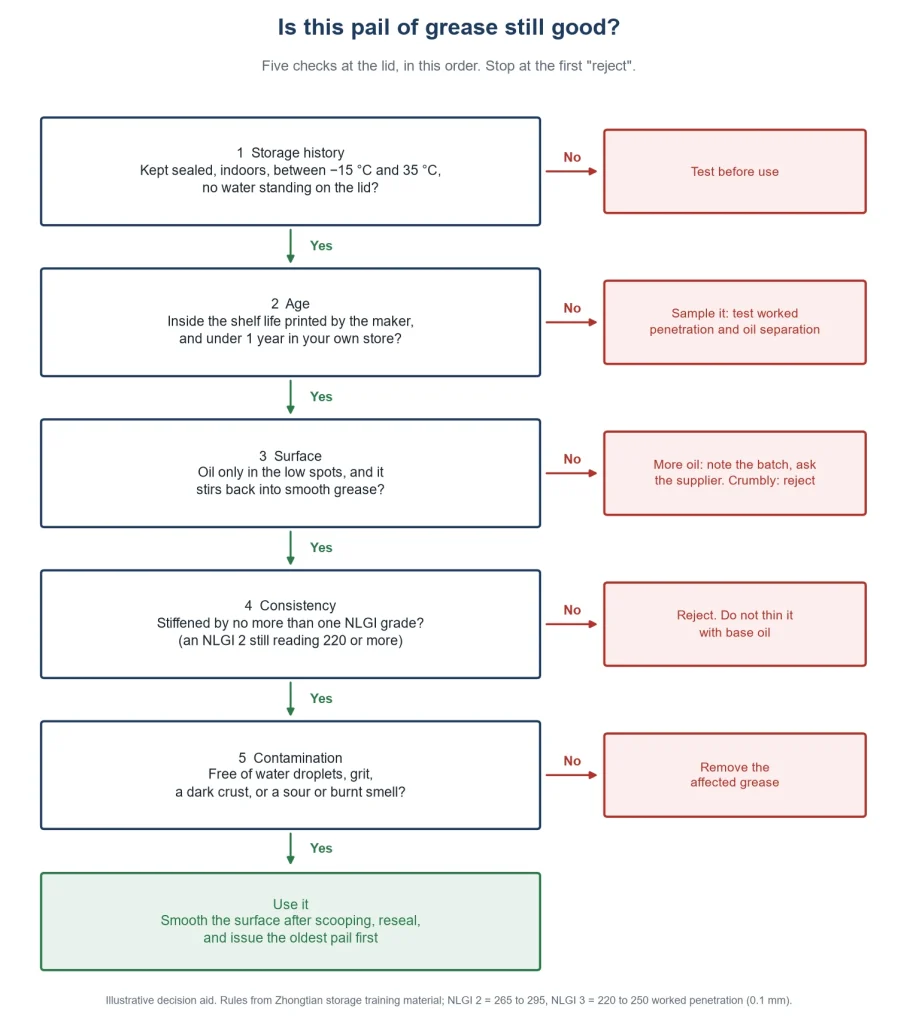
Five checks at the lid
| Check | Passes if | If it fails |
|---|---|---|
| 1. Storage history | Sealed, indoors, kept within −15 to 35 °C, no water standing on the lid | Test before use |
| 2. Age | Within the maker’s stated shelf life, and less than a year in store | Re-sample and check the key properties first; our rule applies to anything stored over a year, and Chevron’s procedure is to test against the original specification |
| 3. Surface oil | Oil lies only in the low spots and stirs back into smooth grease | More oil than that, over grease that is still smooth: note the batch number and ask the supplier. Oil over a hard or crumbly mass: reject |
| 4. Consistency | Stiffer by no more than one NLGI grade | Reject; do not thin it with base oil |
| 5. Contamination | No water droplets, grit, dark crust, or sour or burnt smell | Remove the affected grease |
On surface oil, ExxonMobil and Shell give the same advice. Mobil’s note on static oil bleed treats a small amount covering only low spots, readily absorbed on stirring, as usable; ExxonMobil’s aviation bulletin says to mix it into the top one to two inches; the AeroShell Book allows use after thorough stirring unless the separation is excessive. On thinning, our rule is firm: a grease that has stiffened should not be let down with base oil, because without the homogenising step done at the plant the mixture separates again. How to tell which way a grease has failed is covered in why grease hardens, softens or bleeds.
How much stiffening is too much, in numbers
Two independent rules land in almost the same place. Ours is “no more than one grade”. An NLGI 2 grease has a worked penetration of 265 to 295; one grade stiffer is NLGI 3, 220 to 250 (NLGI grades). A higher number means a softer grease, so an NLGI 2 grease that still reads 220 or more passes. ExxonMobil’s shelf-life technical topic treats a change of more than 25% in penetration as a sign of deterioration. Take our multi-purpose lithium grease 2#, with a typical worked penetration of 277: a 25% drop takes it to about 208, just below the NLGI 3 floor of 220. The measurement that settles it is a cone penetration test to ASTM D217 on a sample from the pail.
Storing grease so the stated life holds
- Keep it indoors, sealed, and between 10 and 30 °C where you can; out of direct sun and off wet floors.
- Store pails and drums upright, as Chevron advises, with the lid on between uses.
- After scooping, smooth the surface flat. Chevron and our own storage rules say the same thing: oil bleeds into the hollow a scoop leaves behind.
- Issue by production date, oldest first.
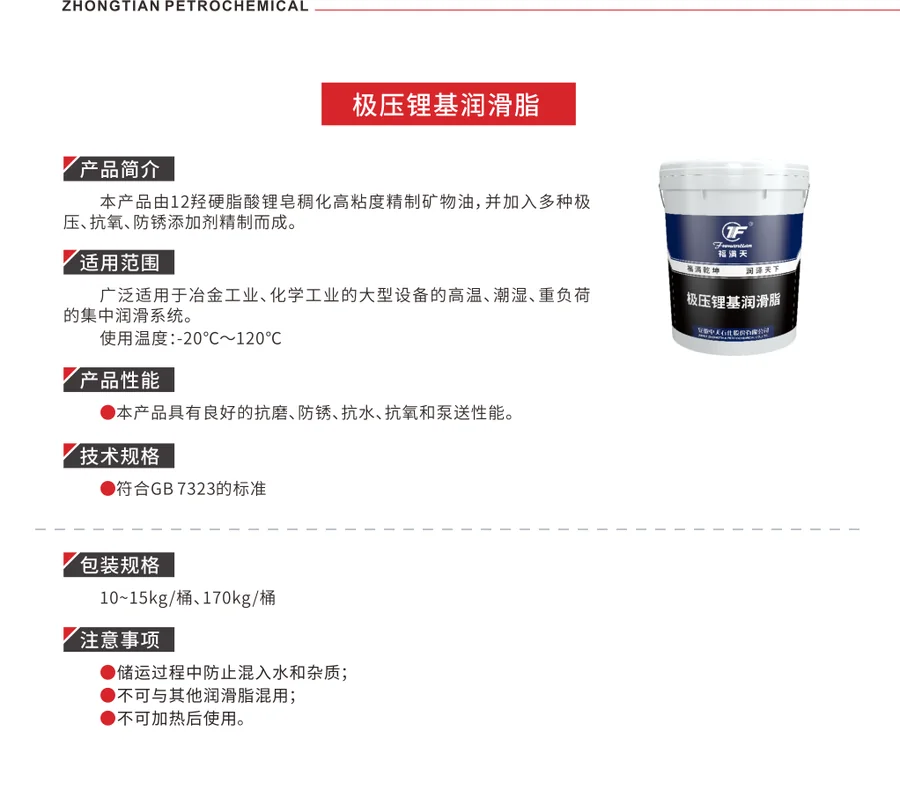
- Match pack size to use. The greases in our steel-industry manual ship in 10 to 15 kg pails and 170 kg drums; a grade you use slowly is better bought in pails than left in a half-empty drum for a year.
- Use clean tools, and never top up one grease with another.
What to ask the supplier for
Ask for the stated shelf life of the exact product, the production date and batch number on each container, and the certificate of analysis for that batch. If the certificate reports worked penetration and oil separation, those are the figures to test an old pail against. It also helps to know which bleed test a figure comes from: ASTM D1742 measures separation in storage at room temperature, while the steel-mesh test at 100 °C, the counterpart of ASTM D6184, shows it at working temperature. Our multi-purpose lithium grease lists 1.5% for 2# and 0.8% for 3# on the steel-mesh test (100 °C, 30 hours, typical values). We issue the certificate of analysis for each grade and batch on request, and because we make grease to order, storage-related limits such as oil separation can also be agreed in your purchase specification.
Frequently asked questions
What is the shelf life of grease?
Three to five years for most industrial greases in the sealed original container: Mobil and SKF state five years, Chevron three. Soft grades get less; Petro-Canada gives NLGI 0 and softer about three years against five for stiffer grades. The shelf life printed for your specific product is the one that applies.
Can I use expired grease?
Not straight into a critical bearing. Sample it first: check that the worked penetration has moved no more than one NLGI grade and that any surface oil stirs back in. Chevron’s guidance is to test against the original specification and, if the grease passes, use it within a year of that test. Bearing makers can be stricter: Timken’s engineering manual says not to use product that has exceeded its shelf life.
Can I use lube that’s 4 years past date?
Only after the same test. Four years past a three- to five-year date makes the grease seven to nine years old, older than any industrial grease life in the table above, so treat it as untested stock and compare its consistency and oil separation with the original certificate.
Is 20 year old oil still good?
Not without a laboratory check. The longest shelf life in the published figures above is ten years, for two ExxonMobil aviation greases. Twenty-year-old stock of any lubricant should be analysed against its original data sheet before it goes near a machine.
Check an old pail against its batch
If the pail is one of ours, send us the batch number from its label or delivery papers. We will send that batch’s certificate of analysis, so you have the original figures to test the pail against, and tell you how the grade should be stored from here. Contact Zhongtian Petrochemical.