


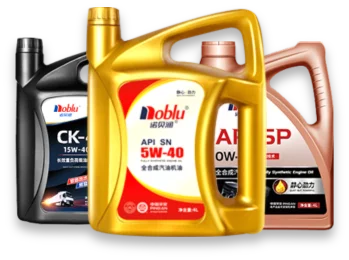


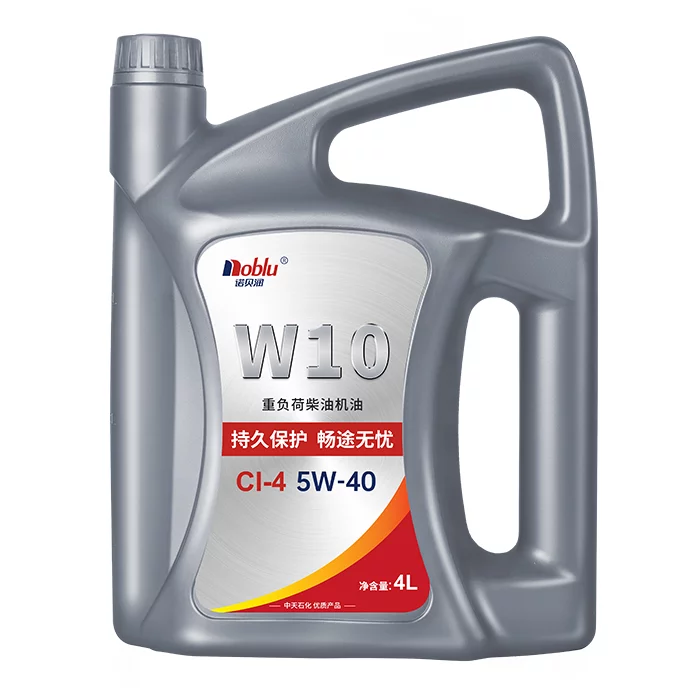
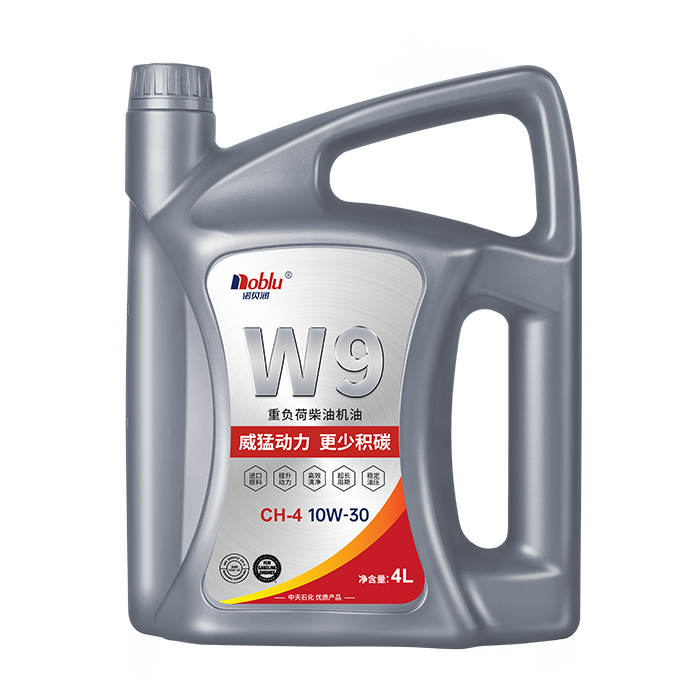
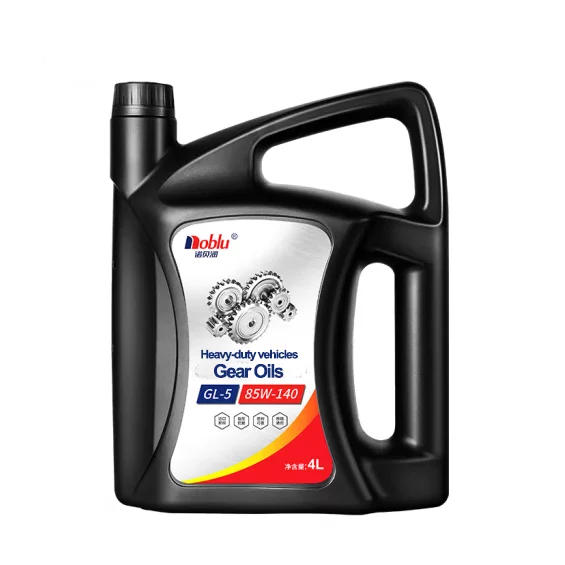

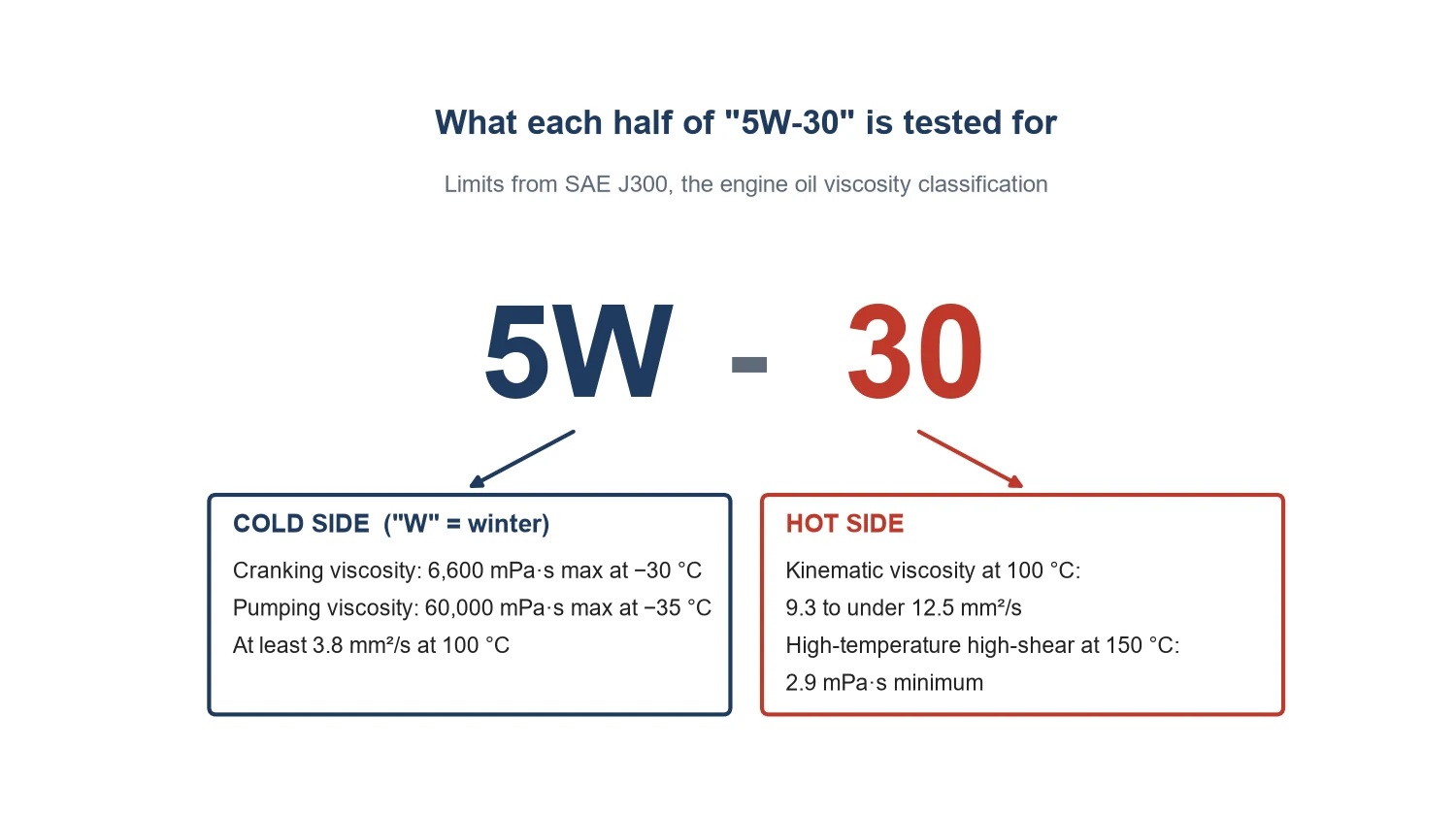
The 5W-30 meaning comes from SAE J300, where each half of the grade is a separate set of laboratory limits. “5W” (W for winter, not weight) means cranking viscosity no higher than 6,600 mPa·s at −30 °C and pumping viscosity no higher than 60,000 mPa·s at −35 °C. “30” means kinematic viscosity of 9.3 to under 12.5 mm²/s at 100 °C.
In plain terms, the 5W caps how thick the oil can get in deep cold, and the 30 holds its thickness inside a set band once it is hot. 100 °C is roughly the oil temperature in a running engine, so the 30 describes the oil at work whatever the weather. The 30 also requires a high-temperature high-shear (HTHS) viscosity of at least 2.9 mPa·s at 150 °C, measured under the kind of shear oil meets in engine bearings. Rating one oil at both ends is what makes 5W-30 a multigrade. On data sheets, mPa·s is the same number as centipoise (cP), and mm²/s is the same as centistokes (cSt).
What does 5W-30 mean? The limits behind each half of the grade
The cold limits make sure the starter can turn the engine and the oil reaches the pump. The hot limits keep the oil film thick enough in the bearings and on the cylinder wall. Here is 5W-30 beside the grades on either side of it.
| W grade | Cranking viscosity, max | Pumping viscosity, max |
|---|---|---|
| 0W | 6,200 mPa·s at −35 °C | 60,000 mPa·s at −40 °C |
| 5W | 6,600 mPa·s at −30 °C | 60,000 mPa·s at −35 °C |
| 10W | 7,000 mPa·s at −25 °C | 60,000 mPa·s at −30 °C |
| Hot grade | Kinematic viscosity at 100 °C | HTHS at 150 °C, min |
|---|---|---|
| 20 | 6.9 to under 9.3 mm²/s | 2.6 mPa·s |
| 30 | 9.3 to under 12.5 mm²/s | 2.9 mPa·s |
| 40 | 12.5 to under 16.3 mm²/s | 3.5 mPa·s (0W-40, 5W-40, 10W-40) |
J300 also sets a minimum viscosity at 100 °C for every W grade (3.8 mm²/s for 5W, as the diagram shows), but any oil that meets a 30 grade clears it easily. We took these limits from the 2021 edition of the J300 tables. SAE revised the standard in May 2024, so confirm them against that revision before you put them in a contract.
Under J300 an oil takes the lowest W grade whose limits it meets. A lower W number means the oil passed colder tests. How thin it is once the engine is warm is the job of the second number.
5W-30 and 10W-30 share the same hot-side grade
The data sheet for Zhongtian’s SP fully synthetic gasoline engine oil gives typical values for five grades. Compare the 5W-30 and 10W-30 rows to see what the W changes and what it leaves alone.
| Grade | Kinematic viscosity at 100 °C (mm²/s) | Cold cranking viscosity (mPa·s) |
|---|---|---|
| 0W-20 | 8.9 | 5,002 at −35 °C |
| 10W-30 | 10.7 | 5,860 at −25 °C |
| 5W-30 | 10.9 | 5,370 at −30 °C |
| 5W-40 | 14.08 | 5,710 at −30 °C |
| 10W-40 | 14.14 | 6,042 at −25 °C |
At 100 °C the 5W-30 and the 10W-30 differ by 0.2 mm²/s, about 2 percent, and both sit in the SAE 30 window. On the label, what separates them is the cold tests: the 5W-30 has to pass both at temperatures five degrees lower. Those are classification test temperatures and say little about the coldest morning you can start on. How the two oils compare on a mild morning depends on their viscosity at lower temperatures, which the typical values above do not include. The grade itself only promises a difference in hard cold.
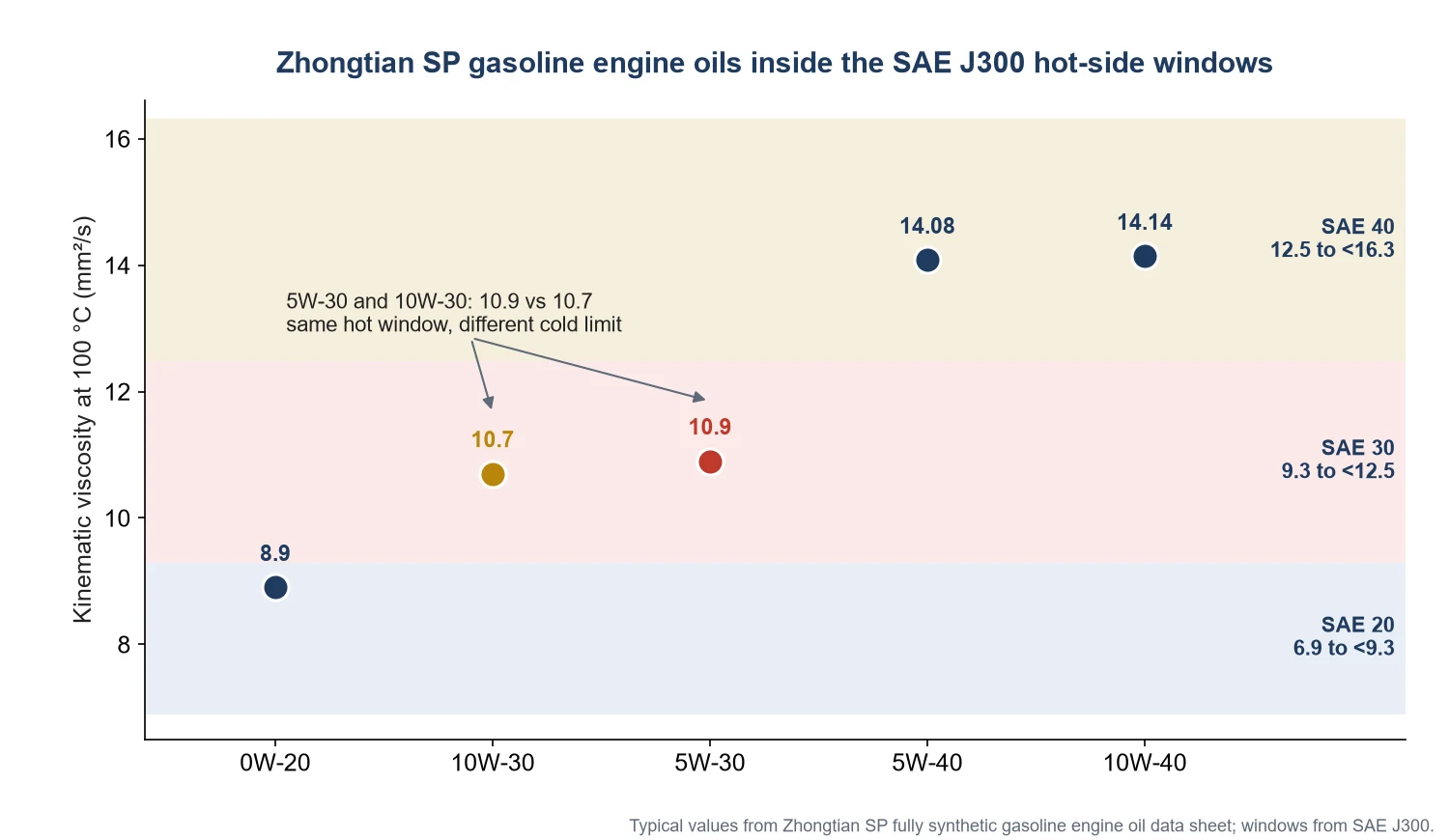
Moving up one hot-side grade makes a bigger difference. In this line the 5W-30, listed at 10.9 mm²/s, is about 22 percent thicker at 100 °C than the 0W-20 at 8.9, and the 5W-40, at 14.08, is about 29 percent thicker again.
How to check that a 5W-30 really is one
A label only states the grade. To check it against J300, find these four numbers on the data sheet:
- Kinematic viscosity at 100 °C from 9.3 to under 12.5 mm²/s. Some sheets print it in cSt. Zhongtian’s SP 5W-30 sheet lists 10.9, and its SN synthetic 5W-30 sheet lists 11.19.
- Cold cranking viscosity at or below 6,600 mPa·s, reported at −30 °C. Sheets may call it CCS or low-temperature dynamic viscosity. The SP and SN 5W-30 sheets give 5,370 and 5,798 mPa·s, both at −30 °C. Read the temperature in brackets as carefully as the number, because a figure reported at −25 °C belongs to the 10W test and does not show that the oil meets 5W.
- High-temperature high-shear viscosity of at least 2.9 mPa·s. J300 requires it of every 30 grade, and some engine makers set a higher minimum. Our own typical-value sheets do not list it yet, and many other sheets leave it out too. If your engine maker names a minimum, ask for a measured figure before you order, whoever the supplier is.
- Pumping viscosity at or below 60,000 mPa·s at −35 °C, with no yield stress. Our sheets do not print this one either; ask for it if your equipment starts in hard frost.
Worked example: a laboratory report on our 5W-40
5W-40 has the same cold limits as 5W-30, with a 100 °C window of 12.5 to under 16.3 mm²/s and an HTHS minimum of 3.5 mPa·s. In April 2021 we sent a one-litre sample of our SP 5W-40 gasoline engine oil to GTI, the testing institute of Guangzhou Mechanical Engineering Research Institute Co., Ltd. The report carries the accreditation mark of CNAS, China’s national accreditation body and a signatory to the ILAC mutual recognition arrangement, with laboratory number L2386. The report is for a 5W-40 rather than a 5W-30 and dates from 2021, so read it as a worked example of the check, not as current data for a 5W-30. Report 8620210400078 was issued on 8 April 2021 and is shown in full below.
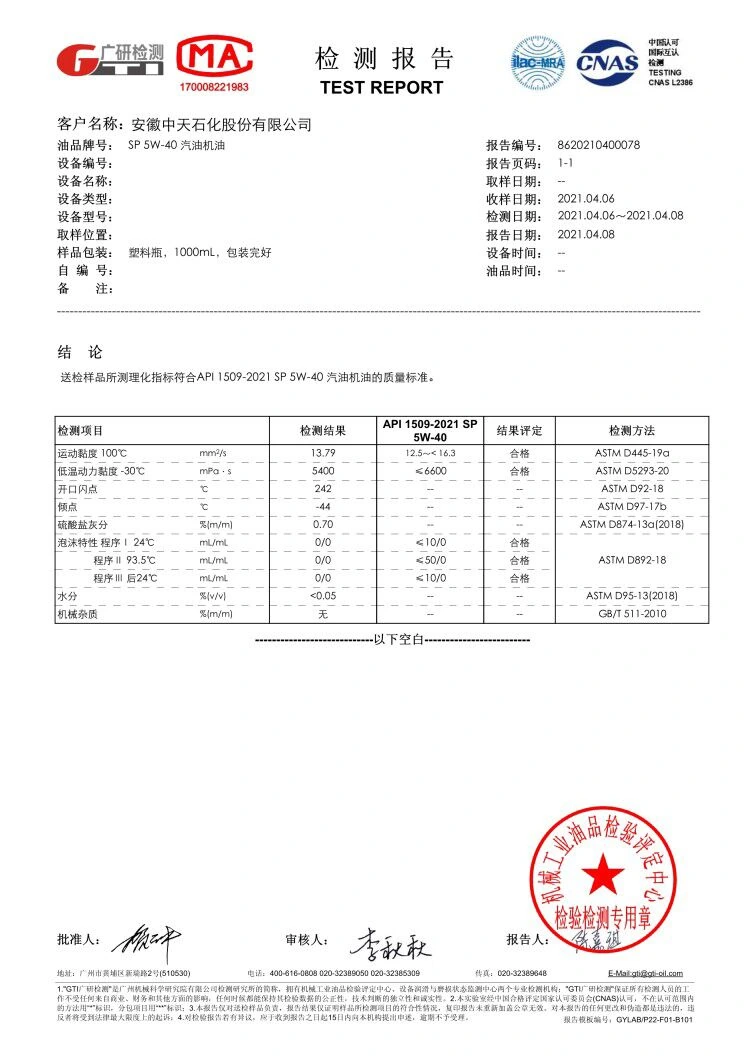
| Line on the report | Measured on the sample | Limit printed | Which half of the grade |
|---|---|---|---|
| Kinematic viscosity at 100 °C | 13.79 mm²/s | 12.5 to under 16.3 | The “40” |
| Cranking viscosity at −30 °C | 5,400 mPa·s | 6,600 max | The “5W” |
| HTHS at 150 °C and pumping viscosity at −35 °C | not tested | none | Ask for these separately |
The report covers one test on each side of the grade. 13.79 mm²/s is inside the SAE 40 window, and 5,400 mPa·s at −30 °C is under the 6,600 ceiling for a 5W, so it confirms two of the four lines and is silent on the other two. On a 5W-30 report the cranking test and its limit are the same, and the 100 °C line has to fall from 9.3 to under 12.5 mm²/s. The report also lists foaming, flash point, pour point, sulfated ash, water and mechanical impurities.
GTI compared its results with the limits it cites from API 1509 (2021 edition) for SP 5W-40 and reported that the measured properties meet them. As the report’s own footer notes, it applies only to the sample submitted and the items tested. It is a bench test of physical properties: it does not include the engine tests behind the API SP category, and it is not an API licence. Our current typical values for SP 5W-40 are 14.08 mm²/s and 5,710 mPa·s, and the 2021 sample measured about 2 and 5 percent lower. One sample without a batch number cannot say why, which is why a result for the batch you are buying tells you more than a typical value.
Base oil, performance level and drain interval are separate questions
J300 classifies oils “in rheological terms only”, which means by viscosity and nothing else. Base oil is outside it, so mineral, part-synthetic and fully synthetic oils can all be 5W-30. Performance level is outside it too: API service categories, ILSAC and ACEA are separate specifications printed beside the grade, and our own SP and SN lines both come in 5W-30 while differing in performance tier. Drain interval and compatibility between brands are separate questions again.
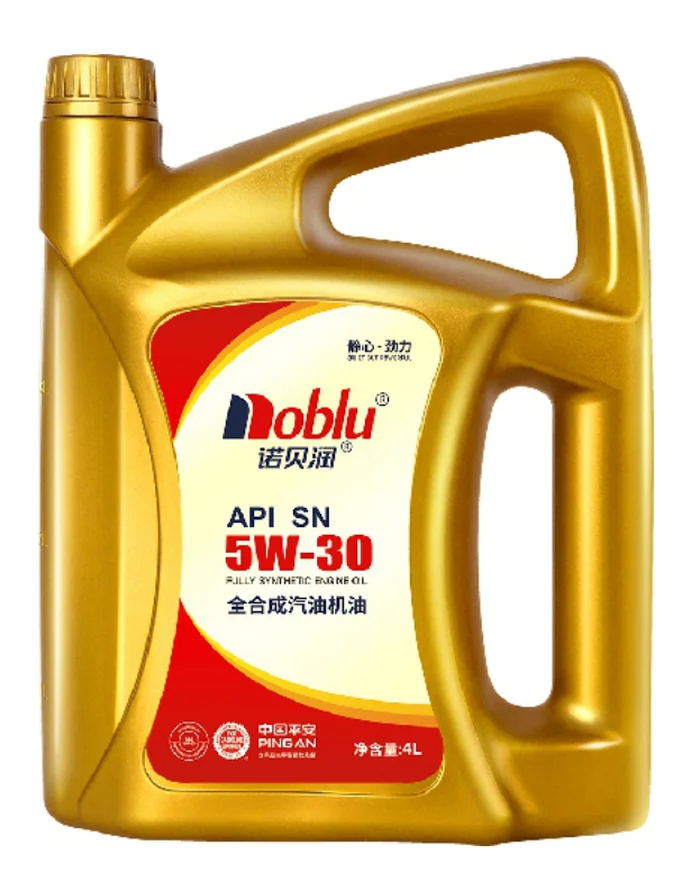
On a motorcycle bottle the grade means the same thing. Suitability for a wet clutch is a separate JASO rating (MA or MA2), printed elsewhere on the label.
When the manual gives an ISO VG number instead
Industrial manuals use another scale. A hydraulic pump, compressor or gearbox manual rarely says 5W-30. It says ISO VG 46 or 68 for a hydraulic system or compressor, or something like ISO VG 220 or 320 for an enclosed industrial gearbox, and ISO VG grades are measured at 40 °C.
| Grade as printed | Where it is measured | What the number means |
|---|---|---|
| ISO VG 46 | 40 °C | Kinematic viscosity from 41.4 to 50.6 mm²/s, per ISO 3448 |
| SAE 30, the “30” in 5W-30 | 100 °C, and 150 °C under high shear | 9.3 to under 12.5 mm²/s, plus HTHS of at least 2.9 mPa·s |
| SAE 5W, the “5W” in 5W-30 | −30 °C and −35 °C | Cranking and pumping limits, in mPa·s |
| SAE 80W-90 | The separate SAE scale for gear oils | Neither the engine oil scale nor an ISO grade; there is no ISO VG 90 |
You can only place an ISO VG oil in an SAE hot-side window if its data sheet also gives viscosity at 100 °C, or a viscosity index from which it can be calculated, and even then the W grade and HTHS need their own tests. Two oils in the same ISO grade can land in different SAE windows when their viscosity index (how much the viscosity changes with temperature) differs. The full set of ISO windows, from VG 10 to VG 680, is in our ISO viscosity grades chart.
An engine oil at the right viscosity is still a different fluid from a hydraulic oil. Engine oils carry detergent and dispersant additives that keep contaminants, and water, suspended in the oil, while most anti-wear hydraulic oils are formulated to let water separate out so it can be drained from the reservoir. Put an engine oil in a hydraulic system only where the fluid table in the operator’s manual lists it.
Frequently asked questions
What does 5W mean in oil?
The W stands for winter, not weight, and the 5 means the oil passed the SAE J300 winter tests: cranking viscosity no higher than 6,600 mPa·s at −30 °C and pumping viscosity no higher than 60,000 mPa·s at −35 °C. A lower W number means the oil passed colder tests, not that it is thinner when hot.
Is 5W-30 good for hot weather?
Yes, for engines whose manual specifies it. The “30” is set by tests at 100 °C and 150 °C, close to the oil’s working temperature in a running engine, and the cooling system keeps that working temperature near its design range on a hot day. Towing, sustained high speed or heavy loads in a very hot climate push oil temperature higher, and some owner’s manuals list a 40 grade above a stated air temperature. Follow the temperature chart in the manual.
Can I put 10w30 instead of 5W30?
Only if your owner’s manual lists 10W-30 for the temperatures you drive in, and only with a 10W-30 that also meets the performance specification the manual calls for. At running temperature the two are close: in Zhongtian’s SP line they differ by about 2 percent at 100 °C. The difference is the cold start. 10W-30 is held to its cranking limit at −25 °C and its pumping limit at −30 °C, five degrees warmer than 5W-30 on both tests.
Which type of oil is better, 5W-40 or 5W-30?
It depends on the engine. The two share the same cold limits, and the 5W-40 is thicker when hot, about 29 percent in Zhongtian’s SP line on typical values, with a higher HTHS minimum. Many manuals list both. If yours lists only 5W-30, use 5W-30, since the extra thickness of a 5W-40 adds friction the engine maker has not asked for.
What is 5W-30 oil used for?
5W-30 is a common grade for passenger-car gasoline engines, and it is also widely used in light-duty diesel engines, where the oil usually has to meet an ACEA sequence or the car maker’s own approval as well. The grade only describes viscosity; whether a given 5W-30 suits an engine depends on the performance specification in the manual. Zhongtian’s SP and SN 5W-30 oils are gasoline engine oils.
What happens if I put 5W30 instead of 5W20?
Expect slightly higher friction and a possible small loss of fuel economy, because the thicker oil adds viscous friction in an engine designed around a 20 grade. A 20 grade must stay under 9.3 mm²/s at 100 °C and a 30 grade must reach at least 9.3. Zhongtian’s SP 0W-20 lists 8.9 mm²/s against 10.9 for its 5W-30, about 22 percent thicker. Under warranty, switch back to the listed grade at the next oil change.
Before you order: the filler cap, the manual, then the data sheet
Look at the oil filler cap and the owner’s manual first. Some engine makers print the grade on the cap, and the manual lists which grades suit which temperature range. The grade means the same thing on a Toyota, a Honda or any other car; the carmaker decides which grade an engine needs. Then hold the supplier’s figures against the four lines above.
Anhui Zhongtian Petrochemical has made lubricants in China since 1998 and is certified to ISO 9001:2015 (certificate 62825Q9372R0S). For a fleet or a workshop, send us the grades and the API or ACEA categories your equipment specifies, with the pack size you use. We will reply with the data sheet and safety data sheet for each grade, each cold cranking figure given with its test temperature, and we can supply the certificate of analysis for your batch on request. Packs run from 1 L bottles to 200 L drums, and small trial orders are accepted. If your specification calls for HTHS or pumping viscosity, say so, and we will tell you whether a measured figure is available.